Athletic Archive Metadata Crosswalk Guide: Map Rosters, Awards, Photos, and Records
- Home /
- Touch Archive Blog /
- Athletic Archive Metadata Crosswalk Guide: Map Rosters, Awards, Photos, and Records
The Easiest Touchscreen Solution




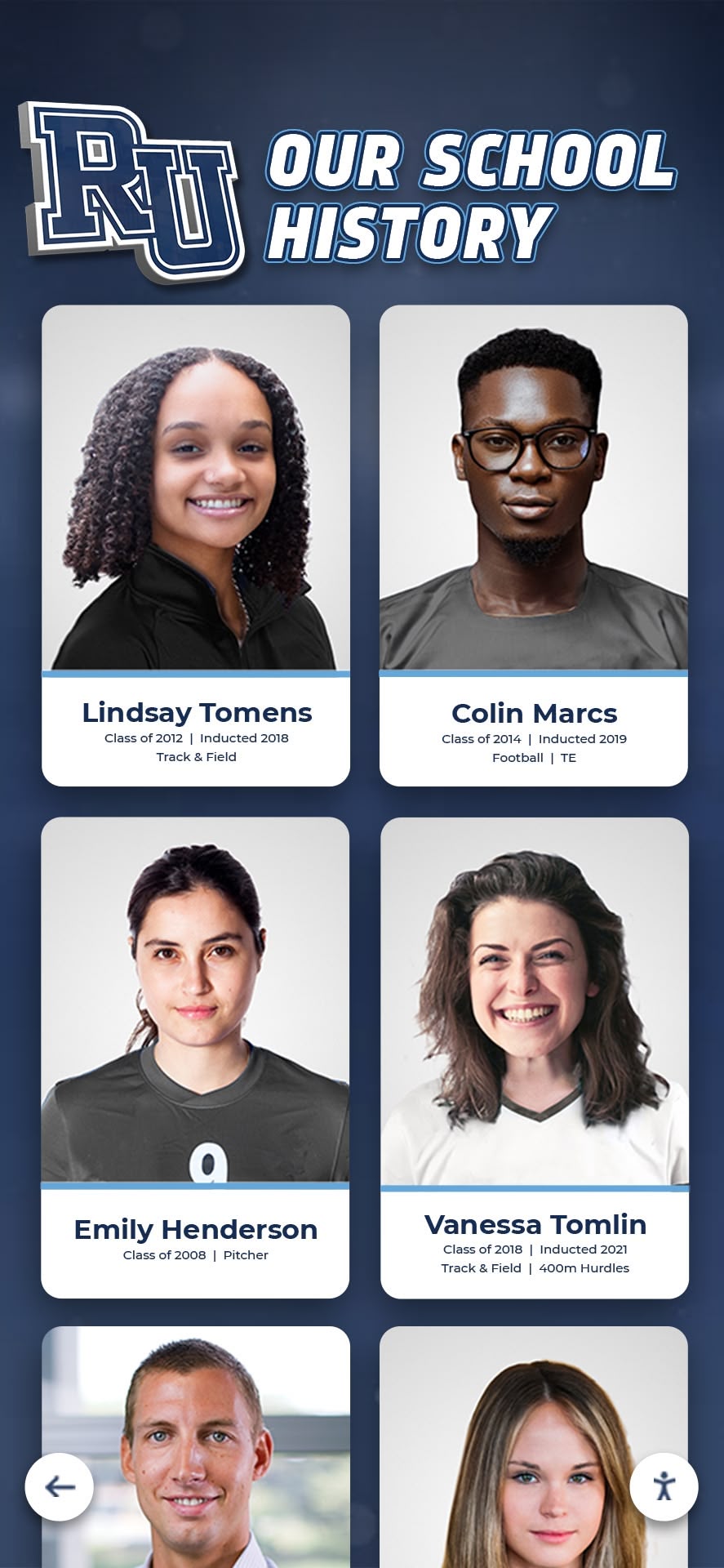
Live Example: Rocket Alumni Solutions Touchscreen Display
Interact with a live example (16:9 scaled 1920x1080 display). All content is automatically responsive to all screen sizes and orientations.
An athletic archive metadata crosswalk guide is a structured field-mapping reference that shows schools how to translate the inconsistent column names, value formats, and data structures found in legacy rosters, award records, photographs, and performance records into a single normalized schema — so that decades of athletic history can be imported cleanly into a searchable digital archive or recognition display. The direct answer: before any data moves from a spreadsheet, paper form, or database export into a display platform, every source field must be matched to a target field with an agreed-upon name, data type, and controlled vocabulary. This guide provides field-mapping tables for all four major athletic archive data types — rosters, awards, photos, and records — plus a six-step migration workflow, a normalization troubleshooting table, and answers to the questions school administrators, athletic directors, and archive coordinators ask most often when preparing a legacy archive for digital display.
Nothing in this guide constitutes legal or records management advice. Retention schedules and data governance decisions should follow your school district’s written policies and qualified counsel.
Every school athletic archive holds the same fundamental problem in a slightly different form. The track records are in one spreadsheet. The hall of fame inductees are in another. The photograph file cabinet uses one naming system; the awards binder uses a different one. When an athletic director wants to build a searchable digital display that shows a student’s championship certificate, portrait photo, and career statistics on a single screen, those three systems do not speak to each other.
A metadata crosswalk is the solution. In information science, a crosswalk is a mapping that shows how fields in one data structure correspond to fields in another. In an athletic archive context, it is the document — usually a table — that answers: what does each legacy source call this piece of information, what will the target system call it, and what transformation is required to make the values consistent?
Getting this mapping right before any import begins is the difference between a clean, searchable archive and a collection of records that partially match, fail filter searches, and require manual cleanup every time the display is updated.

Athletic archives accumulate records across decades, each era using slightly different field names and value conventions — a metadata crosswalk translates all of them into a single normalized schema before any record moves to a digital display
What a Metadata Crosswalk Does (and What It Does Not Do)
A crosswalk maps fields. It does not clean data, verify accuracy, or fill in missing values — those are separate tasks. The crosswalk establishes the schema that data cleaning and verification then work against.
For an athletic archive, a crosswalk answers four questions for every field in every source system:
- What is this field called in the source? (The legacy name — often inconsistent across years or staff)
- What will it be called in the target system? (The normalized name — one term, used consistently)
- What data type and format does the target require? (Text, integer, YYYY-YY, controlled vocabulary)
- What transformation is needed to move a source value to the target format? (Convert “Sr. ‘24” to “2024”; standardize “bball” to “Basketball”)
Once those four questions are answered for every field, the import can proceed. Without them, each batch of records imported from a different era or different staff member’s spreadsheet adds a new variation to the system rather than contributing to a unified, searchable whole.
Understanding how data integrity failures propagate through a display system — and what automated advisory tools can and cannot do to prevent them — helps administrators set realistic expectations about what a crosswalk-driven import will and will not catch automatically.
Crosswalk Table 1: Roster Data Fields
Roster records are the most common starting point for athletic archive migration. They exist in every era of a program’s history and provide the backbone for athlete profiles in any recognition display: who played, what sport, what season, what position.
The challenge with rosters is that the same piece of information has been named differently by every person who ever maintained the spreadsheet. “Player Name” and “Athlete” and “Full Name” and “Last, First” all refer to the same field — but a system that treats them as four separate fields will fail every cross-season search.
| Legacy Field Names (Common Variations) | Normalized Target Field | Data Type | Target Format | Example Value | Transformation Required |
|---|---|---|---|---|---|
| Player Name / Athlete / Full Name / Name | athlete_full_name | Text | Last, First | “Rivera, Maria” | Invert if source is First Last; standardize punctuation |
| Jersey # / Number / No. / # / Uniform | jersey_number | Integer | Numeric only | 22 | Strip “#”, leading zeros, and non-numeric text |
| Class / Grade / Yr / Year / Grad Year | graduation_year | Integer | 4-digit year | 2024 | Convert “Senior ‘24” or “12th” to expected graduation year |
| Sport / Team / Activity / Program | sport_name | Controlled vocab | Approved list | “Basketball” | Map all variations to one approved term per sport |
| Position / Pos / Role | position | Controlled vocab | Approved list | “Point Guard” | Map abbreviations (“PG”, “G”) to full terms |
| Head Coach / Coach / Coach Name | coach_name | Text | Last, First | “Williams, Dana” | Standardize format; one entry per season |
| Season / Year / Academic Year | season | Text | YYYY-YY | “2023-24” | Convert “2024” or “Fall 2023” to academic year format |
| School / Program / Team Name | school_name | Text | Full official name | “Lincoln High School” | Do not abbreviate; use the official district name |
| Captain / C / Team Captain | is_captain | Boolean | Yes / No | Yes | Convert any variation to binary flag |
| Notes / Comments / Special | athlete_notes | Text | Free text | “Transfer student” | Carry forward as-is; do not parse |
Controlled vocabulary for sport names is the most critical crosswalk decision for roster data. Once approved terms are established — “Baseball,” “Boys Basketball,” “Girls Basketball,” “Cross Country,” and so on — every roster from every era must map to that list. A search for “Basketball” will not return records imported as “Bball,” “B-Ball,” or “Boys Hoops.”
Crosswalk Table 2: Award and Honor Records
Award records are where metadata inconsistency has the most visible impact on recognition programs. If a hall of fame display cannot surface all of an athlete’s awards because three of them were entered under “All-State” and one was entered under “All State” (no hyphen), the recognition program fails to honor the athlete completely.
| Legacy Field Names (Common Variations) | Normalized Target Field | Data Type | Target Format | Example Value | Transformation Required |
|---|---|---|---|---|---|
| Award / Honor / Recognition / Achievement | award_name | Controlled vocab | Approved list | “All-State First Team” | Map all name variants to canonical award names |
| Year / Season / Date Awarded | award_year | Integer | 4-digit year | 2019 | Convert academic years to the spring year (“2018-19” → 2019) |
| Sport / Activity | sport_name | Controlled vocab | Approved list | “Soccer” | Same controlled vocab as roster sport_name |
| Athlete / Player / Recipient / Name | athlete_full_name | Text | Last, First | “Jordan, Alex” | Match format to roster athlete_full_name |
| Presented By / Org / Association / Body | awarding_body | Text | Full name | “State Athletic Association” | Spell out abbreviations; one consistent form per organization |
| Level / Tier / Scope | award_level | Controlled vocab | Local / Regional / State / National | “State” | Normalize all variants to four approved levels |
| Certificate # / Document ID | award_document_id | Text | As-is | “SAA-2019-1142” | Carry forward without transformation |
| Description / Notes / Citation | award_description | Text | Free text | “Led state in goals scored” | Carry forward as-is; trim whitespace |
Award level normalization matters beyond display aesthetics. Recognition displays and hall of fame nomination workflows that sort by award level — to show state and national honors more prominently than local ones — require a consistent controlled vocabulary. If the source data uses “State,” “Statewide,” “State-level,” and “Dist. 1A State” interchangeably, sort and filter logic will not work reliably.
For programs structuring how academic all-American and high-honor athletic awards appear in recognition displays, the award crosswalk is also the point where academic achievement records — GPA-linked honors, scholar-athlete designations — can be included alongside athletic award records in a unified schema.

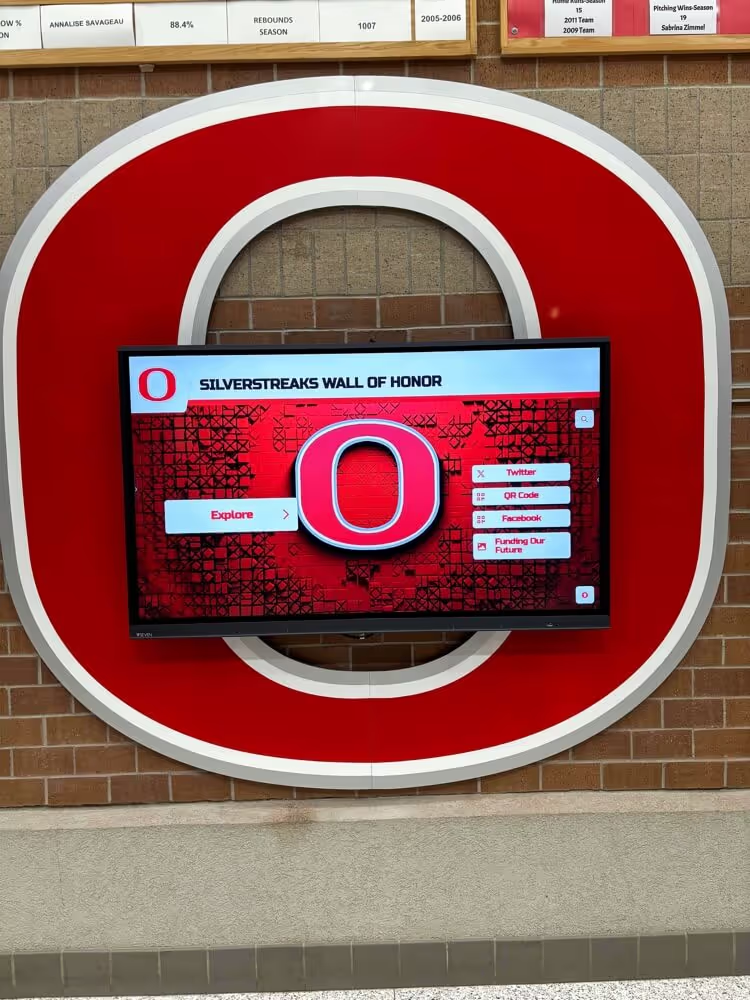
Honor boards in a school hallway represent the visible output of well-structured award data — when the underlying records share a consistent schema, the display can surface every qualifying honor without manual curation for each athlete
Crosswalk Table 3: Photograph and Media Records
Photograph metadata is typically the least structured of the four athletic archive data types. Images accumulated over decades often have no embedded metadata, no consistent file naming, and no caption system — just a file name assigned by a camera or scanner, and perhaps a handwritten note on the back of a physical print.
A photograph crosswalk maps whatever descriptive information exists — captions, folder labels, handwritten notes, embedded EXIF data — to a normalized set of fields that make images searchable by sport, season, athlete, and photo type.
| Legacy Field / Source | Normalized Target Field | Data Type | Target Format | Example Value | Transformation Required |
|---|---|---|---|---|---|
| File name / Scanned name / Original label | asset_filename | Text | Sport_SeasonYY_Type_NNN.ext | “BBALL_202324_Team_001.jpg” | Rename to convention; preserve original name in notes |
| Caption / Description / Back-of-print note | asset_caption | Text | Free text | “2023-24 Varsity Basketball team photo” | Transcribe handwritten notes; clean whitespace |
| Date / Year / Season (from folder or caption) | asset_date | Text | YYYY-YY or YYYY | “2023-24” | Extract from folder label, caption, or EXIF date |
| Sport / Team / Program | sport_name | Controlled vocab | Approved list | “Basketball” | Same controlled vocab as rosters and awards |
| Photo type / Category | asset_type | Controlled vocab | Portrait / Team / Action / Award / Event | “Team Portrait” | Assign based on content; do not carry forward inconsistent labels |
| Athletes Pictured / Who / Names / ID | athletes_depicted | Text (multi-value) | “Last, First; Last, First” | “Jordan, Alex; Rivera, Maria” | Semicolon-delimit multiple athletes; match name format to roster |
| Photographer / Credit / Source | photo_credit | Text | Free text | “Annual photography contract, 2023” | Carry forward as-is; use “Unknown” if absent |
| Condition / Quality / Scan quality | asset_condition | Controlled vocab | Excellent / Good / Fair / Poor | “Good” | Assess at time of scanning; apply consistent criteria |
| Display status / Flag | display_ready | Controlled vocab | Ready / Pending / Not Suitable | “Ready” | Assign based on resolution, identification completeness, and condition |
The display_ready field is a crosswalk-specific addition that does not exist in most legacy photo systems — it is created during the normalization process. It separates photographs that have sufficient resolution, complete identification, and acceptable condition for immediate display from those that require additional work.
For programs building youth sports and alumni recognition displays that draw on decades of photography, the athletes_depicted field is the most labor-intensive to complete — it requires identifying athletes by name from photographs, which often requires community outreach and alumni involvement when caption information is absent.
Crosswalk Table 4: Performance Records and Statistics
Performance records — individual and team statistics, school records, season totals — are often stored in formats that prioritize human readability over machine searchability. Record boards maintained in spreadsheets may use merged cells, multi-row headers, or mixed data types in a single column. The crosswalk for records data must explicitly address these formatting decisions.
| Legacy Field Names (Common Variations) | Normalized Target Field | Data Type | Target Format | Example Value | Transformation Required |
|---|---|---|---|---|---|
| Record Type / Category / Stat | record_category | Controlled vocab | Approved list | “Season Points Scored” | Map all variants to canonical category names |
| Record / Mark / Score / Value / Best | record_value | Text | Numeric or formatted text | “847” | Keep as text to support times, distances, ratios |
| Unit / Measure | record_unit | Controlled vocab | Approved list | “points” | Standardize units (“pts,” “pt,” “points” → “points”) |
| Athlete / Holder / Record Holder / Name | record_holder | Text | Last, First | “Jordan, Alex” | Match format to athlete_full_name in roster and award tables |
| Season / Year / Year Set / When | record_season | Text | YYYY-YY | “1998-99” | Convert all year formats to YYYY-YY; use best estimate if exact year unknown |
| Sport | sport_name | Controlled vocab | Approved list | “Basketball” | Same controlled vocab |
| Verified / Confirmed / Source Checked | record_verified | Boolean | Yes / No | Yes | Flag only records confirmed against source documentation |
| Source / Documentation / Evidence | record_source | Text | Free text | “Official scorebook, 1999 season” | Cite specific document; “Unknown” if no source available |
| Previous Record / Prior Mark | previous_record_value | Text | As record_value | “812” | Carry forward if available; leave blank if not |
Record verification deserves particular attention. A record_verified flag serves an important function: an unverified record that turns out to be incorrect creates a visible correction obligation when it appears on a display viewed by students, parents, and alumni. Flagging records as unverified does not prevent display — but it creates a review queue that staff can work through with source documentation before a record is promoted to a primary display position.
For programs aligning athletic records with broader recognition initiatives, including academic honor roll and achievement displays, the sport_name controlled vocabulary from the performance records table can extend to academic subjects and extracurricular programs — enabling a single recognition schema covering both athletic and academic achievement.

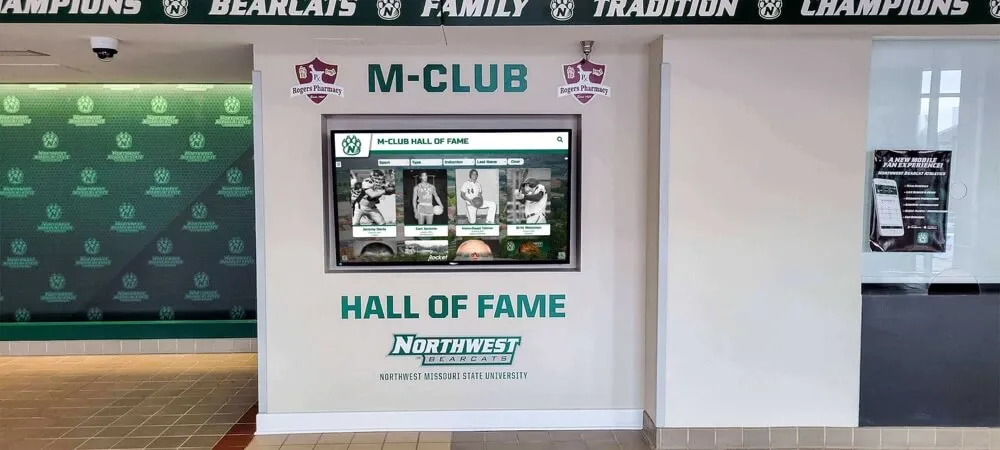
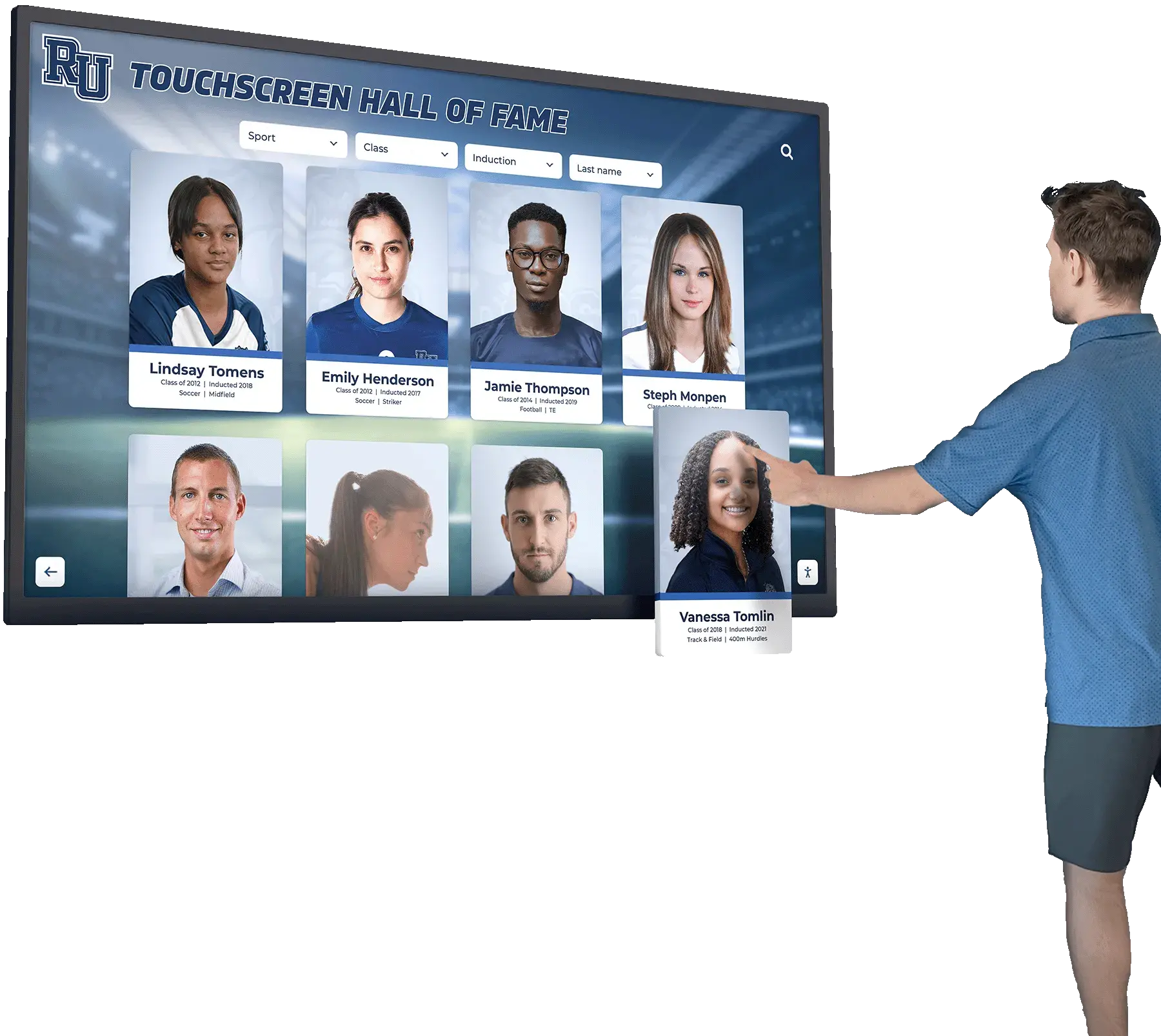
A touchscreen hall of fame displays athlete portrait cards because the underlying records share a normalized schema — consistent name formats and controlled sport names allow the display to surface the right records for every search and filter combination
The 6-Step Athletic Archive Metadata Migration Workflow
With crosswalk tables established for all four data types, the migration proceeds in six steps. The tables answer what to map; the workflow answers how to move data through the mapping process.
Step 1: Audit All Source Systems and Export All Source Data
Before applying any crosswalk, document every source system that holds athletic records: spreadsheets, database exports, paper forms that have been partially digitized, and scanned documents with extractable text. For each source, record the format (Excel, CSV, PDF, paper), the field names as they appear in the source, the approximate record count, and the date range covered.
Export all source data to a neutral format — CSV is the most practical choice for tabular data — before beginning any transformation. Never transform data in the original source file; work from exports so the original is preserved as a reference if the mapping needs to be revised.
Step 2: Map Each Source Field to the Target Schema Using the Crosswalk Tables
For each source file, create a mapping document that lists every column or field in the source alongside the corresponding target field from the crosswalk tables above. Document fields in the source that have no target mapping (carry them to a notes field rather than discarding) and target fields that have no source equivalent (mark as blank or “Unknown” depending on display requirements).
This step often surfaces data quality issues that were invisible in the source system: a graduation year column that contains “Junior,” “2022,” “11th,” and blank cells all in the same column. Those issues do not block the crosswalk mapping — they define the data cleaning work that Step 3 addresses.
Step 3: Apply Data Transformations Field by Field
With the crosswalk mapping in place, apply transformations to bring source values into the target format. Work field by field, not record by record: transform all graduation_year values across the entire dataset before moving to the next field. This approach makes it easier to spot inconsistencies and verify transformation completeness.
Common transformations for athletic archive data:
- Name format standardization: Convert “First Last” to “Last, First” consistently
- Season format conversion: Standardize all year references to YYYY-YY
- Controlled vocabulary mapping: Replace all sport name variants with approved terms
- Award level normalization: Assign Local / Regional / State / National to every award record
- Boolean conversion: Convert any “captain,” “Y,” “yes,” “✓,” or “x” to a consistent Yes / No
Document every transformation decision in writing. If “Boys Basketball” becomes “Basketball” and “Girls Basketball” stays “Girls Basketball” — or both become “Basketball” with a separate gender field — that decision must be recorded so that any future import from an unconverted source follows the same rule.
Step 4: Validate Transformed Data Against Crosswalk Targets
Before importing, validate the transformed data against the crosswalk definitions. For each field:
- Confirm that all values fall within the expected data type (no text in an integer field, no dates in a text field)
- Confirm that all controlled vocabulary fields contain only approved terms (no variants, no blanks in required fields)
- Confirm that name format is consistent across the dataset and matches the format in related tables (an athlete who appears in the roster table as “Rivera, Maria” must appear the same way in the award and photo tables)
- Flag records with missing values in required fields and resolve them before import — a record with no sport_name will not appear in any sport-filtered search
Cross-table validation is particularly important: an award record that references an athlete who does not appear in the roster table will either fail to match or will create an orphaned record in the display system. Resolve cross-table mismatches before import.
Step 5: Import in Tiers, Starting with Roster and Award Data
Import data in order of recognition impact, not in the order it was easiest to prepare. Roster and award records should move to the target system before photograph records and performance records, because recognition displays and hall of fame workflows depend on athlete identity (roster) and honor history (awards) more immediately than on photographs or statistics.
For each import tier:
- Import a test batch of 25–50 records
- Verify that the display system surfaces them correctly in all relevant filters (sport, season, award level)
- Resolve any display-layer issues before importing the full dataset
- Import the full dataset for that tier
- Document the import date, record count, and any transformation decisions made during import
For programs planning multi-sport digital recognition and records displays, the tiered import approach also produces a display that grows visibly over the import period — stakeholders can see progress after each tier rather than waiting for the entire dataset to migrate before anything is visible.
Ready to Move Your Normalized Archive into a Display Platform?
Once your crosswalk is complete and your data is clean, the import step is where the archive becomes visible. Rocket Alumni Solutions helps school athletic programs move from structured data to an interactive touchscreen recognition display — with support at every stage of the import and configuration process.
See a DemoStep 6: Establish Import Standards for New Records
The crosswalk serves one additional function beyond the initial migration: it defines the standards that all future records must meet before they are added to the system. A current-season roster entered in any format other than the crosswalk schema will not integrate cleanly with historical records. A new award record that uses an unapproved sport name will not surface in sport-filtered searches.
After the initial migration, maintain the crosswalk tables as a living document. When a new sport is added to the program, add it to the sport_name controlled vocabulary. When a new award type is introduced, add it to the award_name list. When a new data source becomes available — a parent volunteer’s photograph collection, a retired coach’s records — apply the crosswalk before any data enters the system.
Common Normalization Problems and Resolutions
| Problem | Source | Impact | Resolution |
|---|---|---|---|
| Multiple name formats for the same athlete | Different staff maintained different seasons’ rosters | Cross-season searches fail to return all records for one athlete | Establish a single canonical name format; run a deduplication pass before import; use a unique athlete ID if the display system supports it |
| Inconsistent sport naming across decades | No controlled vocabulary was established originally | Sport filter searches return incomplete results | Map all variants to approved list; update all records in a single transformation pass before import |
| Award records with no linked athlete | Award was documented without a corresponding roster entry | Award appears in the system but cannot be linked to an athlete profile | Cross-reference award records against rosters; add roster entries for award-only athletes; use a “Historical Only” flag if the roster is incomplete |
| Photographs with no caption or identification | Original prints had no caption; scanner did not capture context | Photos cannot be filtered by athlete, sport, or season | File under best available information; mark athletes_depicted as “Unidentified — Review Pending”; initiate community identification process |
| Duplicate records from multiple sources | Two different staff maintained overlapping record systems | Record board shows duplicate entries; totals are inflated | Deduplication pass using athlete name, season, and sport as composite key; retain the most complete record and merge or discard the duplicate |
| Performance records with no verification source | Record was entered from memory or a secondary report | Incorrect record is displayed as authoritative | Apply record_verified = No flag; create a review queue; engage alumni and coaching staff to locate source documentation |
| Mixed data types in a single column | No schema enforced in legacy spreadsheet | Transformation fails or produces incorrect results | Split column into multiple fields if needed; apply type conversion with explicit rules for each observed value pattern; log all conversion decisions |
Data Integrity in Athletic Archive Displays
A metadata crosswalk addresses the structural problem of inconsistent field names and value formats. It does not, on its own, verify that the underlying data is accurate — that a record was genuinely set by the athlete listed, that an award was actually received, or that a photograph correctly depicts the athletes identified in the caption.
Display systems for athletic recognition depend on a level of data integrity that goes beyond structural consistency. Understanding how data integrity risks affect recognition display systems — including the kinds of errors that automated tools can and cannot catch — helps administrators set realistic expectations about what a crosswalk-driven migration will produce and what human review remains necessary.
For academic recognition programs that extend the athletic archive schema to honor roll and scholar-athlete recognition, data integrity questions extend to GPA verification, graduation status, and eligibility criteria — each of which has its own source system and requires its own crosswalk mapping before integration into a shared recognition display.

A student can search an athletic archive by name, sport, or season only because the underlying records were normalized against a crosswalk before import — the quality of the crosswalk determines the quality of every search result the display produces
Frequently Asked Questions
What is the difference between a metadata crosswalk and a data cleaning checklist? A crosswalk maps fields from source schemas to target schemas — it defines the relationship between field names and value formats across two different data structures. A data cleaning checklist specifies the corrections needed within a single dataset (fixing typos, resolving duplicates, standardizing values). Both are necessary for an athletic archive migration: the crosswalk defines the target; the cleaning checklist addresses the gap between the source data and the crosswalk’s requirements.
Do we need a crosswalk if we are only importing records from one source? Yes. Even a single source — a school’s roster spreadsheet maintained over twenty years — will typically contain field-naming inconsistencies introduced by different staff, format changes from spreadsheet migrations, and value variations that accumulated without a controlled vocabulary. The crosswalk for a single-source migration is simpler than one covering multiple systems, but it is still necessary.
How do we handle records where a required crosswalk field has no value? Use a controlled “Unknown” placeholder rather than leaving the field blank. A blank graduation_year field breaks filtered searches differently than an “Unknown” value: blank records may be excluded from results entirely, while records tagged “Unknown” can be filtered explicitly. After import, maintain a missing-data queue and work through it using alumni outreach, coaching staff, and historical records.
How long does a metadata crosswalk take to create? Creating crosswalk tables for a typical school athletic archive — covering four data types, three to five source systems, and fifty to one hundred field mappings — typically requires eight to sixteen hours of staff time when approached systematically using this guide. The initial crosswalk creation is a one-time investment; subsequent imports from new sources require only the time needed to map the new source’s fields to the established target schema.
Can a display platform automatically create the crosswalk for us? Display platforms can often automate the import process once the crosswalk is established and data is transformed — but the crosswalk itself requires human decisions about controlled vocabularies, name formats, and how to handle legacy data that does not fit cleanly into the target schema. Automated tools can flag inconsistencies and suggest mappings, but which sport name variants count as equivalent, which award levels apply to which award names, and how to handle records with no verifiable source are institutional judgments that require staff input.
What should we do with legacy records that do not fit any crosswalk field? Carry them forward to a free-text notes field rather than discarding them. Legacy records sometimes contain information that is meaningful to alumni or recognition committees even if it does not map to a standard display field — a handwritten note about an athlete’s injury, a record broken by a student who later transferred, a team award not covered by the standard award taxonomy. Preserving that information in a notes field keeps it accessible without forcing it into a category where it does not belong.
Transform Your Normalized Athletic Archive into a Living Recognition Display
A completed metadata crosswalk and a clean, structured dataset are the foundation for a searchable athletic recognition display that students, alumni, and visitors can explore by sport, season, award, or athlete name. Rocket Alumni Solutions helps school athletic programs move from a normalized archive to an interactive touchscreen experience — with support from crosswalk review through final display configuration.
Request a DemoLive Example: Rocket Alumni Solutions Touchscreen Display
Interact with a live example (16:9 scaled 1920x1080 display). All content is automatically responsive to all screen sizes and orientations.