Disc Golf Rules: The Complete Guide to Scoring, Etiquette, and Penalties
- Home /
- Touch Archive Blog /
- Disc Golf Rules: The Complete Guide to Scoring, Etiquette, and Penalties
The Easiest Touchscreen Solution




Live Example: Rocket Alumni Solutions Touchscreen Display
Interact with a live example (16:9 scaled 1920x1080 display). All content is automatically responsive to all screen sizes and orientations.
Disc golf has exploded from a casual park activity into a structured sport with established courses on college campuses, public parks, and dedicated facilities nationwide. As participation grows—particularly among college students, alumni groups, and recreational sports programs—understanding the sport’s official rules becomes essential for enjoying fair competition and respecting course etiquette. Unlike casual throwing games, competitive disc golf follows comprehensive regulations governing everything from legal throws to penalty strokes.
Many newcomers to disc golf courses struggle with basic questions: How do you keep score? What happens if your disc lands out of bounds? Can you move obstacles blocking your throw? When do penalty strokes apply? Meanwhile, schools and universities adding disc golf to recreation programs, club sports rosters, and alumni event activities need participants who understand fundamental rules to ensure enjoyable, safe play that respects both the sport and fellow players.
This comprehensive guide explains disc golf rules from basic scoring through advanced PDGA regulations, covering the essential knowledge recreational players need while providing competitive players with detailed rule interpretations. Whether you’re planning your first round, organizing a campus tournament, or building a disc golf club that needs recognition alongside traditional athletics, understanding these rules ensures everyone plays the game correctly.
Disc golf combines elements of traditional golf with the accessible, low-cost appeal of frisbee throwing. The Professional Disc Golf Association (PDGA) governs official rules, but the fundamentals apply equally to casual weekend rounds and competitive tournament play.

Recreational sports like disc golf deserve recognition alongside traditional athletics in comprehensive campus achievement programs
Disc Golf Basics: Understanding the Game’s Objective
Before examining specific rules, grasping disc golf’s fundamental structure helps everything else make sense.
The Core Objective
Disc golf mirrors traditional golf’s basic concept: complete each hole in the fewest throws possible by landing your disc in the target basket.
Key Elements
Every disc golf round involves these core components:
- Tee Throws: Each hole begins from a designated tee area where players make their first throw
- Fairway Play: Successive throws advance the disc toward the basket from wherever it came to rest
- Target Completion: The hole ends when your disc comes to rest in the chains or basket
- Score Tracking: Count every throw plus any penalty strokes to determine your hole score
- Course Navigation: Complete all holes (typically 9 or 18) in sequential order
The Playing Area
Disc golf courses feature specific elements:
- Tee Pads: Concrete, rubber, or natural surfaces marking where each hole begins
- Fairways: The intended path from tee to basket, often through wooded or open terrain
- Baskets: Metal targets featuring hanging chains above a basket that catches discs
- Out-of-Bounds Areas: Designated zones (water hazards, property boundaries) where discs incur penalties
- Obstacles: Natural features (trees, elevation changes) and sometimes artificial hazards
Course layouts vary dramatically from open park courses to heavily wooded technical tracks, each requiring different disc selection and throwing strategies.
Standard Game Format
Most disc golf follows traditional stroke play:
Stroke Play Scoring
The most common format:
- Each throw counts as one stroke
- Penalty strokes add to your total for rules violations
- Player with fewest total strokes after all holes wins
- Scores typically recorded as over/under par (like traditional golf)
Alternative Formats
Casual and tournament play sometimes use variations:
- Match Play: Head-to-head competition where you win individual holes rather than counting total strokes
- Best Disc/Best Shot: Team formats where groups select the best throw and all play from that position
- Singles vs Doubles: Individual competition or two-player teams
- Skins Games: Monetary or point wagering on individual holes
Modern athletic recognition includes emerging sports and recreation activities beyond traditional team athletics
Disc Golf Scoring: How to Keep Track
Understanding scoring mechanics ensures accurate competition and helps players track improvement.
Par System and Scoring Terms
Disc golf uses golf’s traditional par-based scoring:
Par Values
Each hole has an assigned par based on difficulty and distance:
- Par 3: Shorter holes expected to complete in three throws (most common)
- Par 4: Moderate distance requiring four throws for average players
- Par 5: Long holes demanding five throws (less common)
Scoring Terminology
Results relative to par use specific terms:
- Ace (Hole-in-One): Disc lands in basket on first throw from tee (extremely rare and celebrated)
- Eagle: Two strokes under par (finishing par 4 in two throws)
- Birdie: One stroke under par (finishing par 3 in two throws)
- Par: Completing hole in expected strokes
- Bogey: One stroke over par
- Double Bogey: Two strokes over par
Advanced players aim for birdies on most holes, while beginners might celebrate achieving par.
Keeping Score Properly
Accurate scorekeeping prevents disputes and tracks performance:
Scorecard Basics
Standard scorecards include:
- Player names across columns
- Hole numbers with par values down rows
- Boxes for recording each player’s score per hole
- Running total or final total calculation
- Signature lines confirming score accuracy
Marking Guidelines
Traditional scoring conventions:
- Record actual number of throws (including penalties) for each hole
- Calculate score relative to par: write “+1” for bogey, “-1” for birdie
- Total all holes at round conclusion
- Have cardmates verify and sign scorecard in tournament play
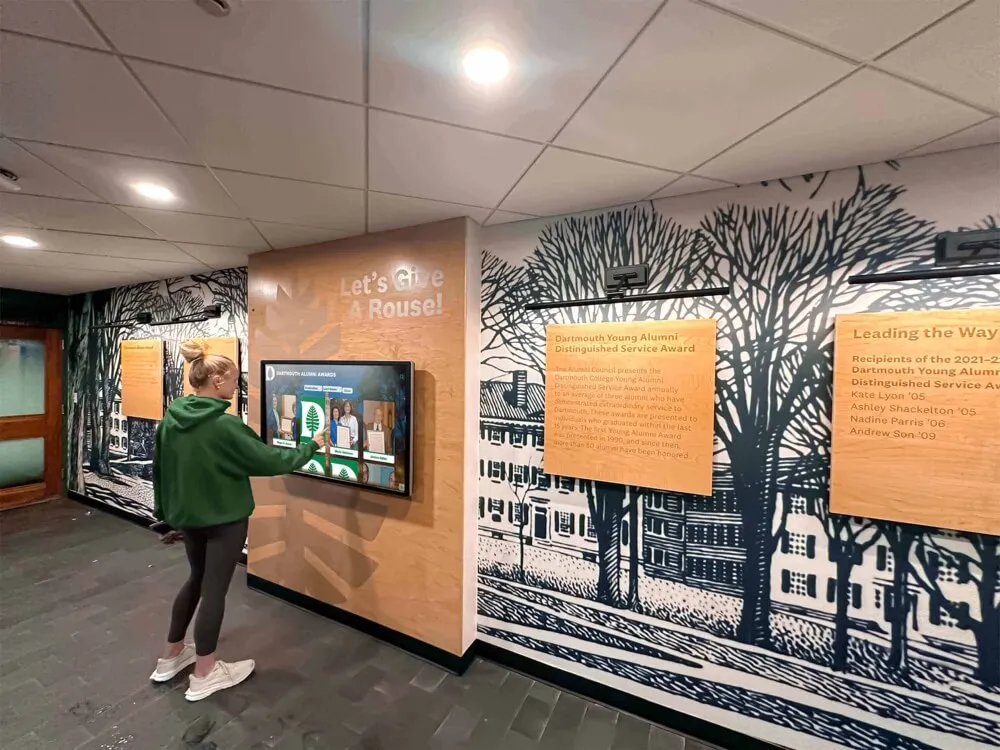
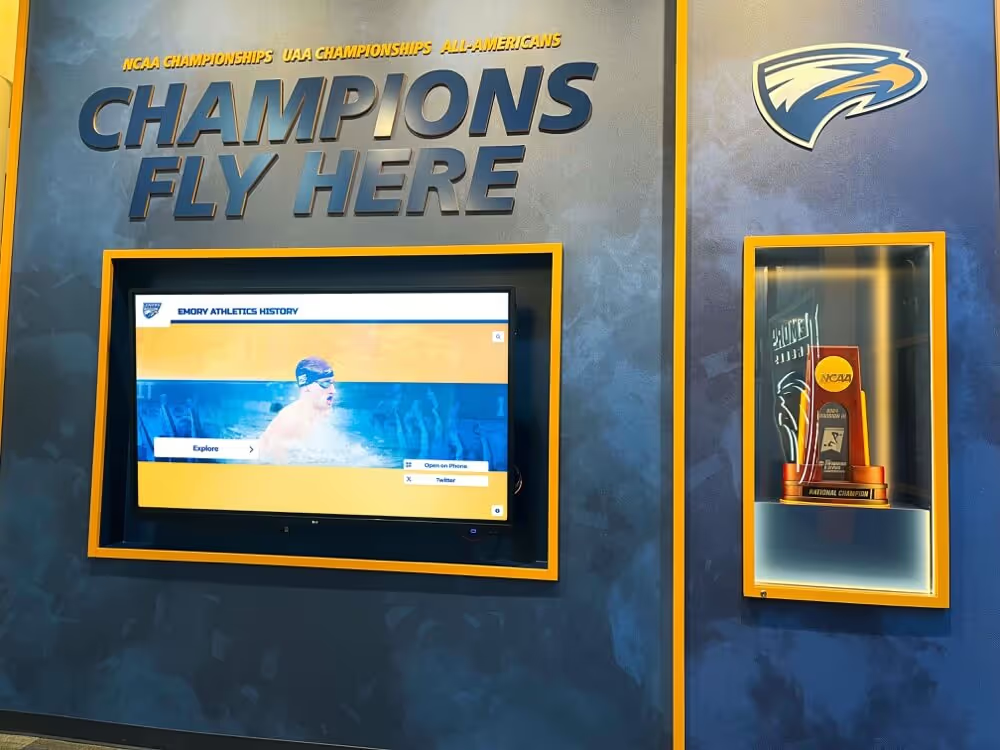
Many campus recreation programs and alumni disc golf events recognize top performers on digital achievement displays that celebrate recreational sports alongside traditional athletics.
Understanding Penalties and Adding Strokes
Penalties affect your score directly:
When Penalties Apply
Common one-stroke penalties:
- Disc lands out-of-bounds
- Rules violations during play (illegal stance, etc.)
- Exceeding time limits for locating discs
- Courtesy violations in some tournament settings
Two-Stroke Penalties
More serious violations:
- Intentionally moving obstacles to clear throwing lane
- Playing wrong hole or out of sequence
- Abandoning disc you cannot locate
Record penalties by adding them to your total throws for that hole. A par-3 hole completed in three throws with one penalty stroke equals a score of 4 (bogey).
Schools celebrating diverse athletic achievements create inclusive recognition cultures valuing all competitive pursuits
Essential PDGA Rules Every Player Should Know
The Professional Disc Golf Association establishes official rules governing competitive play, but these regulations apply equally to recreational rounds.
Legal Throwing Techniques
Understanding what constitutes a legal throw prevents penalties:
Tee Throw Requirements
Starting each hole correctly:
- At least one supporting point must be in contact with tee surface at release
- Cannot step past front of tee pad until disc is released
- May run up to tee but cannot release until contacting tee surface
- Violation results in one-stroke penalty; re-throw from correct position
Lie and Stance Rules
After the tee throw, each subsequent throw must follow positioning rules:
- The Lie: The spot directly beneath where your disc came to rest
- Supporting Point Rule: When throwing, all supporting points must be behind your lie (the disc’s position)
- Balance Requirement: Demonstrate full control after release before advancing
- Falling/Jumping Putts: Within 10 meters of basket, cannot have supporting points closer to basket than lie after release (prevents run-up putts)
Marking Your Lie
Proper marking prevents stance violations:
- Place mini marker disc directly in front of your thrown disc
- Your thrown disc becomes your marker if you don’t use mini
- Supporting point must be behind marker when throwing
- May angle body and lean past marker, but supporting points stay behind
Out-of-Bounds Rules
OB areas significantly affect play:
Defining Out-of-Bounds
Courses designate specific OB zones:
- Water hazards (ponds, streams, drainage areas)
- Property boundaries
- Protected environmental areas
- Designated lines or boundaries marked on course maps
Determining OB Status
Whether your disc is OB depends on specific criteria:
- Disc is OB if any part breaks the plane of OB boundary line
- Water hazards: disc is OB if it lands in or comes to rest touching water
- If questionable, consult cardmates or course markers
- Player gets benefit of doubt if genuinely unclear
Playing from OB
When your disc lands OB:
- Take one-stroke penalty
- Play from point where disc last crossed into OB (not where it came to rest)
- Play from up to one meter away from OB line, measured from the point it crossed
- Cannot throw from OB area itself
Some challenging courses feature significant OB areas that dramatically affect strategy and scoring.
Obstacles and Mandatory Paths
Courses sometimes include mandatory routes or obstacles:
Mandatory Lines (Mandos)
Some holes require passing specific points:
- Disc must pass on designated side of mandatory marker
- Missing mandatory requires re-throw from designated drop zone or previous lie with penalty
- Typically used to prevent dangerous shortcuts or protect property
Casual Obstacles
Natural and course elements you may move:
- Casual Water: Puddles, temporary water accumulation (not designated water hazards)
- Loose Debris: Leaves, sticks, small branches not part of living plants
- Course Equipment: Benches, trash cans (if movable and not part of course design)
Permanent Obstacles
Elements you cannot move:
- Trees, roots, attached branches
- Bolted or installed course equipment
- Boundary fences or permanent markers
- Other players’ equipment
Moving permanent obstacles to clear your throw results in two-stroke penalty.
Universities adding disc golf to campus recreation facilities often recognize club achievement and tournament results through digital displays that showcase emerging sports.
Disc Golf Etiquette: The Unwritten Rules
Beyond official regulations, disc golf culture emphasizes respect, safety, and consideration.
Order of Play
Following proper playing order maintains pace and fairness:
Teeing Order
Who throws first from the tee:
- First hole: any method agreed upon (flip disc, random draw, score from previous round)
- Subsequent holes: player with lowest score on previous hole has “honors” and throws first
- Tied scores: maintain order from previous hole or re-determine
Fairway Order
After tee throws, order changes:
- Player farthest from basket throws next (regardless of who threw first from tee)
- Continue until all players hole out
- Maintains fair competition and prevents closer players from reading the approach
Maintaining Pace
Keep groups moving smoothly:
- Don’t take excessive time selecting discs or reading lies
- Be ready when it’s your turn
- Allow faster groups to play through when appropriate
- Typical round takes 2-3 hours for 18 holes
Safety and Courtesy
Disc golf’s relaxed culture still demands serious safety attention:
Throwing Safety
Preventing injuries:
- Never throw when any person or animal is within throwing range
- Call “fore!” loudly if your disc heads toward other players
- Wait for group ahead to clear landing zones completely
- Be aware of walking paths crossing fairways
Course Courtesy
Respecting other players:
- Quiet During Throws: Remain silent and still when others are throwing
- Stay Behind Thrower: Position yourself behind player throwing, never in throwing line
- Avoid Distractions: No sudden movements, loud conversations, or phone use near players throwing
- Help Search for Discs: Assist cardmates looking for errant throws (three-minute search limit)
Environmental Responsibility
Protecting courses:
- Carry out all trash (pack in, pack out principle)
- Respect wildlife and vegetation
- Stay on marked paths when possible
- Avoid damaging trees or plants when retrieving discs
Many college campus courses serve dual purposes as both disc golf venues and natural areas, requiring particular environmental sensitivity.
Competition and Casual Play Differences
Rules enforcement varies by setting:
Tournament Play
Competitive events feature stricter adherence:
- All PDGA rules enforced precisely
- Players call violations on cardmates
- Scorecards require signatures and verification
- Tournament director resolves disputes
Casual Rounds
Recreational play allows flexibility:
- Groups may agree to ignore minor foot faults or technical violations
- “Gimme” putts inside circle sometimes accepted
- Friendly atmosphere prioritizes enjoyment over strict enforcement
- Still wise to practice proper rules for tournament preparation
Schools hosting alumni recreation events with disc golf tournaments benefit from clear rule communication to ensure all participants enjoy fair, organized competition.

Interactive displays celebrate all athletic and recreational achievements, creating comprehensive recognition programs
Common Rule Violations and How to Avoid Them
Understanding frequent mistakes helps new players avoid penalties.
Stance and Foot Faults
The most common violation in disc golf:
What Constitutes a Foot Fault
Illegal positioning at release:
- Supporting point beyond front of tee pad on tee throws
- Supporting point in front of lie marker on fairway throws
- Stepping past marker before disc releases
- Falling forward on putts inside 10 meters with supporting point closer to basket
How to Avoid Foot Faults
Developing legal throwing mechanics:
- Practice releasing disc before stepping forward
- Develop balanced follow-through that doesn’t require stepping past marker
- On putts inside circle, “straddle putt” (one foot on each side of marker) or “step putt” (step away from basket after release)
- Exaggerate staying behind marker during practice until it becomes automatic
In casual play, many groups don’t call foot faults unless egregious. Tournament play enforces strictly.
Time Violations
Pace-of-play rules prevent excessive delays:
Disc Search Time Limit
Finding lost discs:
- Three-minute maximum search time per disc
- If not found within three minutes, proceed with penalty
- Play provisional disc if concerned about finding original
Excessive Time Between Throws
Pace requirements:
- 30 seconds allowed from when it’s your turn until throw release
- Applies mainly in tournament play
- Rarely enforced in casual rounds
How to Maintain Proper Pace
Keeping games moving:
- Select disc while others are throwing
- Assess lie and plan shot efficiently
- Limit practice swings and stance adjustments
- Be ready when it’s your turn
Disc Interference
Rules governing interference with discs:
Other Players’ Discs
Don’t touch other discs:
- Never move another player’s disc without permission
- If your disc hits another player’s disc at rest, play yours where it landed; return theirs to original position
- Wait for all players to mark lies before throwing
Your Own Discs
After throwing, don’t touch your disc:
- Cannot adjust or clean disc until marking lie for next throw
- May remove it once properly marked with mini marker
- Penalty for moving disc before marking
Developing good habits in casual play prepares players for tournament situations where rules apply strictly.
Advanced Rules: Tournament and Competitive Play
Serious players and tournament participants need deeper rule knowledge.
The Circle and Putting Rules
The 10-meter circle around baskets has special regulations:
Circle Putting Requirements
Special rules within 10 meters:
- After release, cannot have supporting point closer to basket than lie
- Prevents run-up or jump putts inside circle
- Must demonstrate balance and control after release
- Violation is stance fault with warning, penalty on subsequent violations
Outside the Circle
Beyond 10 meters:
- Normal stance rules apply
- May run up, jump, or fall forward after release
- No special putting restrictions
Why This Rule Exists
Safety and fairness:
- Prevents dangerous collisions at basket from running players
- Maintains skill requirement for circle putting
- Standardizes competitive putting expectations
Group Dynamics and Cardmate Responsibilities
In tournaments, your playing group shares specific duties:
Score Verification
Cardmates confirm each other’s scores:
- Each player’s score must be agreed upon before leaving hole area
- Disputes resolved before proceeding
- Scorekeeper reads back scores periodically for confirmation
- Final scores signed by all cardmates
Calling Violations
Players enforce rules on each other:
- Any cardmate may call violation they clearly observe
- Benefit of doubt goes to player
- Disagreements may invoke tournament director
- False or vindictive calls violate sportsmanship
Courtesy Violations
Egregious behavior may be penalized:
- Excessive time delays
- Intentional distractions
- Abusive language or conduct
- Littering or course damage
Most players never encounter courtesy violations, but serious incidents may result in warnings, penalty strokes, or disqualification.
Tournament Formats and Divisions
Competitive disc golf features structured organization:
Division Structure
Players compete in divisions by skill and demographics:
- Open: Highest skill players, often with professional status
- Advanced/Intermediate/Recreational: Skill-based amateur divisions
- Masters/Grandmasters: Age-based divisions (40+, 50+, etc.)
- Junior: Youth divisions by age groups
- FPO (Female Professional Open): Top women’s division
Round Structures
Tournament organization:
- Multiple rounds (typically 2-4) determine final standings
- Each round may feature different course layouts or tee positions
- Cumulative scoring across all rounds
- Final round sometimes includes only top performers
Schools with competitive club sports programs increasingly recognize disc golf achievements alongside traditional athletics, creating inclusive recognition cultures.
Modern athletic recognition systems accommodate diverse sports and achievement categories beyond traditional team competitions
Disc Golf Equipment and Legal Discs
Understanding equipment rules ensures compliance and optimal performance.
PDGA Approved Discs
Official competition requires approved discs:
Approval Standards
Discs must meet specifications:
- Listed on PDGA Approved Disc List
- Meet size, weight, and design requirements
- Manufactured by approved producers
- Unmodified from original manufactured condition
Common Disc Types
Discs fall into general categories:
- Putters: Slow, stable discs for controlled short throws and putting
- Midrange: Moderate speed and distance for controlled fairway shots
- Fairway Drivers: Faster discs for longer, controlled distance
- Distance Drivers: Maximum speed and distance for advanced players
Disc Modifications
Rules prohibit certain changes:
- Cannot add weight or material
- Cannot modify flight characteristics through sanding or cutting
- Wear from normal use acceptable
- Writing name and phone number allowed and encouraged
Other Equipment
Additional gear regulations:
Markers
Mini marker discs:
- Must be disc-shaped
- Typically 7-10cm diameter
- Used to mark lie position
- Not required (can use thrown disc as marker)
Bags and Carts
Carrying equipment:
- No restrictions on bag types or carts
- Cannot be used to measure distances or provide unfair advantage
- May carry multiple discs (most players carry 15-25)
Technology and Aids
Permitted and prohibited:
- Allowed: Range finders, scorekeeping apps, course maps
- Prohibited: Devices affecting disc flight, artificial lighting (except designated night rounds)
Most recreational players need only 5-10 discs to enjoy courses fully, with more options useful as skills develop.
Building a Disc Golf Program: Recognition and Growth
Schools and organizations developing disc golf initiatives benefit from proper structure.
Establishing Campus and Community Courses
Growing disc golf participation:
Course Development
Creating accessible facilities:
- Partner with parks departments or utilize campus green spaces
- Professional course designers optimize layouts for available space
- Permanent installations versus temporary baskets for events
- Consider skill levels: beginner-friendly layouts versus championship-caliber challenges
Club Formation
Organizing players:
- Establish club sports structure through recreation department
- Regular practice rounds and skill development sessions
- Host tournaments and alumni events
- Create pathways to competitive opportunities
Recognizing Disc Golf Achievements
Celebrating participation and excellence:
Achievement Categories
What to recognize:
- Tournament winners and division champions
- Course records and aces
- Participation milestones
- Club leadership and development contributions
- Alumni competitive achievements
Modern Recognition Solutions
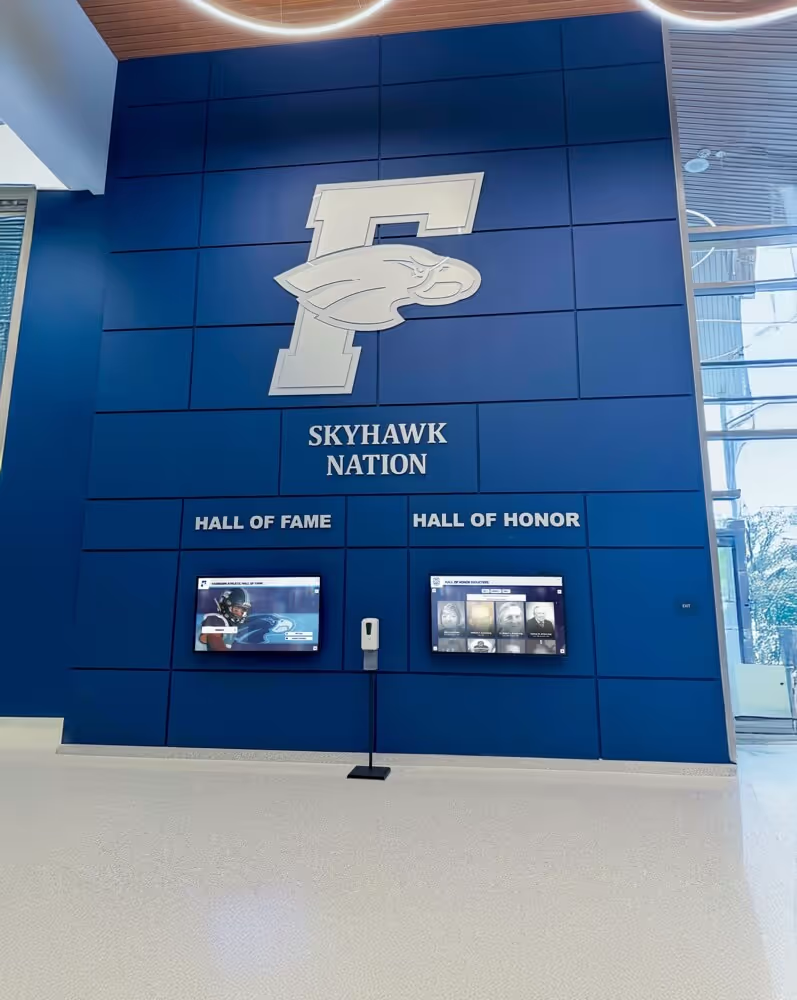
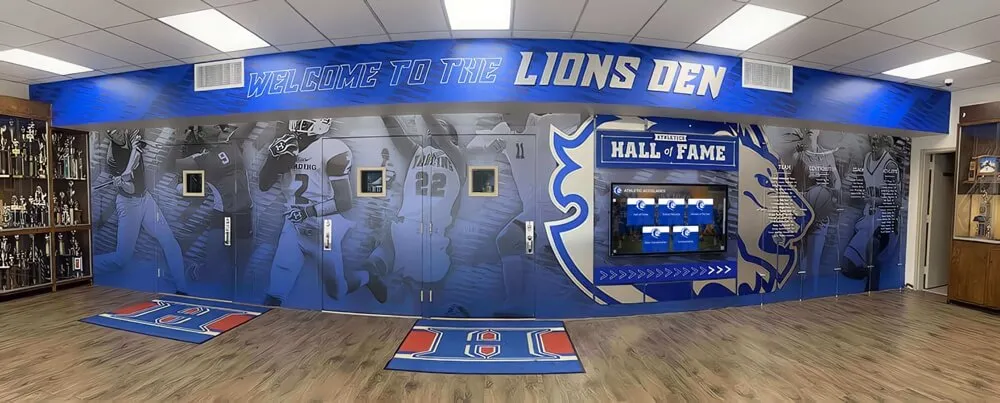
Many universities now feature comprehensive digital displays celebrating both traditional athletics and emerging sports like disc golf, creating inclusive recognition cultures that value diverse competitive pursuits. These systems allow equal visibility for club sports, recreation programs, and varsity athletics.
Building Program Identity
Creating lasting culture:
- Document history through photos and achievement records
- Highlight notable players and memorable rounds
- Connect current players with alumni competitors
- Showcase program growth and development
Recognition displays in campus facilities celebrate the full spectrum of athletic and recreational achievement
Frequently Asked Questions About Disc Golf Rules
Common questions from new and developing players:
What happens if I can’t find my disc?
After three minutes of searching, the disc is declared lost. Take a one-stroke penalty and play from your previous lie (re-throw from where you last threw).
Can I move my lie to avoid obstacles?
No. You must play from where your disc came to rest (within one meter perpendicular to target, but not closer). Moving your lie position constitutes a violation.
Are there penalties for hitting trees?
No penalty for hitting obstacles during disc flight. Play the disc where it comes to rest. Trees are part of the course challenge.
What if my disc lands on top of something (basket, roof, tree branch)?
If more than two meters above ground, you mark your lie directly below where it came to rest and take one-stroke penalty. If you can reach it safely and it’s below two meters, you may attempt to retrieve and play it normally.
Do I have to use a mini marker or can I just throw from my disc?
Mini markers are optional. You may use your thrown disc as your marker. Many players use minis because they’re easier to position precisely and allow you to retrieve your thrown disc to clean or switch discs.
How do I know which tee pad to use?
Courses often have multiple tee positions per hole:
- Short/beginner tees (typically white or red)
- Long/advanced tees (typically blue or gold)
- Tournament tees (typically championship or professional)
Check course signage or ask regulars which tees match your skill level.
Can I practice putts or throws before official rounds?
Tournament rules vary. Some allow designated practice periods; others prohibit practice on competition day. Casual rounds allow practice any time.
Disc Golf’s Growing Role in Campus Recreation
Understanding disc golf’s expanding presence in educational settings:
Why Schools Are Adding Disc Golf
The sport’s appeal for campus programs:
Accessibility and Inclusion
Disc golf offers unique advantages:
- Low cost of participation (discs cost $10-20 each)
- No special athletic background required
- Accommodates wide range of fitness levels
- Year-round outdoor activity
- Minimal injuries compared to contact sports
Facility Efficiency
Making use of campus resources:
- Courses utilize existing green spaces
- Minimal maintenance requirements
- Multi-use areas (courses coexist with walking paths, general campus use)
- One-time installation versus ongoing operational costs
Alumni Engagement
Recreation-based programming:
- Alumni returning for reunions enjoy casual disc golf tournaments
- Creates networking opportunities in relaxed, active settings
- Easier participation than high-intensity traditional sports
- Multi-generational appeal spans ages and fitness levels
Integrating into Recognition Programs
Creating comprehensive athletic celebration:
Beyond Traditional Athletics
Modern institutions recognize:
- Club sports deserve acknowledgment alongside varsity programs
- Recreation participation contributes to campus culture
- Emerging sports attract diverse student populations
- Inclusive recognition celebrates all forms of competitive achievement
Schools implementing digital recognition systems can showcase disc golf achievements alongside football championships and academic honors, creating equitable visibility for all campus competitive pursuits. These modern platforms accommodate unlimited achievement categories without physical space constraints of traditional trophy cases.
Documentation and History
Preserving program development:
- Record tournament results and notable performances
- Photograph memorable moments and course development
- Track participation growth and club evolution
- Create narratives connecting current students with program origins
Conclusion: Playing Disc Golf the Right Way
Disc golf’s remarkable growth stems partly from its accessibility, but sustained enjoyment requires understanding fundamental rules. Whether you’re attempting your first round on a campus course, organizing an alumni tournament, or joining competitive club play, knowing proper scoring, etiquette, and regulations ensures fair play and maximizes enjoyment.
The rules outlined here—from basic scoring and out-of-bounds penalties to advanced competitive regulations—provide the foundation every player needs. Start with the fundamentals: count all throws, play from where your disc lands, maintain courtesy toward other players, and respect course environments. As your skills develop and competitive interests grow, deeper rule knowledge becomes second nature.
For schools and organizations building disc golf programs, proper rules education creates positive experiences that attract sustained participation. Combined with appropriate recognition celebrating achievements and preserving program history, disc golf can become a valued component of comprehensive campus recreation offerings that engage diverse populations and create lasting connections among students, alumni, and community members.
Play fair, respect the course, enjoy the challenge, and celebrate the achievements that make disc golf a growing force in recreational and competitive athletics.
Live Example: Rocket Alumni Solutions Touchscreen Display
Interact with a live example (16:9 scaled 1920x1080 display). All content is automatically responsive to all screen sizes and orientations.