



A letterman jacket carries more weight than wool and chenille. Pinned with sport bars, academic emblems, and year markers, each jacket maps a student’s entire arc through a program—the seasons dedicated, the teammates shared, the growth tracked from freshman tryout to senior captain. Yet the most common home for that jacket after graduation is a closet shelf or, at best, a household shadow box that squeezes one garment and a few wallet-sized photos into a 16-by-20 frame. The story flattens. The context disappears.
Schools and families who want to do justice to a varsity career need a more deliberate approach to letterman jacket display. This guide covers physical preservation options, what elements deserve to accompany a jacket in any meaningful display, a practical preservation checklist, and how digital archive tools can extend the jacket’s story far beyond any single frame or case.
The letterman jacket exists at the intersection of two traditions: the athletic letter system, which originated at Harvard in the 1860s as a way to mark distinguished performance, and the varsity jacket culture that grew through the 20th century as schools formalized their recognition practices. Together, they produced a garment that is simultaneously a uniform, a trophy, and a personal archive. Displaying one well requires treating it as all three.

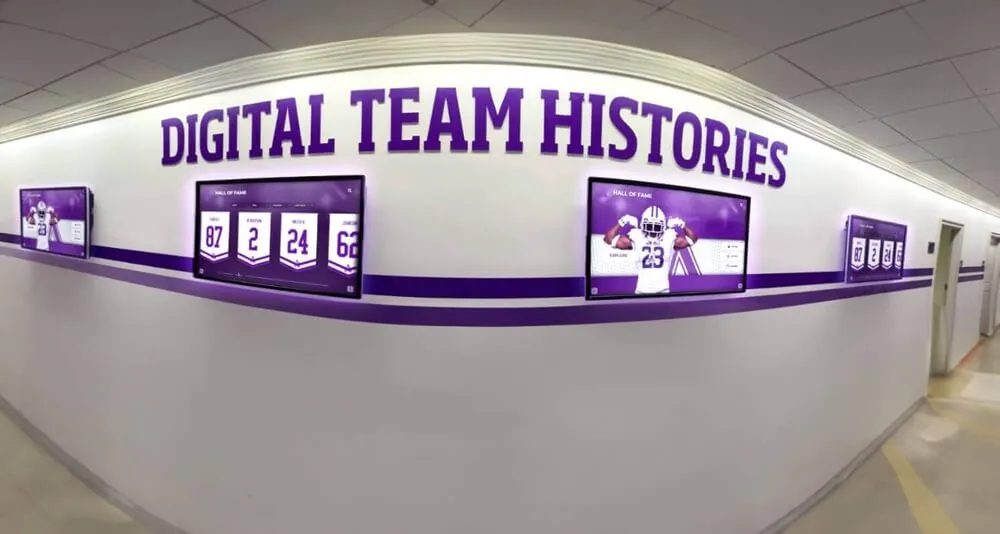
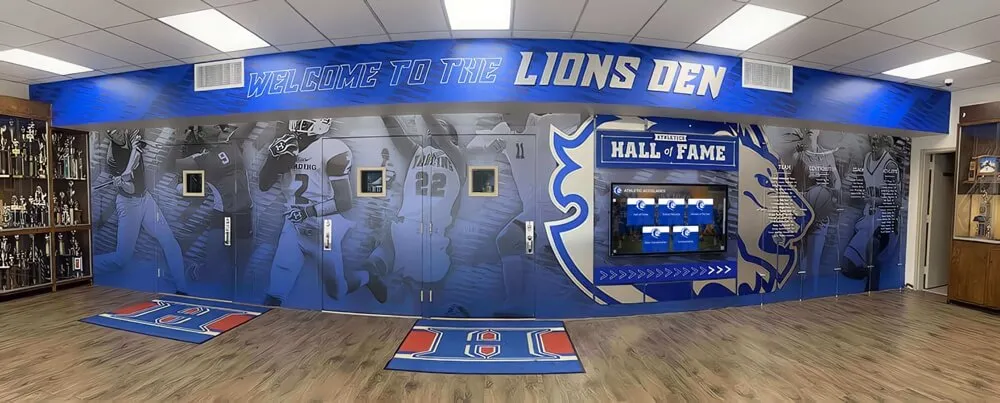
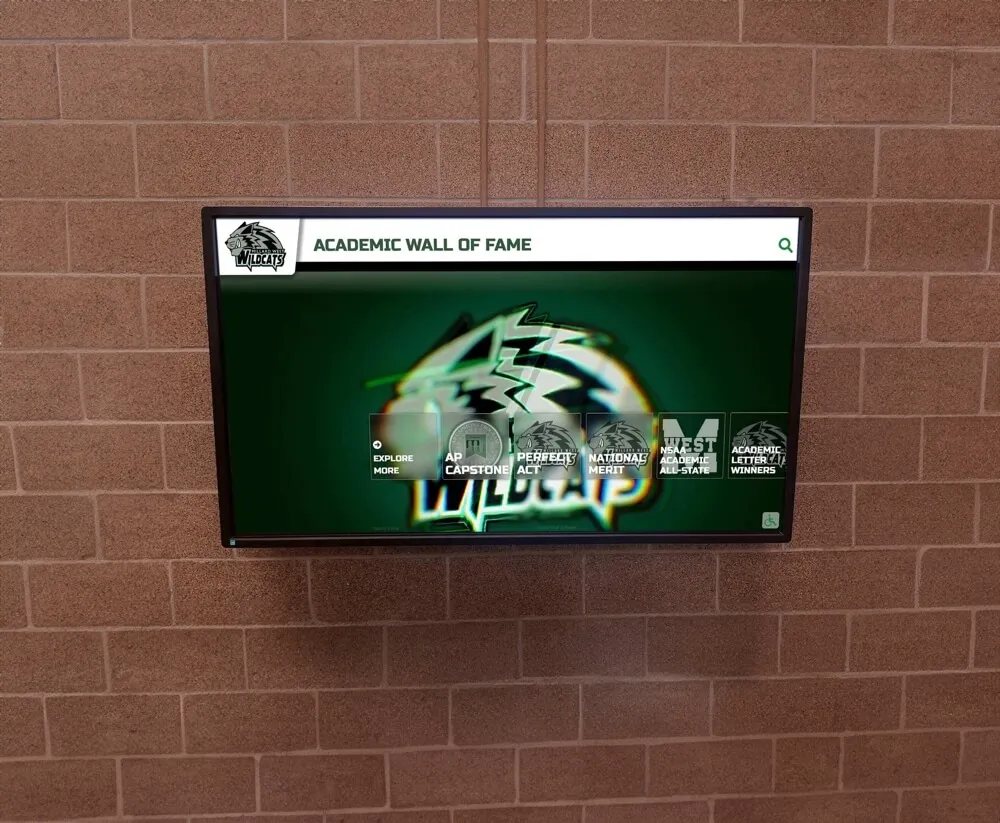
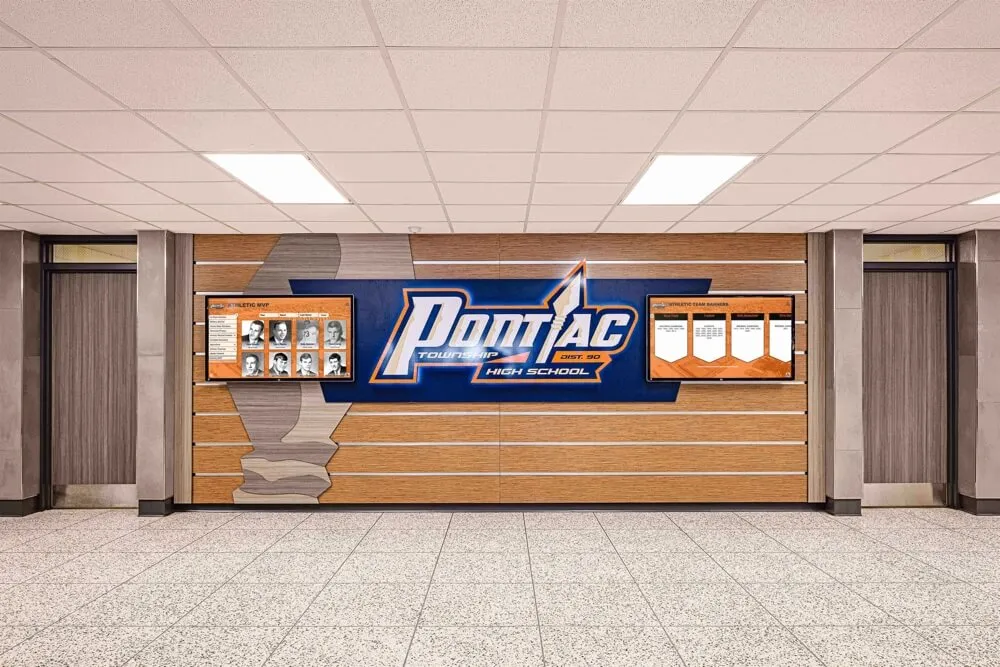
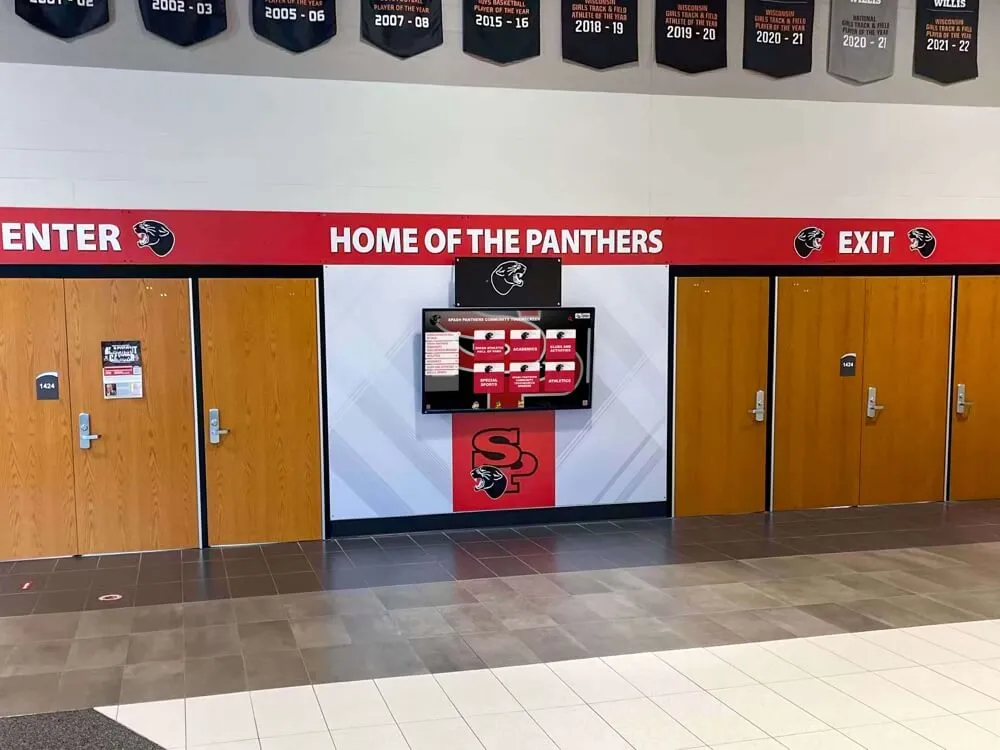
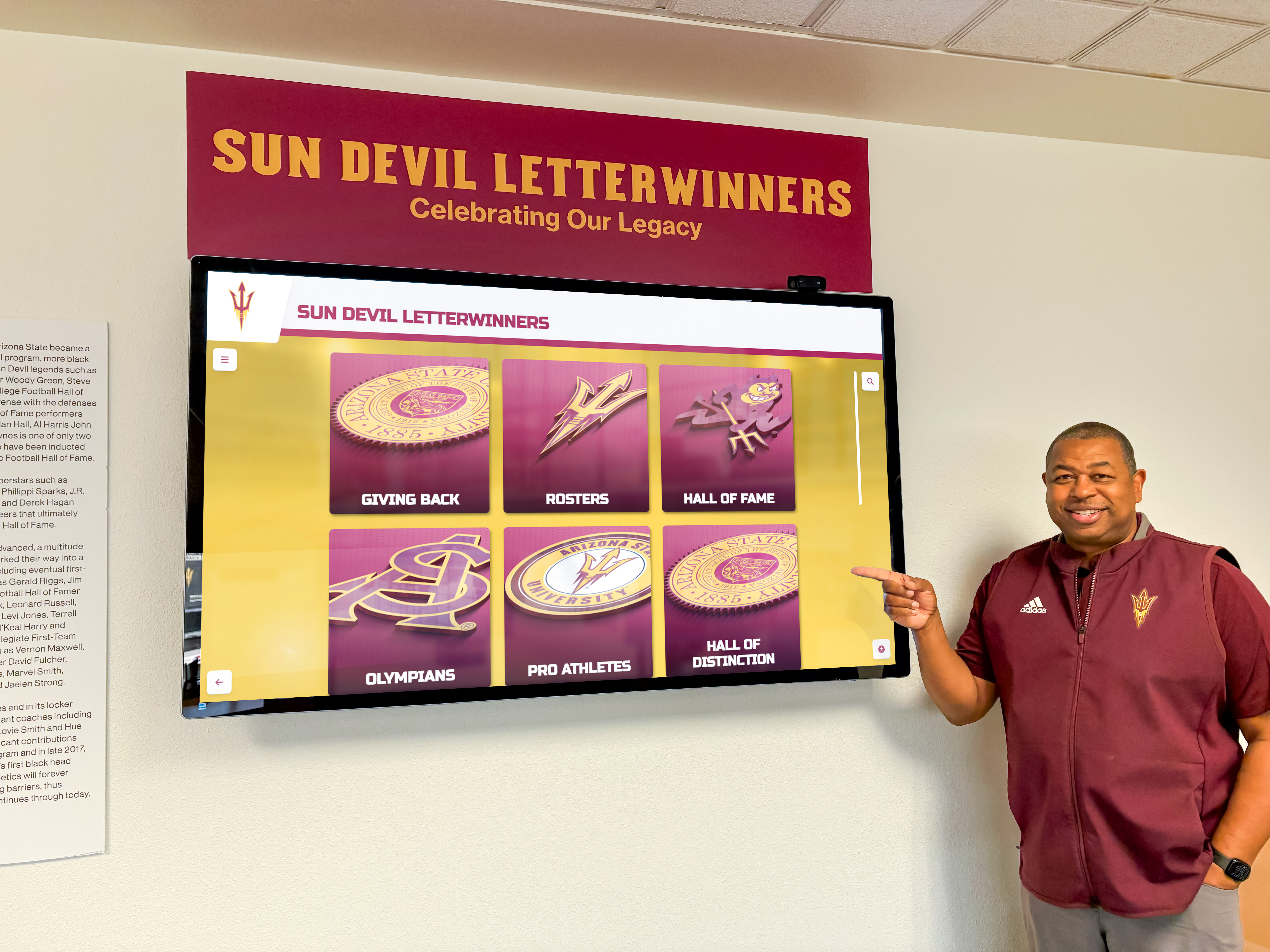
A dedicated letterwinners display gives varsity athletes the institutional visibility their careers deserve — far beyond a shadow box at home
What Makes a Letterman Jacket Display Meaningful
A letterman jacket display that honors a varsity career does more than hold the garment flat. It contextualizes: placing the jacket within a season, a team, and a school history. The difference between a meaningful display and a storage solution comes down to narrative depth.
The Elements That Tell the Full Story
The jacket alone communicates the school, the sport, and roughly the era. Add each of the following layers and the story becomes specific enough to matter:
Athlete identity and season record
- Name, graduation year, and sport(s)
- Season statistics or performance records specific to that athlete
- Position and jersey number
- Years of varsity participation
Visual documentation
- Action photos from games or meets, ideally across multiple seasons
- Team photos showing where the athlete fit within the roster
- Photos from award ceremonies, senior nights, or banquets
- Candid images capturing program culture beyond competition
Awards and recognition markers
- Individual awards earned during varsity seasons (MVP, most improved, team captain)
- All-conference, all-state, or other external recognition
- Academic achievement markers if the jacket includes honor roll or NHS chenille
Program artifacts
- Seasonal game programs or schedules from championship or milestone years
- Tournament brackets or playoff records
- Newspaper clippings or program publications documenting key performances
When a display includes this range of material, viewers — teammates, family members, prospective athletes, or returning alumni — can reconstruct the season and understand exactly what the jacket represents. That specificity is the difference between a keepsake and an archive.
Beyond the Shadow Box: Display Options for Schools and Families
Shadow boxes became the default letterman jacket display solution because they are accessible and inexpensive. A framed case with a backing board works well for a bedroom or family room. But schools creating displays for hallways, trophy rooms, or athletic facilities need formats that can hold more material and withstand higher foot traffic.
Trophy Case Integration
Many schools already maintain trophy cases or athletic display cases in main corridors or gymnasium lobbies. Integrating a letterman jacket display into this infrastructure places individual achievements within the broader program context — a 1998 state championship jacket displayed alongside the trophy from that season, surrounded by team photos and the record board from that year.
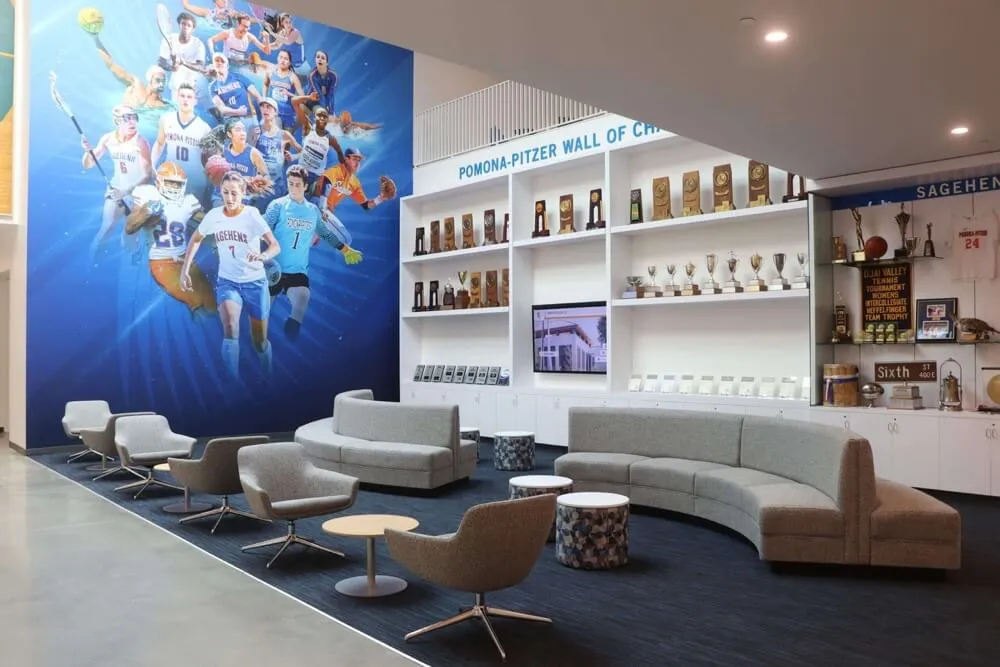
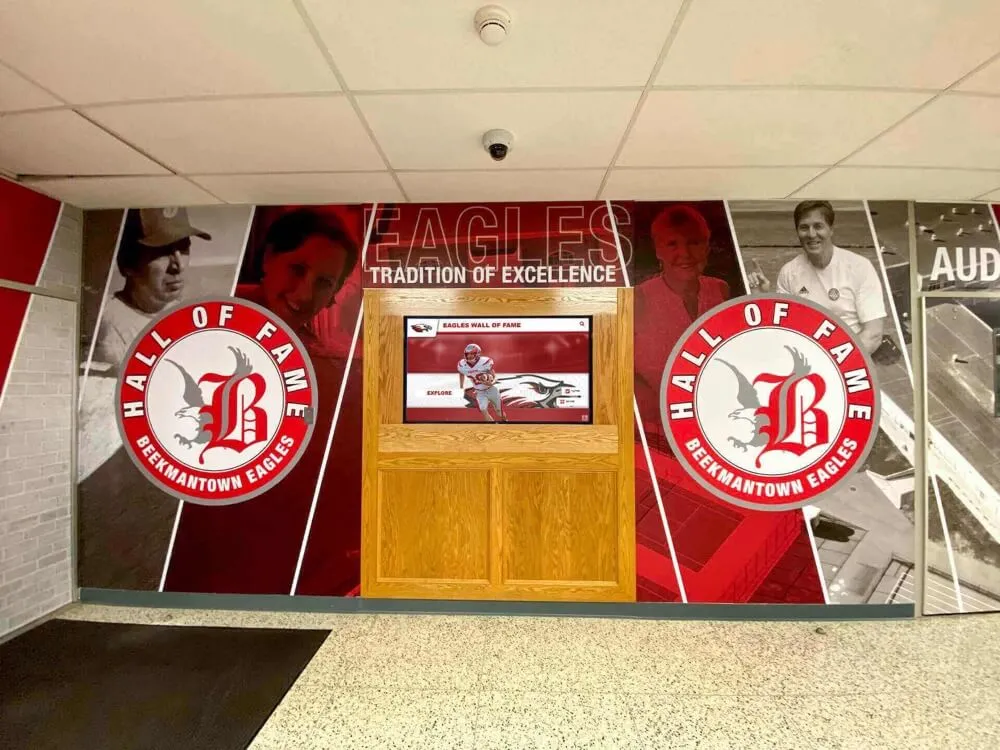
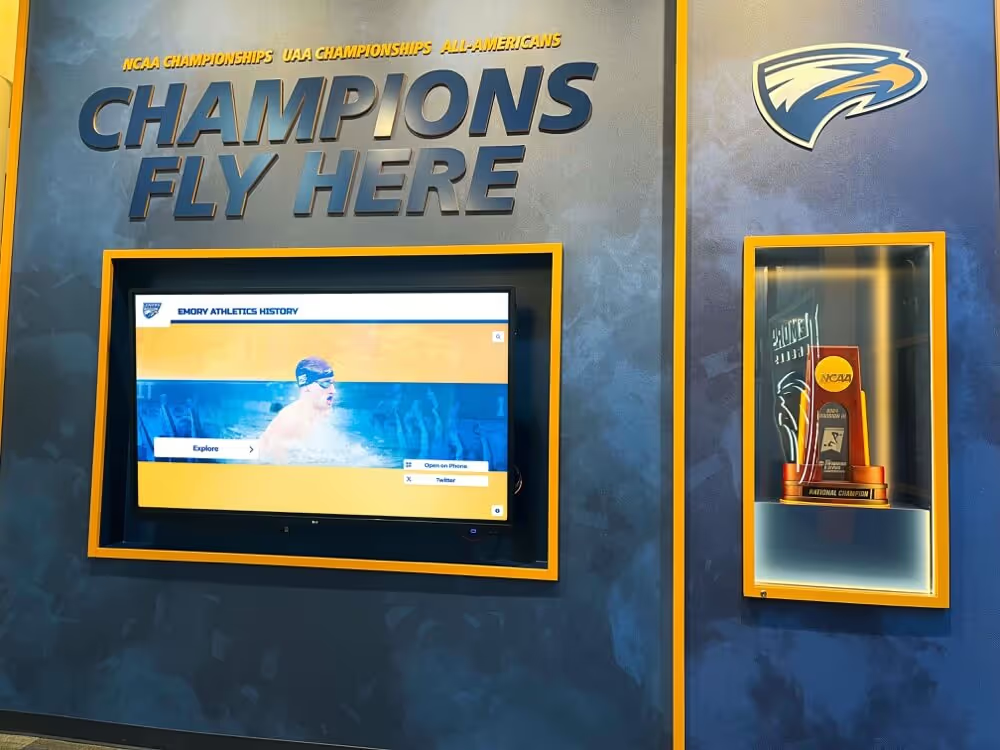
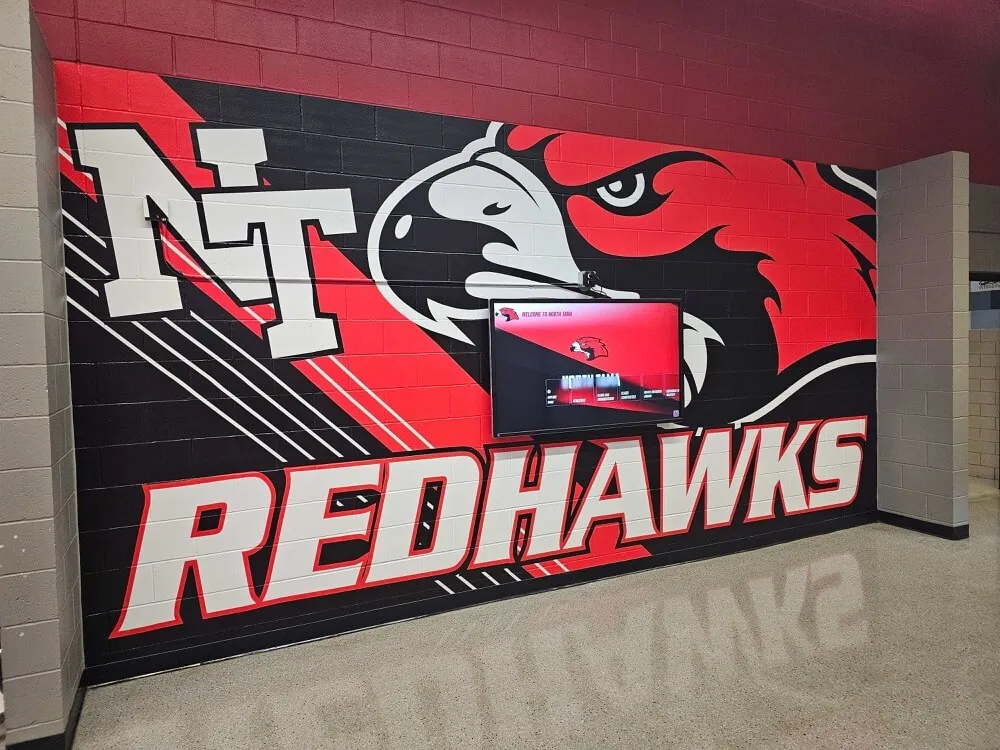
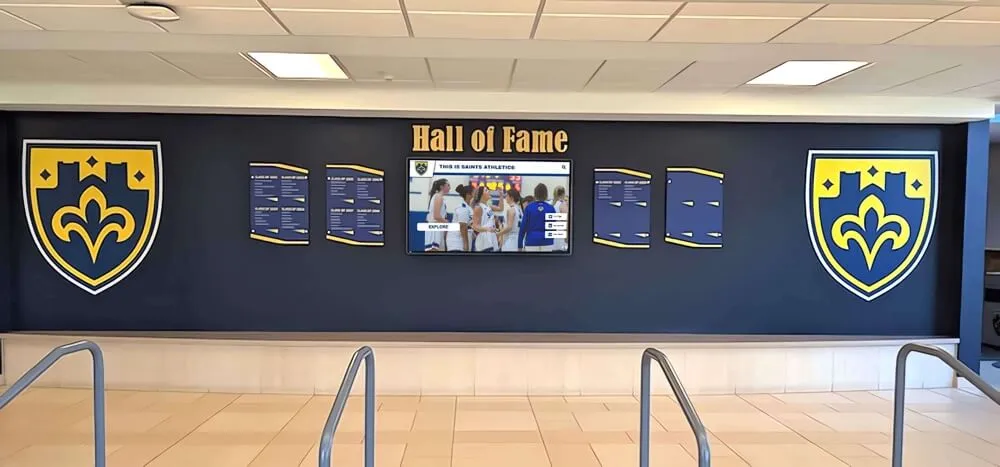
Trophy wall environments create natural homes for letterman jacket displays — situating individual varsity careers within the larger program story
Effective trophy case integration for letterman jackets typically includes:
- A sturdy rear-mount mannequin form or hanger system that displays the jacket at full shape without stress on seams or shoulders
- Adjacent framed panels for photos and artifacts
- Engraved or printed labels identifying the athlete, seasons, and key accomplishments
- Acrylic or glass front panels that allow visibility while limiting dust accumulation
- UV-filtering materials to reduce fading of both fabric and photographs
Schools looking for structural guidance on how game programs and printed artifacts fit into these displays can find useful context in this overview of game day program templates — the same design principles that shape a readable game program apply to making a display’s supplementary materials clear and organized.
Dedicated Letterman Wall Displays
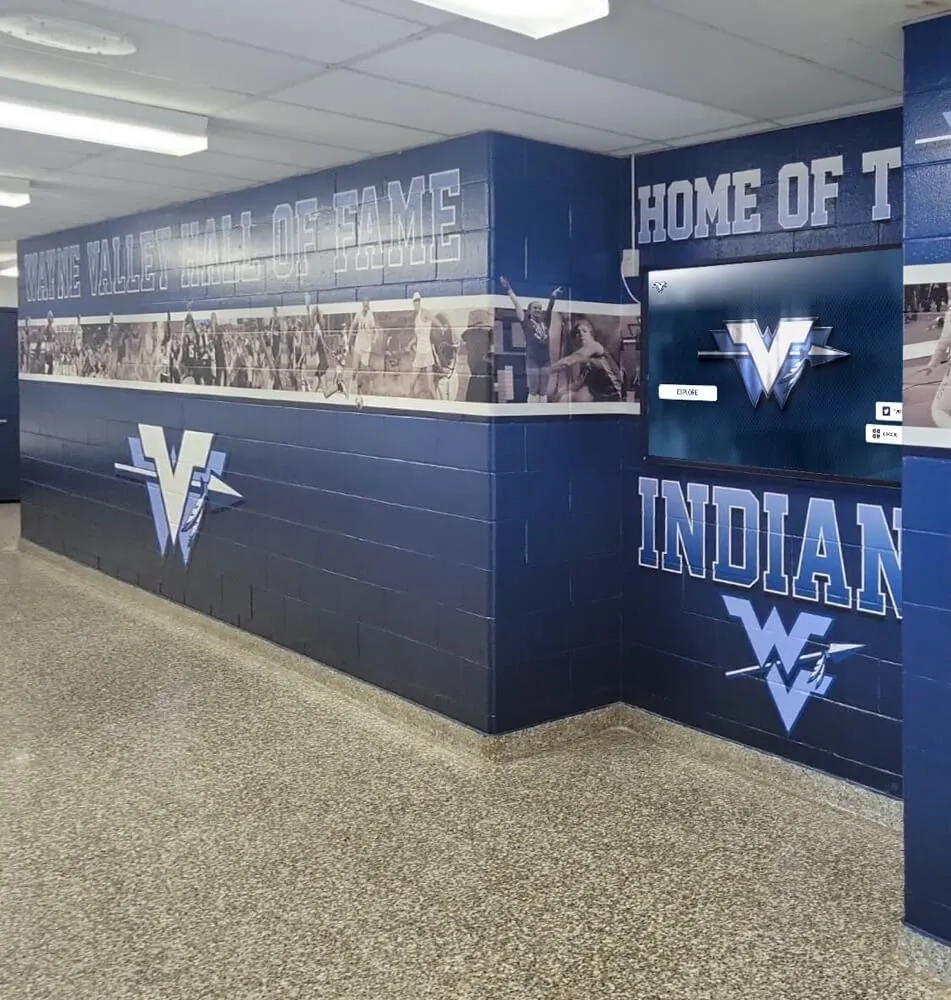
Some programs — particularly those with long traditions or large numbers of varsity letterwinners — create dedicated letterman display walls rather than integrating individual jackets into general trophy cases. These installations function as visual halls of fame organized around the varsity letter itself.
A well-designed letterman wall might include:
- Jacket display mounts organized by graduation decade
- Individual panels for each athlete with name, sport, years, and a brief achievement summary
- A photographic timeline showing uniform and jacket design evolution across decades
- A central case for particularly significant jackets — a four-sport athlete, a record-breaking senior, a state champion
This format also creates an obvious annual tradition: each graduation year adds its letterwinners to the wall, building a cumulative record that grows more compelling with each cohort. Programs with three or four decades of documentation have a genuinely powerful institutional archive on display.
Home Display Options That Go Further Than a Standard Shadow Box
Families seeking a more complete home display than a shadow box can draw on the same principles:
- Custom display cases with depth sufficient to hold a mounted jacket alongside framed photos and artifacts
- Wall-mounted clear acrylic frames that hold the jacket at full display without a backing board, creating a floating effect that shows the full garment including back embroidery
- Framed triptych panels pairing a jacket-mounted centerpiece with flanking frames holding season photos, stats, and program memorabilia
- Archival storage boxes for off-display preservation, used alongside a rotating display that brings different season artifacts to prominence
The key in any home display is maintaining the jacket as a focal point while giving the surrounding material enough space to tell the seasonal story — rather than forcing everything into a single 16×20 frame that can hold only the jacket and one or two photographs.
Preservation Checklist: Protecting a Letterman Jacket for Long-Term Display
Whether displayed in a school hallway or a family room, a letterman jacket requires deliberate preservation care. Wool, chenille, and leather deteriorate at different rates and respond differently to light, humidity, and handling. The following checklist addresses the most common preservation risks.
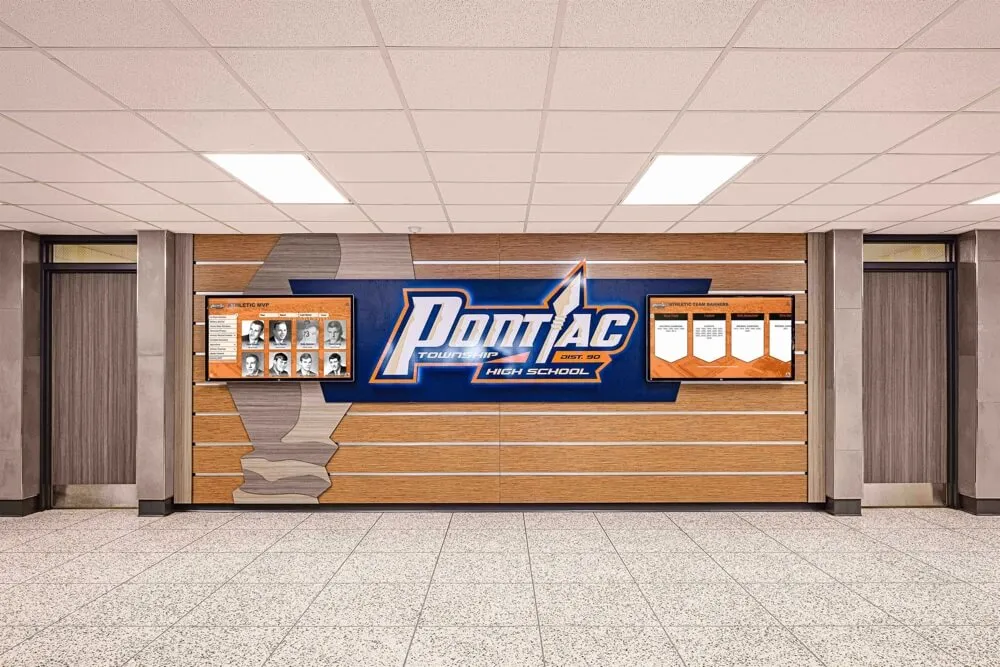
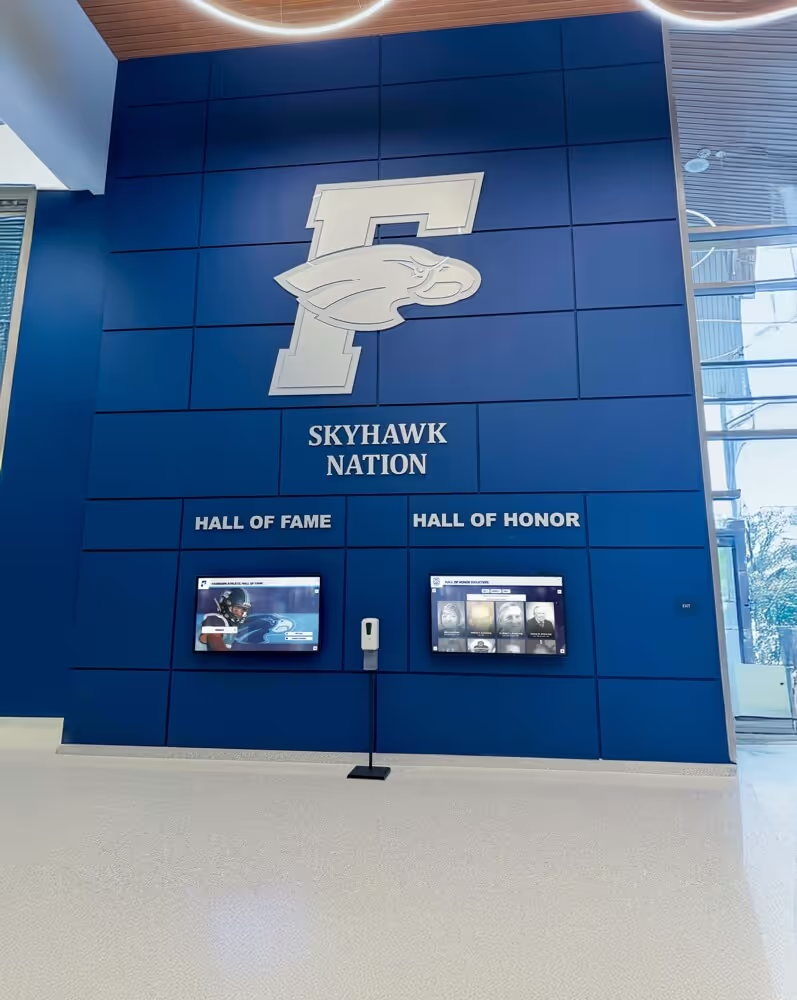
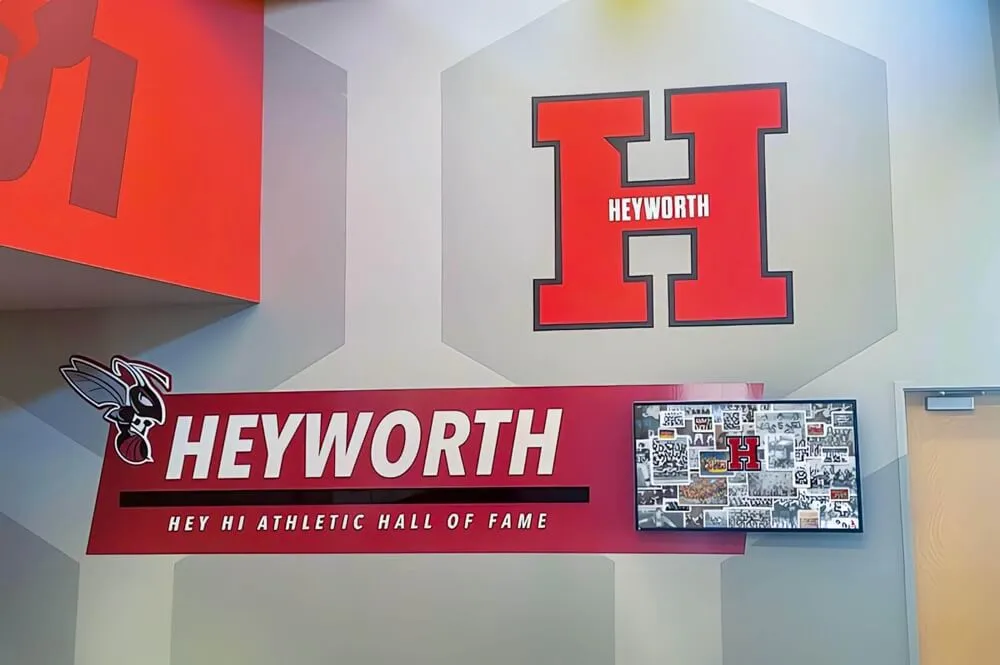
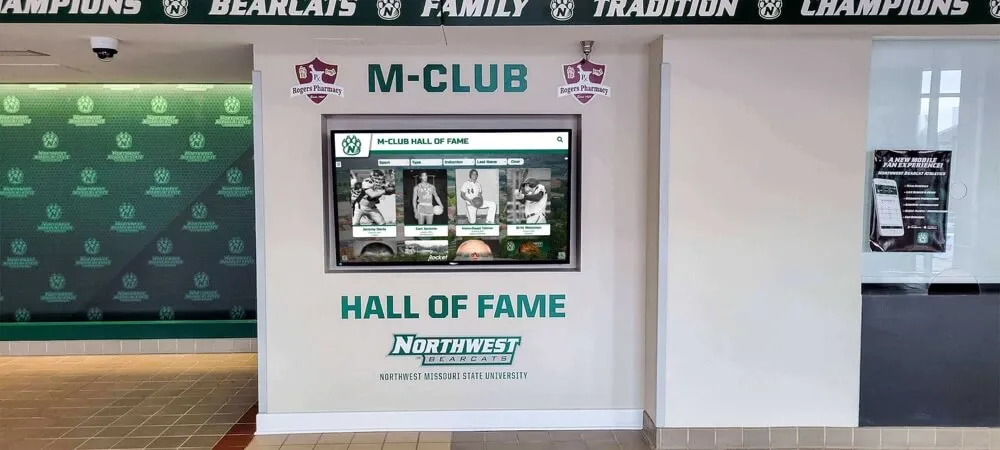
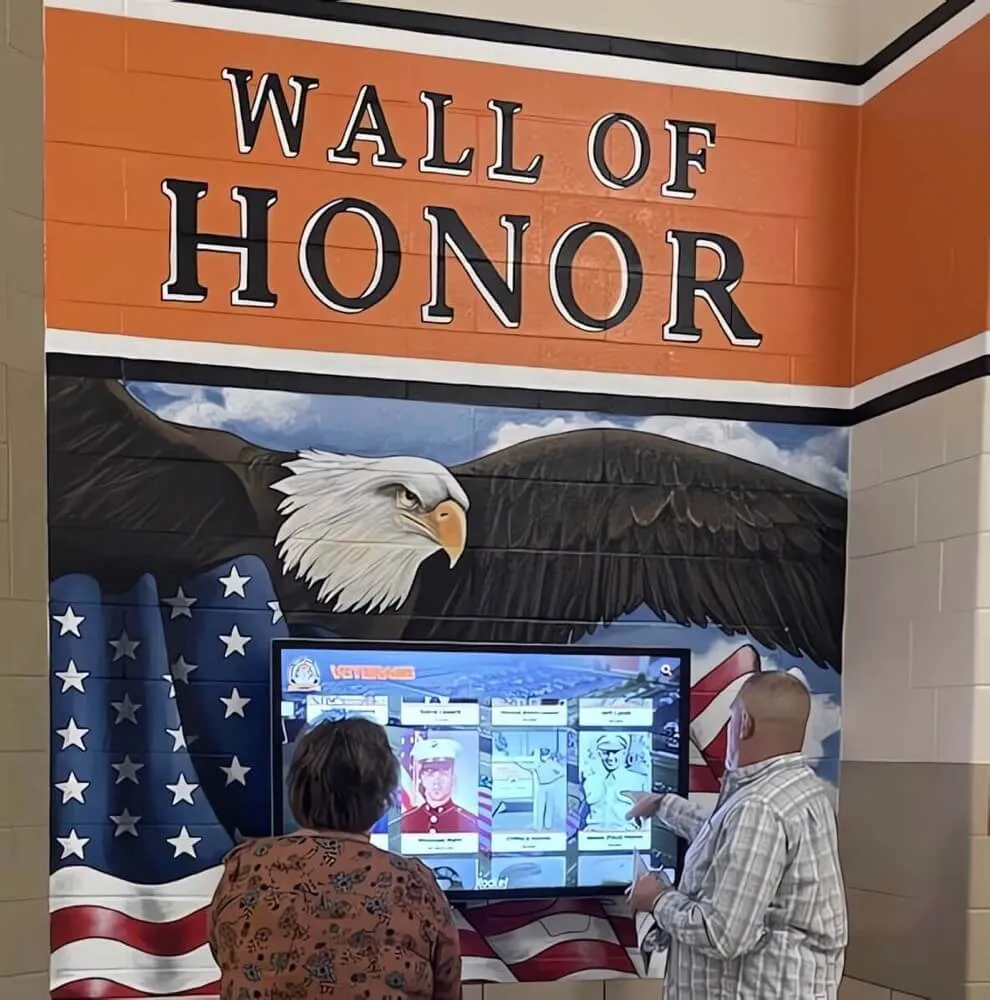
Long-term honor wall installations require the same preservation attention as individual jacket displays — light, humidity, and material choices all affect longevity
Cleaning and Preparation
- Have the jacket professionally cleaned before display — home washing can shrink wool bodies and damage leather sleeves
- Address any existing stains or damage before mounting, as display conditions can accelerate deterioration in damaged areas
- Remove any non-original pins, buttons, or decorations not permanently attached — store these separately in archival envelopes labeled with the jacket owner’s name and year
- Photograph all chenille letters, patches, and embroidery in detail before mounting, creating a digital record of the jacket’s surface at the time of display
Display Conditions
- Keep direct sunlight off the display — UV exposure fades both wool and chenille within years even at modest exposure levels
- Install UV-filtering glass or acrylic if the display is in a sun-exposed location
- Maintain relative humidity between 45–55% where possible — high humidity promotes mold in wool; low humidity brittles leather sleeves
- Avoid display locations near heating vents, exterior walls with condensation risk, or areas with significant temperature swings
- Ensure air circulation within the case or display frame to prevent trapped moisture
Mounting and Support
- Use a padded hanger or mannequin form that supports the jacket at the shoulders without stretching the armholes or creating stress points at seams
- Do not pin through the wool body or leather sleeves to attach supplementary materials — use adjacent panels or framing
- Hang or mount the jacket to prevent creasing at fold points — flat pressure over time degrades wool fibers
- If folding for off-display archival storage, use acid-free tissue between folds and store in an acid-free box
Photographic and Artifact Accompaniments
- Print accompanying photographs using archival inks and acid-free paper — standard inkjet prints fade significantly within 10–15 years under display lighting
- Store original photographs, programs, and newspaper clippings in acid-free sleeves; use high-quality reproductions for the display itself
- Label all photographs on the back with athlete name, date, and context using a soft pencil or archival pen — never ballpoint or felt tip directly on photographs
- Digitize all photographs and paper documents before display, creating a backup archive that survives any physical deterioration
Ongoing Maintenance
- Inspect the display annually — check for signs of moth activity in wool, cracking in leather sleeves, and fading in photographs or chenille
- Rotate supplementary materials periodically in longer-term installations, allowing different artifacts to receive display while others rest in archival storage
- Update the display when new information becomes available — athletic accomplishments are sometimes recognized years after graduation, and displays should reflect the complete record
What Schools Can Display Beyond Individual Jackets
The most compelling institutional letterman displays connect individual jackets to the broader program history they represent. A jacket worn during a championship season is more meaningful when it sits alongside documentation of that season — not just as a family keepsake, but as a chapter in the program’s ongoing story.
Schools developing athletic recognition infrastructure can draw from a wide range of materials beyond the jacket itself:
Season and Program Documentation
- Sport-by-sport records organized by year, showing where each cohort of letterwinners fell in the program’s historical arc
- Championship brackets and tournament records for seasons when lettermen contributed to title runs
- Coaching histories showing which staff supervised which generations of athletes — a connecting thread that matters to alumni revisiting their careers
The overlap between letterman jacket display and broader athletic records display is significant. Programs already investing in medal and trophy display options will find that the same case infrastructure adapts readily to jacket and artifact display, reducing the cost and space footprint of building a complete athletic recognition environment.
Photo Archives as Display Anchors
Team photographs organized by graduating class create a natural complement to jacket displays — the jacket marks the individual, the team photo places that individual within the cohort, and the season record contextualizes both. Schools that have systematically photographed every team over decades possess an extraordinary visual archive that merits prominent display rather than archival storage.
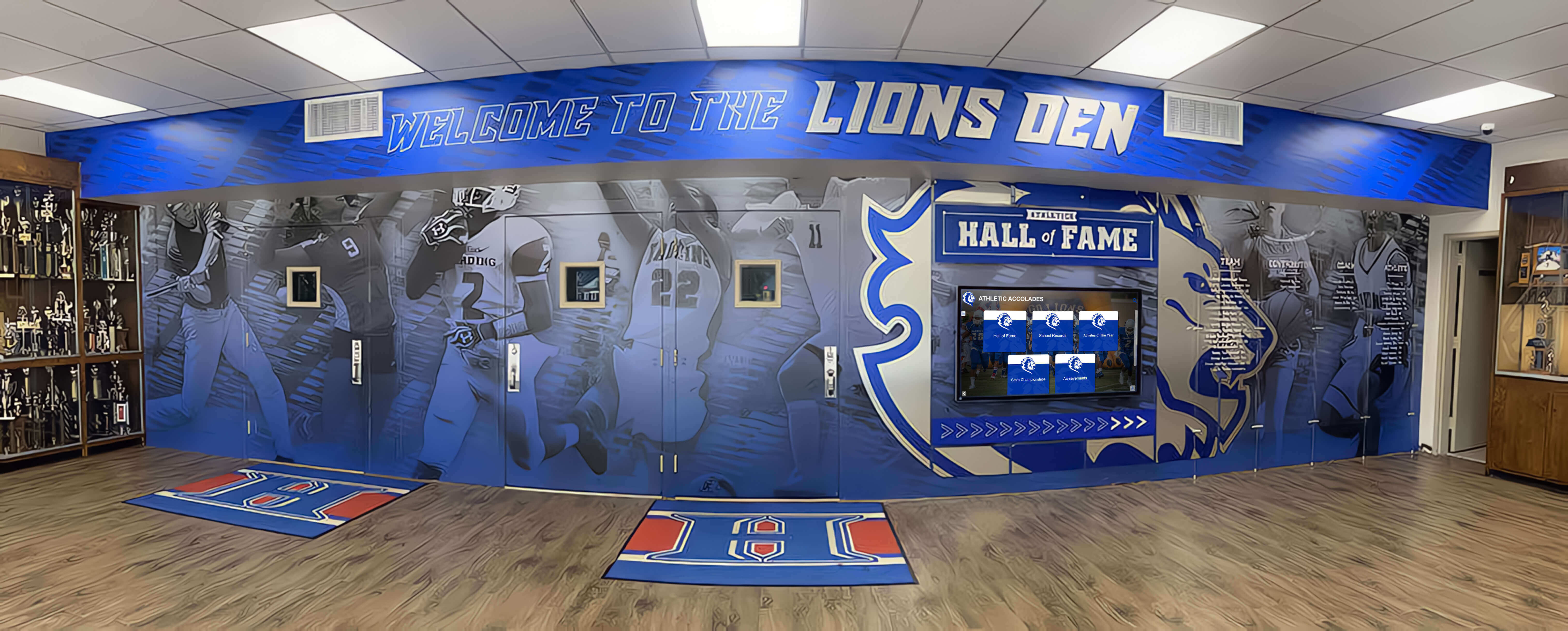
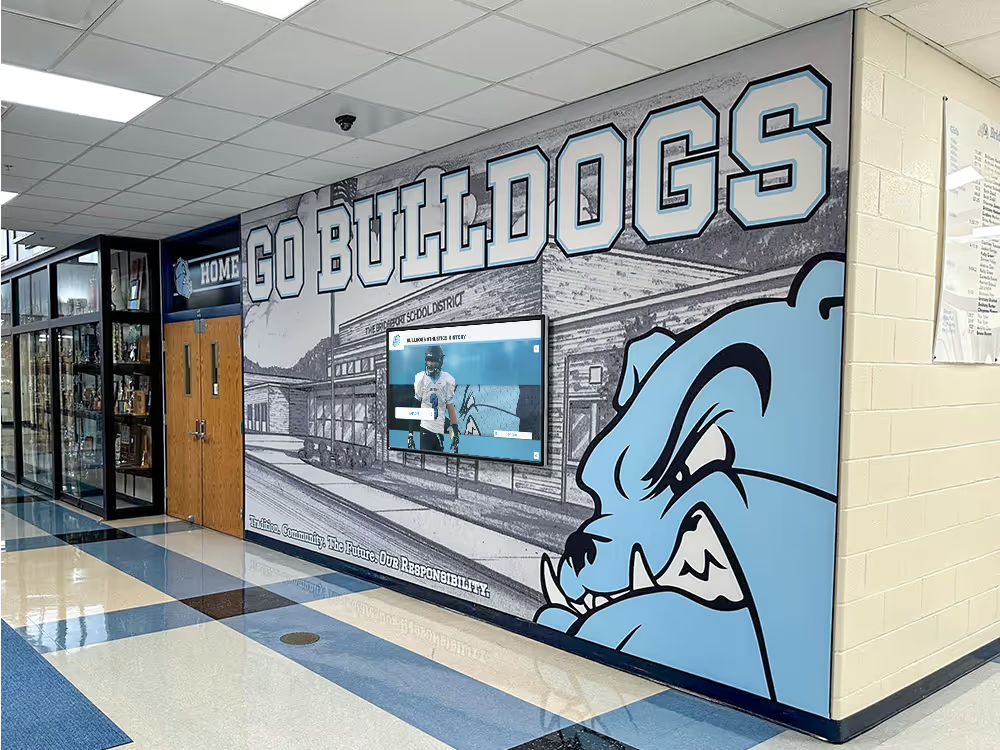
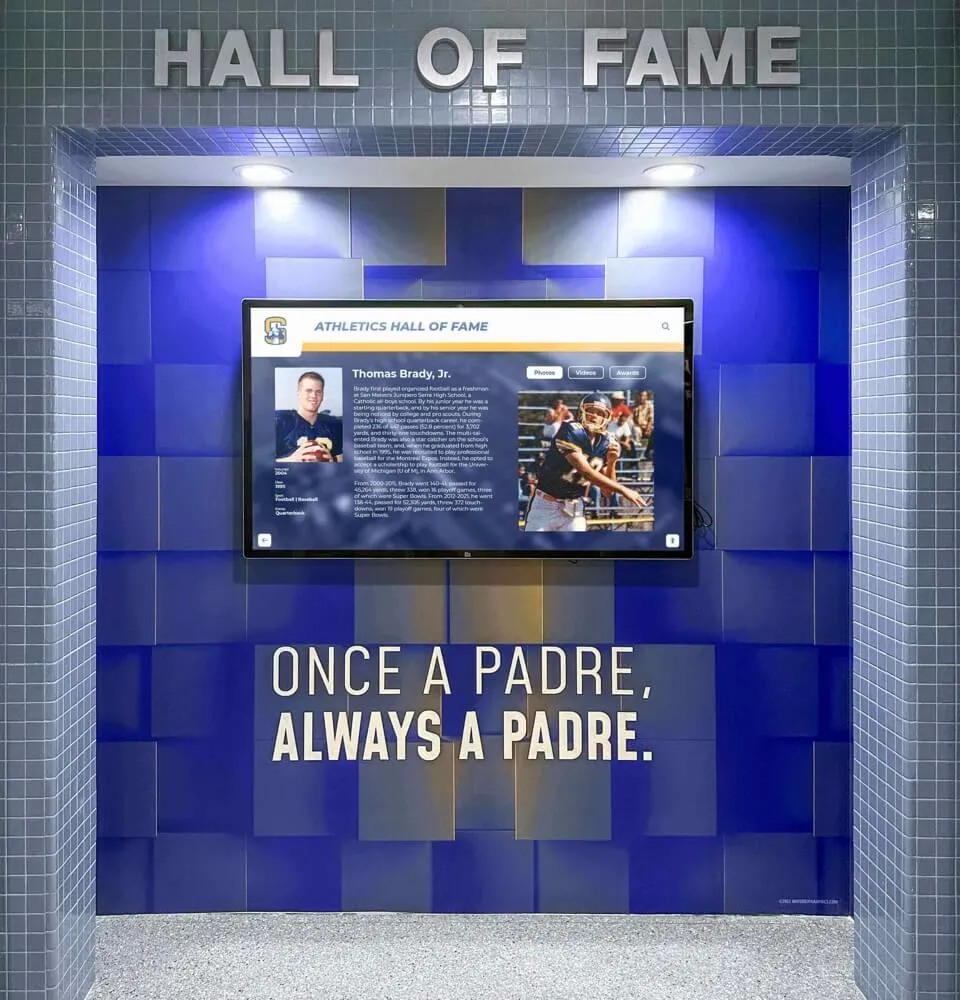
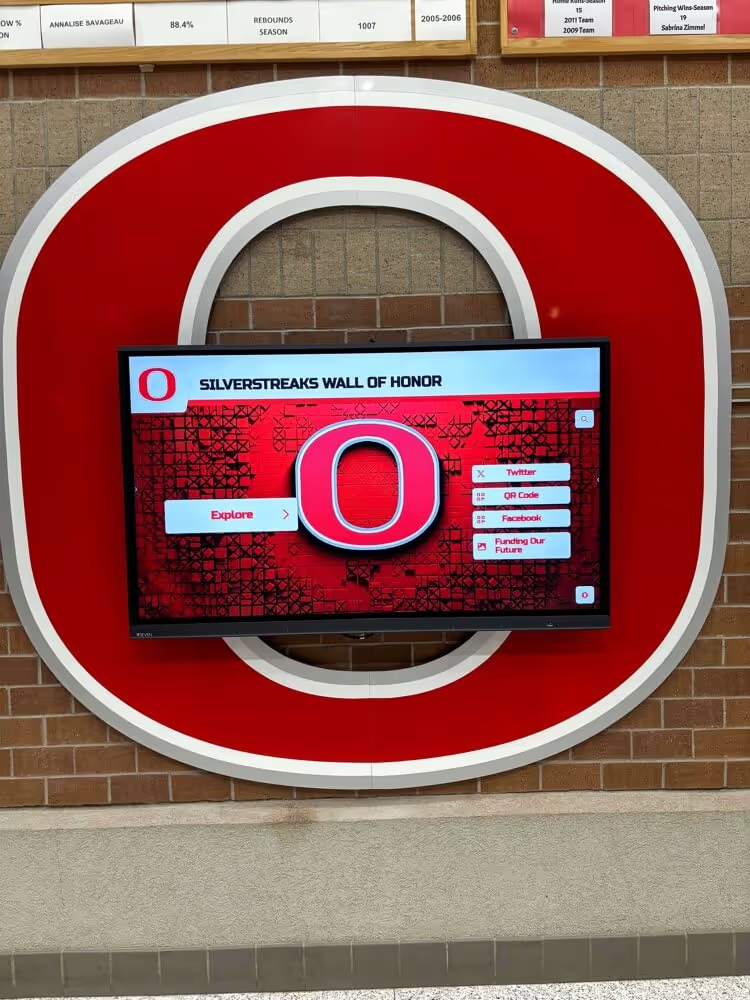
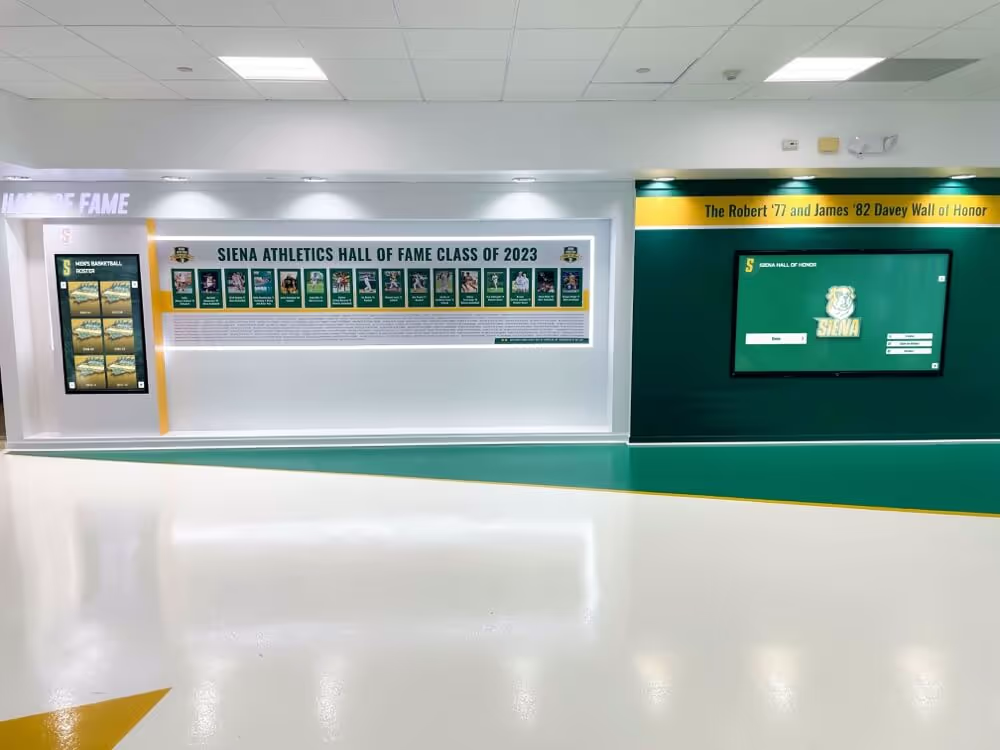
Trophy case environments that integrate murals, team photos, and individual recognition artifacts create immersive program history displays that go far beyond any single letterman jacket
Connecting to Athlete Profiles and Alumni Stories
Individual letterwinners often have stories that extend well beyond their high school careers. Collegiate athletic careers, professional accomplishments, and community contributions — when documented — add dimension to a display that otherwise captures only the high school chapter.
Programs that maintain active alumni relationships generate the kind of ongoing information that keeps letterman displays current and compelling. Alumni mentorship and recognition programs create natural channels for gathering this information and routing it back into the school’s recognition infrastructure.
Digital Extension: Taking Varsity Stories Beyond the Display Case
Physical displays of letterman jackets face a fundamental limitation: they hold a finite amount of material in a fixed space. A jacket from 2003 can display one team photo, a list of awards, and a few statistics — but not the full season’s worth of game photos, the post-graduation career arc, or the athlete’s own account of what the program meant to them.
Digital archives remove that constraint entirely.
Bring Your Varsity Legacy to Life on a Touchscreen
Rocket Alumni Solutions touchscreen displays let schools build searchable, expanding archives of every letterwinner — with photos, stats, seasons, and stories that no shadow box can hold. See how an interactive archive transforms your athletic hallway.
Request a DemoWhat a Digital Archive Adds to a Physical Display
An interactive digital archive installed alongside or in place of a traditional display case enables capabilities that physical formats cannot match:
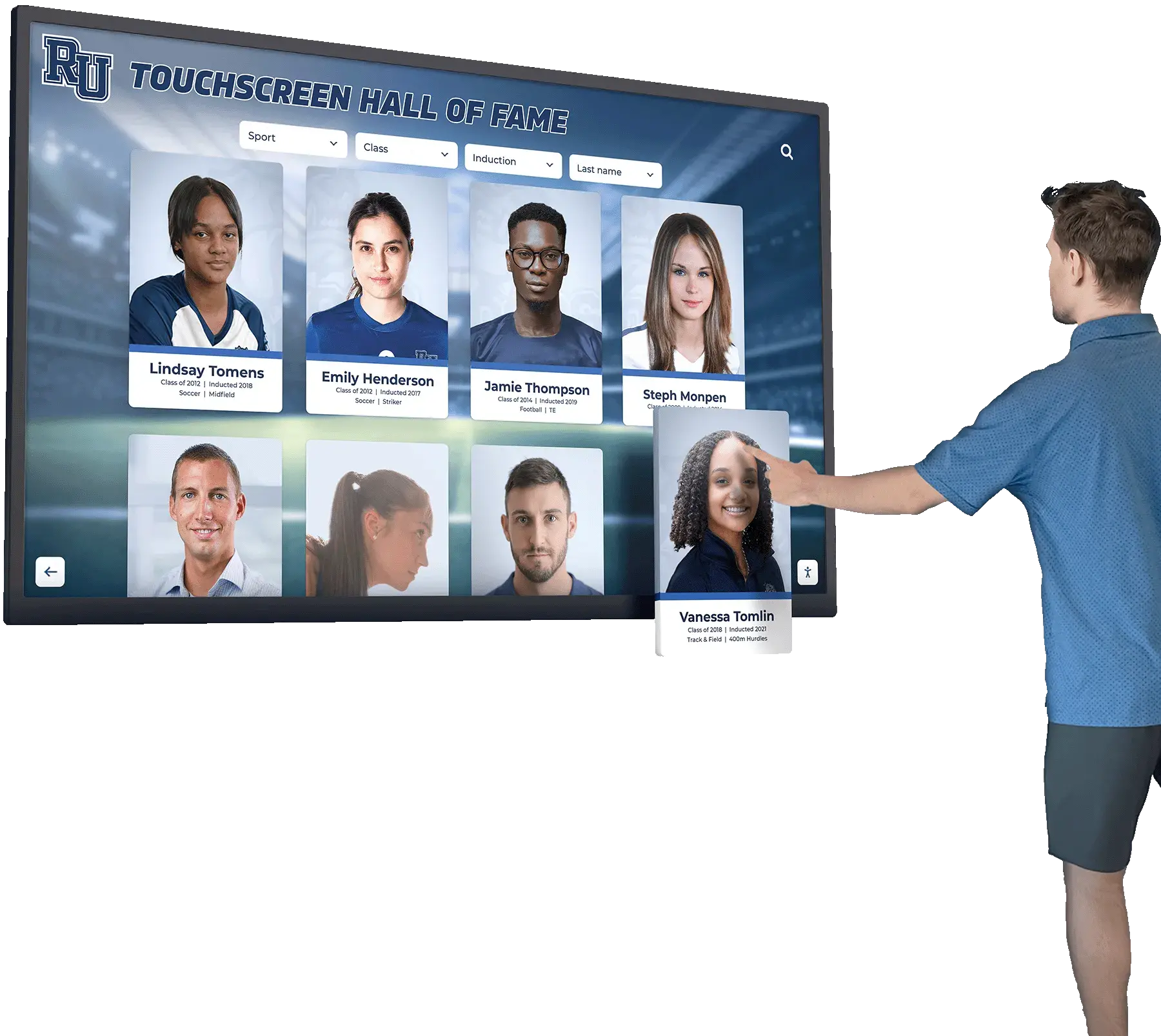
Unlimited depth per athlete Each letterwinner can have a dedicated profile with full-season statistics, multiple photographs, action video clips, awards history, post-graduation updates, and narrative biography — without any of that material competing for physical space with anyone else’s record.
Searchability across decades A visitor can search by sport, graduation year, jersey number, or award type and immediately surface every matching athlete across the program’s full history. That kind of cross-cohort exploration is impossible with physical displays, where a jacket from 1987 and one from 2019 occupy separate cases on different walls.
Easy updates without reconstruction When a 2015 letterwinner earns a professional contract, a community award, or a hall of fame induction years after graduation, the digital archive updates in minutes. Physical displays require removing and reconstructing the case to add new material.
Accessibility and remote viewing Alumni who live far from the school can access the archive from anywhere. Parents attending a game encounter the display on their phones via QR code. Students exploring the facility in the off-season discover program history without needing supervised access to locked trophy cases.
Schools evaluating digital signage software for school athletic facilities will find that the most capable platforms support this kind of searchable, updatable archive rather than simply displaying static graphics on a screen.
Integrating Physical Jackets with Digital Context
The most effective approach pairs physical and digital elements rather than choosing between them. A physical letterman jacket display — with the actual garment, mounted and preserved — draws visitors through its tangibility. A companion touchscreen installed adjacent to the case provides the depth the physical format cannot hold.
That pairing is increasingly common in well-resourced athletic facilities: a row of mounted jackets from significant seasons, each accompanied by a QR code or touchscreen panel that expands into the full archive for that athlete and era. The physical object invites engagement; the digital layer rewards it.
Championship trophy display traditions at the collegiate level have long combined physical objects with contextual documentation — narrating the story behind the hardware rather than letting the object speak alone. High school athletic programs that adopt the same philosophy create richer recognition environments than any static display case achieves.
Building a Complete Varsity Recognition System
Individual letterman jacket displays fit within a broader athletic recognition ecosystem that most schools are assembling across multiple years and budget cycles. Understanding where jacket displays fit in that ecosystem helps prioritize investment.
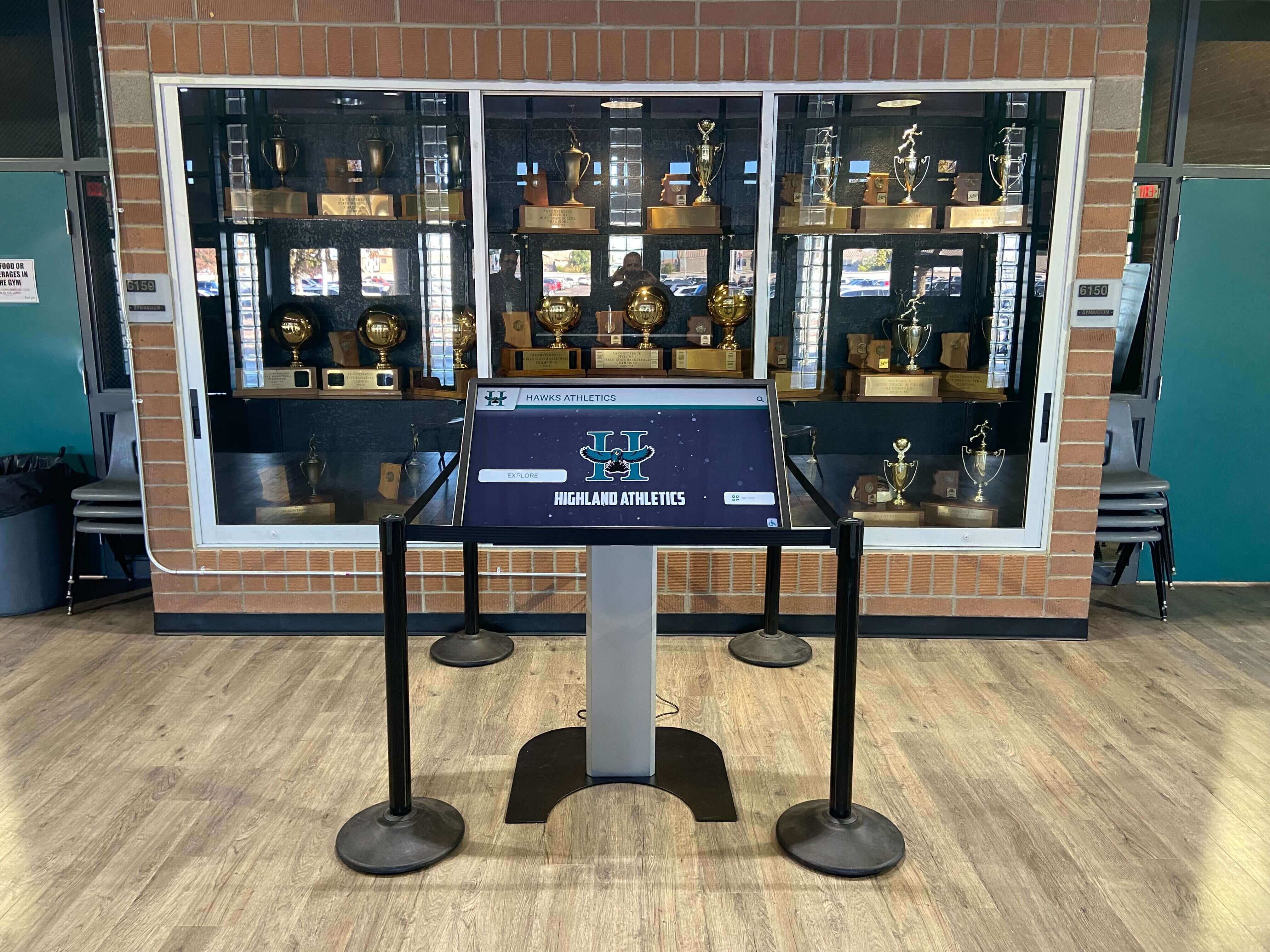
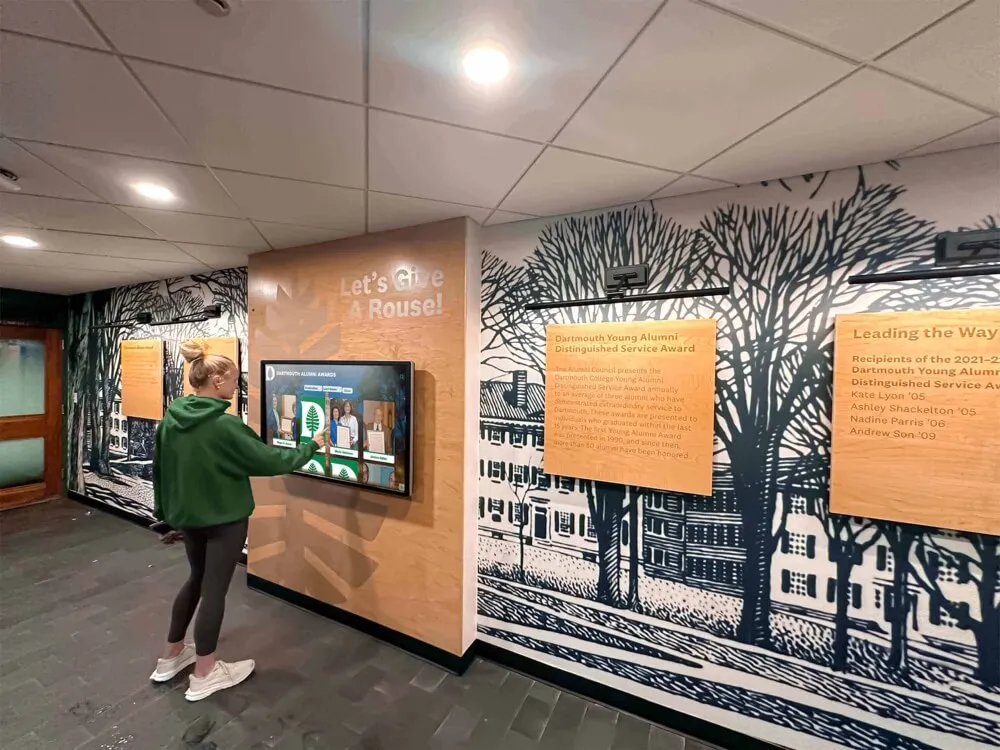
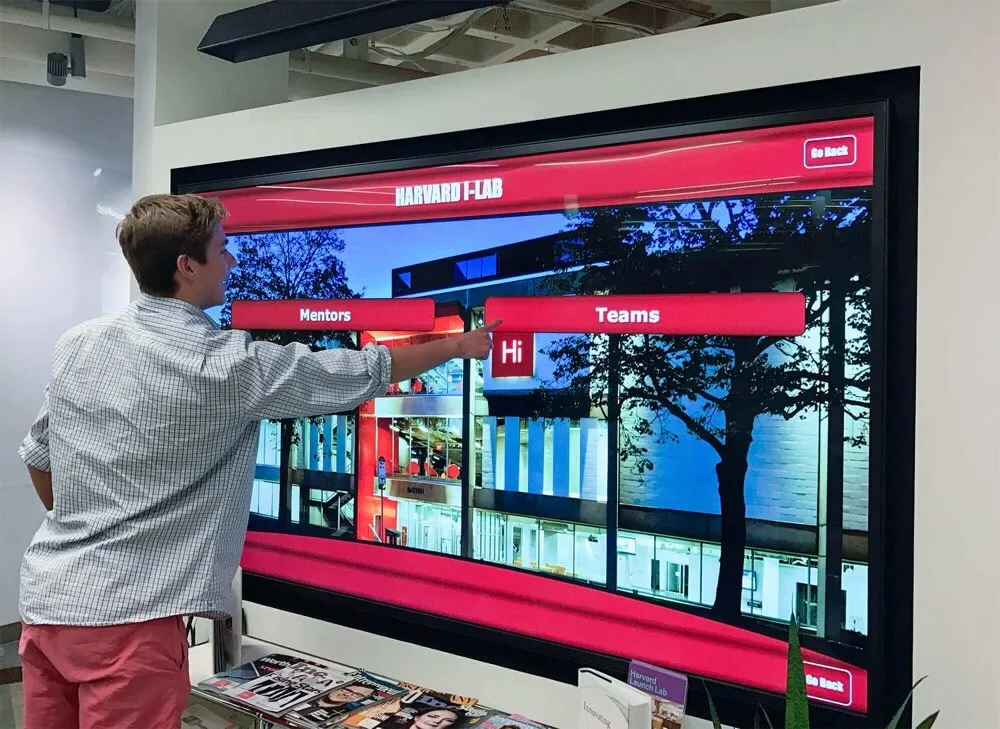
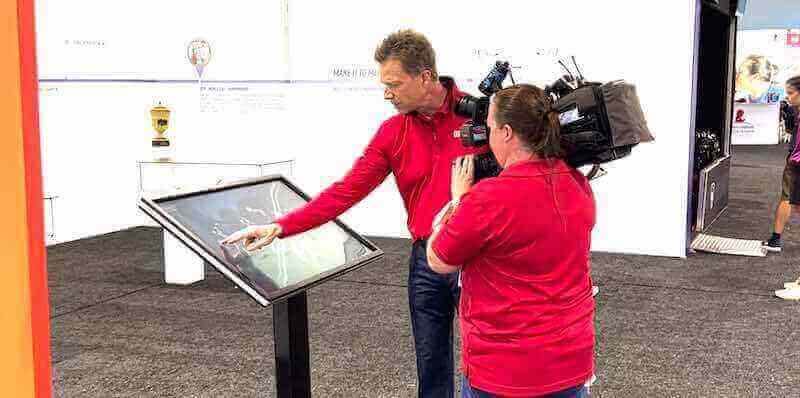
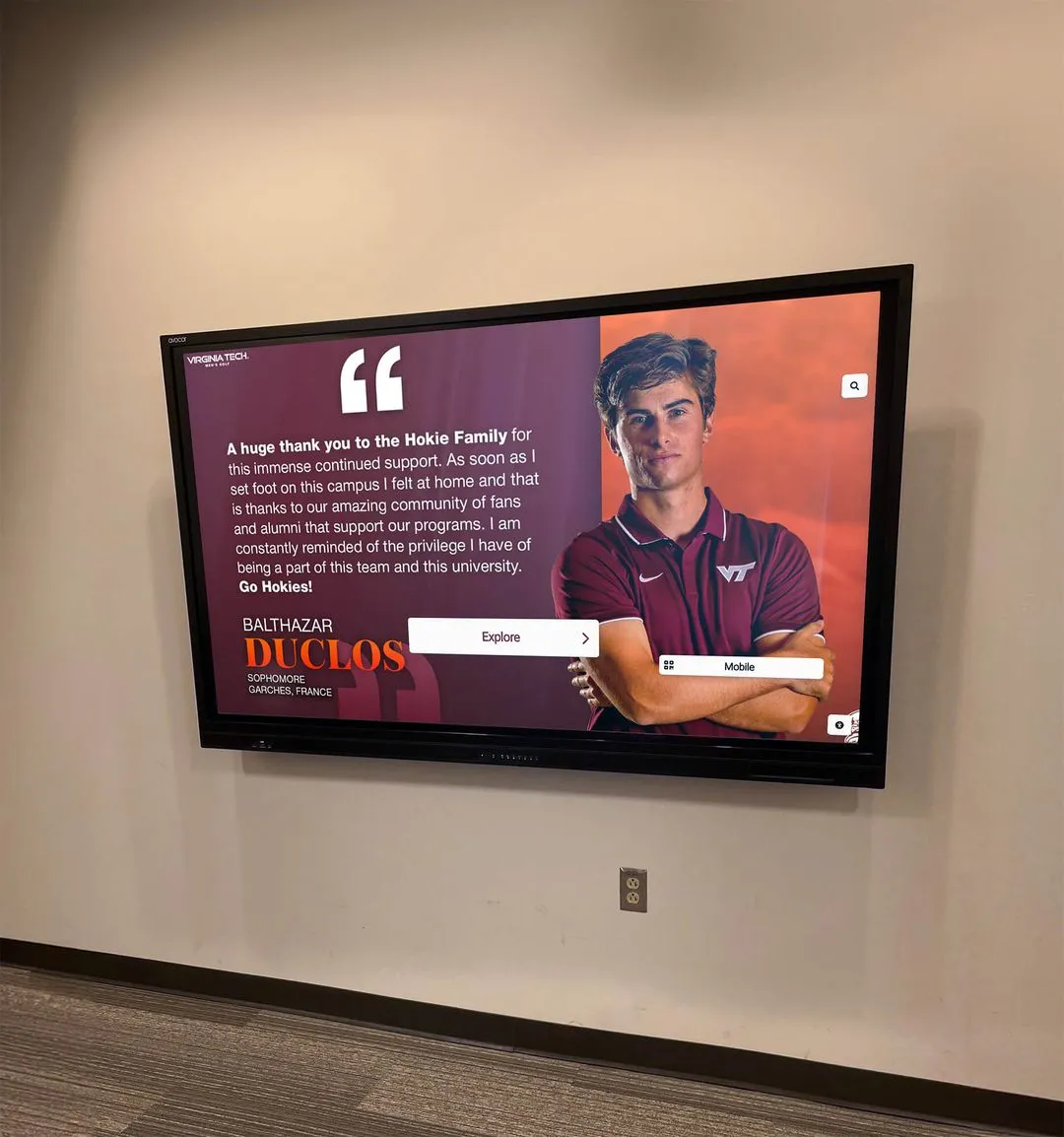
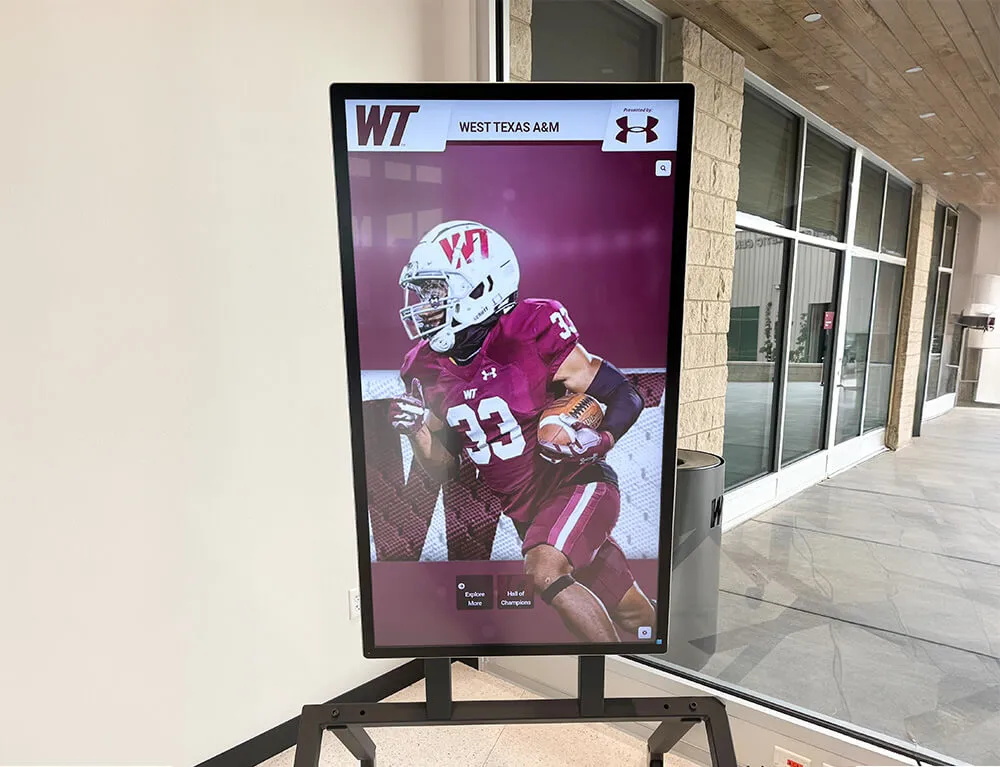
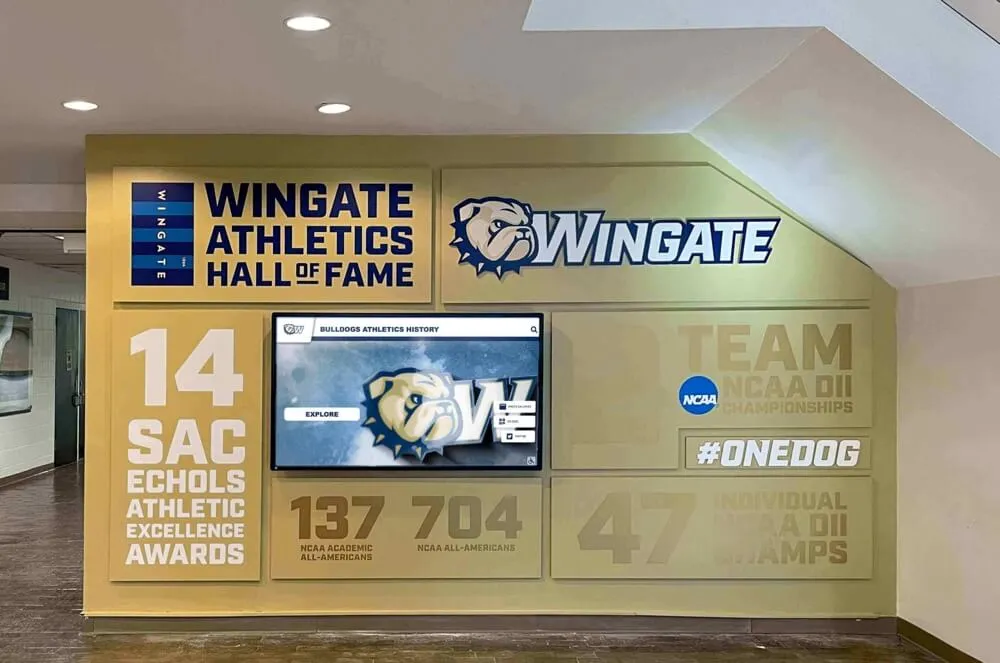
Touchscreen kiosks installed within trophy case infrastructure blend physical and digital recognition — extending the letterman jacket display into a searchable, expandable archive
A complete varsity recognition system typically includes:
- Physical display layer: Mounted jackets, trophies, championship hardware, and framed team photos in the athletic hallway or lobby
- Record board layer: Sport-by-sport records organized by event and era, updated as records fall
- Digital archive layer: Searchable touchscreen profiles for every letterwinner, team, and season
- Alumni engagement layer: Mechanisms for gathering updates from former athletes and routing recognition back to the school community
Schools developing donor recognition alongside athletic recognition find that the infrastructure overlaps significantly. A touchscreen system that handles letterwinner profiles can extend to donor recognition wall displays in the same facility — reducing per-component cost while creating a unified recognition environment that honors all contributors to the program’s success.
For programs exploring what a fully digital recognition wall looks like at scale, reviews of virtual hall of fame platforms provide useful benchmarks for evaluating the depth and flexibility of available systems.
The question of whether to invest in physical case infrastructure, digital archive systems, or both often depends on audience and program age. Programs with decades of history benefit most from digital archives that can surface the full record. Newer programs building toward that depth benefit from physical displays that create visible tradition from the beginning. Most programs at any stage benefit from both working together.
Senior Night and the Letterman Display Connection
Senior night ceremonies — the final home game recognition events for graduating athletes — create natural content for letterman jacket displays. The photos from senior night, the parent introductions, the jersey presentations, and the post-game celebration all represent documentation that families cherish and that programs can incorporate into permanent displays.
Schools that photograph and archive senior night materials systematically give themselves a built-in source of display-ready content for every graduation class. Senior night ideas for basketball and other sports consistently include photo and memory elements — and the best programs route that material directly into the institutional archive rather than letting it live only in parents’ camera rolls.
A letterman jacket displayed alongside a well-curated set of senior night photographs represents a more complete record of the athlete’s final season than the jacket alone — and creates exactly the kind of display that returning alumni stop to examine when they visit the facility years later.
Schools and Athletic Directors: A Display Planning Framework
Athletic directors and school administrators managing a first letterman jacket display initiative — or revitalizing an existing one — benefit from a structured approach:
Step 1: Inventory existing materials Survey current athletic storage for jackets, photographs, game programs, and artifacts that could anchor displays. Many schools possess decades of archival material that has never been formally organized or displayed.
Step 2: Prioritize high-significance items Championship seasons, multi-sport athletes, record-setters, and first-generation letterwinners all represent natural anchors for early display investment. Starting with the most significant items creates immediate impact and builds community support for expanding the display.
Step 3: Establish documentation practices going forward Whatever the starting point, put systems in place to document current letterwinners in a way that supports future display: consistent senior-year photography, formal records collection, and digital archiving of season materials.
Step 4: Identify display infrastructure needs Assess available space — hallway cases, lobby walls, trophy rooms — and determine what mounting, lighting, and case infrastructure is needed to display the highest-priority materials.
Step 5: Plan the digital complement Identify which digital archive system will receive the records being created and preserved, and ensure that physical display decisions are compatible with eventual digital integration.
Schools investing in comprehensive recognition and donor display systems often find that the planning process for donor walls and athletic recognition walls is nearly identical — and that the two can be developed in parallel with shared infrastructure to serve both purposes efficiently.
Conclusion: The Jacket Is the Beginning, Not the End
A letterman jacket represents earned achievement. But displayed alone — unaccompanied by photographs, records, team context, and the story of a season — it communicates only that someone once earned a letter. The full story of what that letter meant, what it cost, and what it stood for requires deliberate preservation effort from both families and schools.
Physical preservation — proper mounting, UV protection, archival-quality accompaniments — protects the garment and artifacts for decades. Thoughtful display context — photographs, season records, award documentation, team materials — gives viewers the information needed to understand what they are looking at. And digital integration, through touchscreen archives that extend the display into searchable, expanding records, ensures that no varsity career is constrained by the physical limits of a case or frame.
The letterman jacket display is an entry point. What it opens into — a season, a program, a generation of athletic achievement — is the story worth preserving.
Build the Varsity Archive Your Letterwinners Deserve
Rocket Alumni Solutions touchscreen displays help schools create permanent, searchable athletic archives that expand every letterman jacket display into the full story — photos, stats, seasons, records, and alumni updates that no shadow box can hold. From trophy case kiosks to full hallway installations, see how interactive archives transform how schools honor their varsity legacy.
Request a Demo