



Every season, teams across sports face a significant question: which player contributed most to our success? The Most Valuable Player award represents one of sports’ highest individual honors, recognizing athletes whose impact transcends statistics to define team achievement. Whether presented at youth recreation leagues, high school athletic programs, or professional sports, MVP awards hold unique meaning—celebrating not just excellent performance, but the indispensable contributions that elevate entire teams.
Understanding what “MVP” truly means requires examining the award’s rich history, the criteria teams use for selection, and the enduring impact this recognition creates. From the professional leagues that popularized the concept to today’s school athletic programs adapting selection methods, MVP awards honor excellence while sparking passionate debates about value, contribution, and what makes a player truly essential.
This comprehensive guide explores the MVP award’s meaning, history, and selection processes, providing athletic directors, coaches, and program administrators with insights to implement meaningful recognition that celebrates genuine value while creating lasting traditions.
The phrase “Most Valuable Player” appears simple on its surface—identifying the single athlete most critical to team success. Yet determining value proves remarkably complex, balancing statistical excellence against leadership, measurability against intangibles, and individual achievement against team context. This complexity makes MVP awards both prestigious and perpetually debatable, creating recognition conversations that extend far beyond trophy presentations.

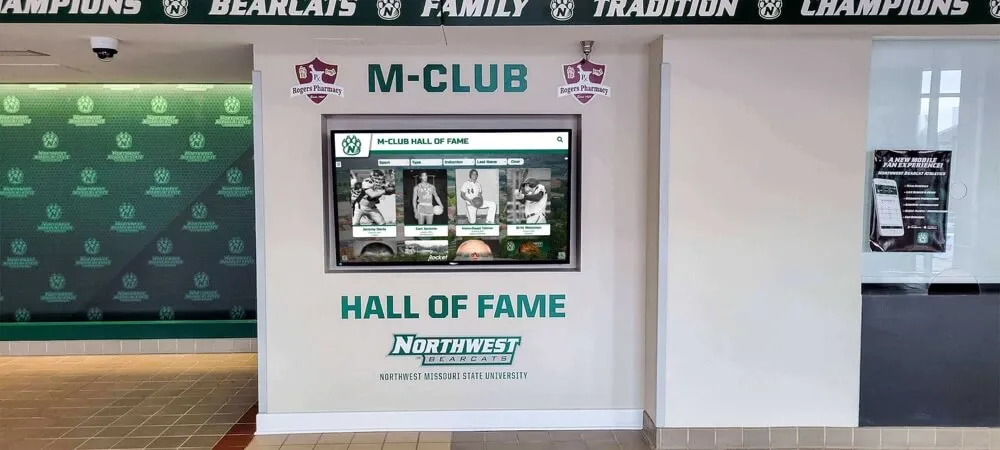
Modern recognition systems honor MVP award winners alongside championship achievements, creating comprehensive program histories
What Does MVP Stand For? Understanding the Award
The MVP acronym stands for “Most Valuable Player,” an honor bestowed upon the athlete deemed most essential to their team’s success during a specific season or competition.
Defining “Value” in Athletic Context
Value extends beyond simple performance metrics to encompass comprehensive team contribution:
Statistical Excellence
Measurable performance provides objective value indicators:
- Points, goals, or scoring leadership
- Assists and play-making contributions
- Defensive statistics and impact measurements
- Efficiency ratings and advanced analytics
- Position-specific performance metrics
- Game-changing plays and clutch performances
Leadership and Intangibles
Non-statistical contributions define complete value:
- Team captain responsibilities and vocal leadership
- Locker room presence and team chemistry building
- Practice intensity setting standards for teammates
- Mentorship of younger or developing players
- Competitive drive elevating team performance
- Mental toughness in pressure situations
Winning Impact
Ultimate value connects to team success:
- Correlation between player performance and team victories
- Performance in critical games and championships
- Ability to elevate teammates’ performance
- Presence-absence differential showing team dependence
- Clutch factor in decisive moments
- Championship contributions and postseason excellence
This multidimensional value definition distinguishes MVP awards from purely statistical recognitions like scoring titles or defensive player awards, requiring evaluators to assess comprehensive contribution rather than isolated excellence.
MVP vs. Other Award Categories
Understanding MVP significance requires distinguishing it from related recognitions:
MVP vs. Scoring Champion or Statistical Leader
- Statistical awards honor category-specific excellence
- MVP requires holistic evaluation across multiple dimensions
- Leading scorer might not be most valuable overall contributor
- MVP selection accounts for position, role, and team context
- Statistical leaders receive recognition separate from value assessment
MVP vs. Offensive/Defensive Player of Year
- Specialized awards focus on specific game aspects
- MVP encompasses complete game contribution
- Players might win specialized awards without MVP selection
- MVP voters weigh offensive and defensive contributions together
- Specialized awards often lead to MVP consideration
MVP vs. Most Improved Player
- Improvement awards celebrate growth from baseline
- MVP recognizes absolute contribution level
- Improving players might win both awards
- Different evaluation criteria and selection philosophy
- Complementary recognition serving distinct purposes
MVP vs. Championship/Finals MVP
- Season MVP covers entire regular season performance
- Championship MVP focuses exclusively on tournament/playoff excellence
- Some athletes excel in regular season without postseason success
- Championship environments create different value dynamics
- Many programs recognize both season and championship MVPs separately

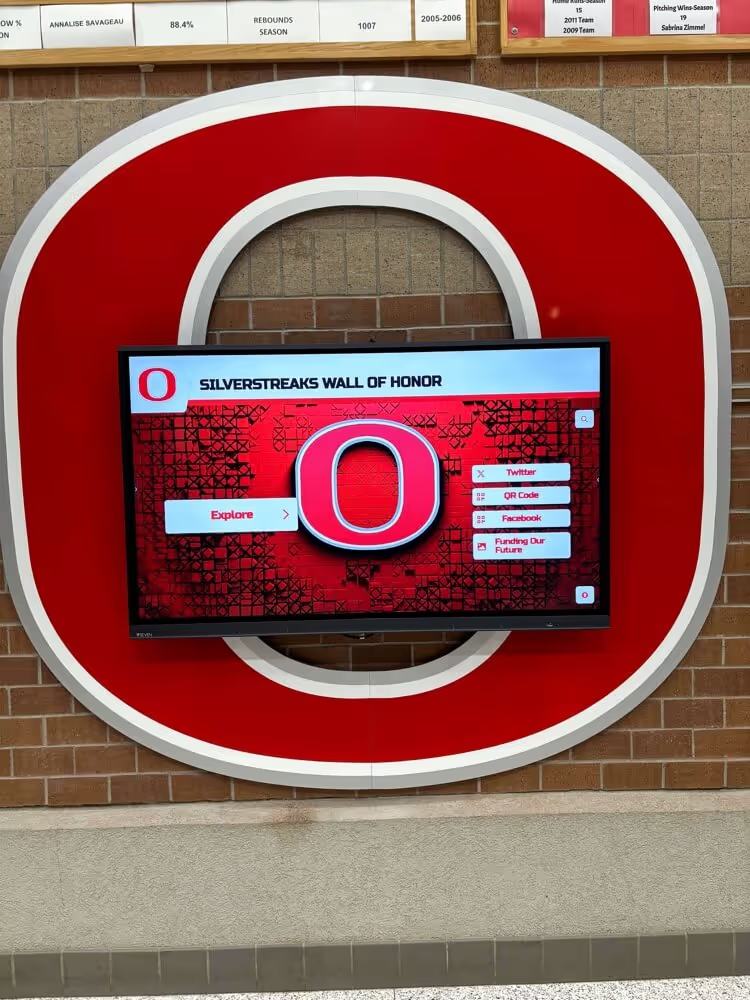
Strategic display placement ensures MVP recognition remains visible to athletes, visitors, and community members year-round
History of the Most Valuable Player Award
The MVP concept emerged from professional baseball in the early 20th century, evolving into sports’ most prestigious individual honor.
Early MVP Award Origins
The formal MVP recognition began with structured professional sports:
Baseball’s MVP Pioneer Status
Baseball established the first official MVP awards:
- Chalmers Award (1911-1914): Automobile company sponsored early MVP recognition, awarding new cars to each league’s most valuable player
- League Awards era (1922-1929): American and Baseball Writers’ Association created formal awards after Chalmers sponsorship ended
- Baseball Writers’ Association of America (BBWAA) MVP (1931-present): Established the continuous MVP tradition still maintained today with yearly awards in American and National Leagues
Baseball’s MVP award became the template professional sports subsequently adopted, establishing recognition standards and selection methodologies other leagues emulated.
Expansion Across Professional Sports
Other major sports developed parallel MVP traditions:
- NFL MVP: Began in 1957 with the Associated Press MVP Award, recognizing the league’s most outstanding player
- NBA MVP: Initiated in 1955-56 season, honoring regular season’s most valuable player
- NHL MVP (Hart Trophy): Established 1923-24, making it among sports’ oldest continuously awarded MVP honors
- MLS MVP: Created with league founding in 1996, continuing soccer’s individual excellence recognition tradition
Each league adapted MVP criteria to sport-specific demands—quarterback value differs from point guard impact, hockey’s team dynamics create different value calculations than baseball’s individual confrontations.
Evolution of MVP Selection Criteria
MVP evaluation methods evolved alongside sports analytics and cultural shifts:
Statistical Era Development
As sports measurement sophistication increased, MVP evaluation incorporated advanced metrics:
- Traditional statistics (batting average, points per game) dominated early awards
- Advanced analytics (WAR in baseball, PER in basketball, DVOA in football) provided objective value measures
- Position adjustments accounting for varying contribution opportunities
- Contextual statistics considering team quality and competitive environment
- Efficiency metrics balancing volume with effectiveness
Narrative and Context Integration
Despite statistical advances, narrative considerations remained central:
- Team success requirements (MVP candidates typically play for winning teams)
- Positional bias recognizing certain positions’ inherent value
- Clutch performance and memorable moments influencing voter perception
- Media coverage and visibility affecting recognition
- Historical precedent creating implicit evaluation standards
- Voter fatigue potentially disadvantaging repeat candidates
This tension between objective measurement and subjective judgment defines modern MVP debates, creating passionate discussions among fans, analysts, and voters about value definition and proper criteria application.
MVP Awards in Youth and Amateur Sports
Professional MVP traditions influenced recognition throughout sports hierarchy:
High School Sports MVP Recognition
Secondary school programs adapted MVP concepts:
- Team-specific MVPs recognizing seasonal excellence
- Conference and league MVP designations
- All-state selections serving as regional MVP equivalents
- Banquet presentations honoring team MVPs formally
- Multiple MVPs sometimes recognized across offense/defense
- Senior recognition often incorporating MVP announcements
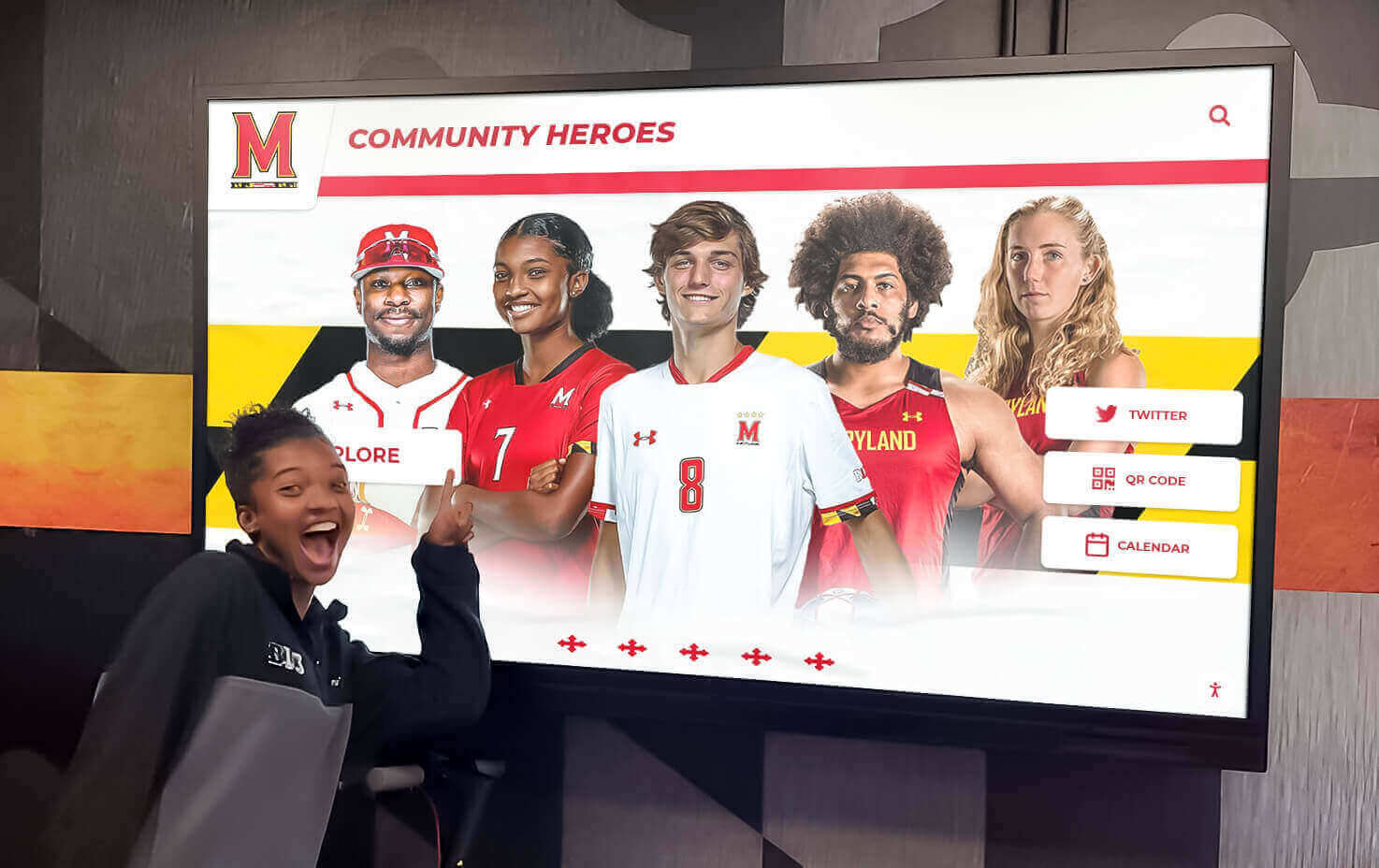
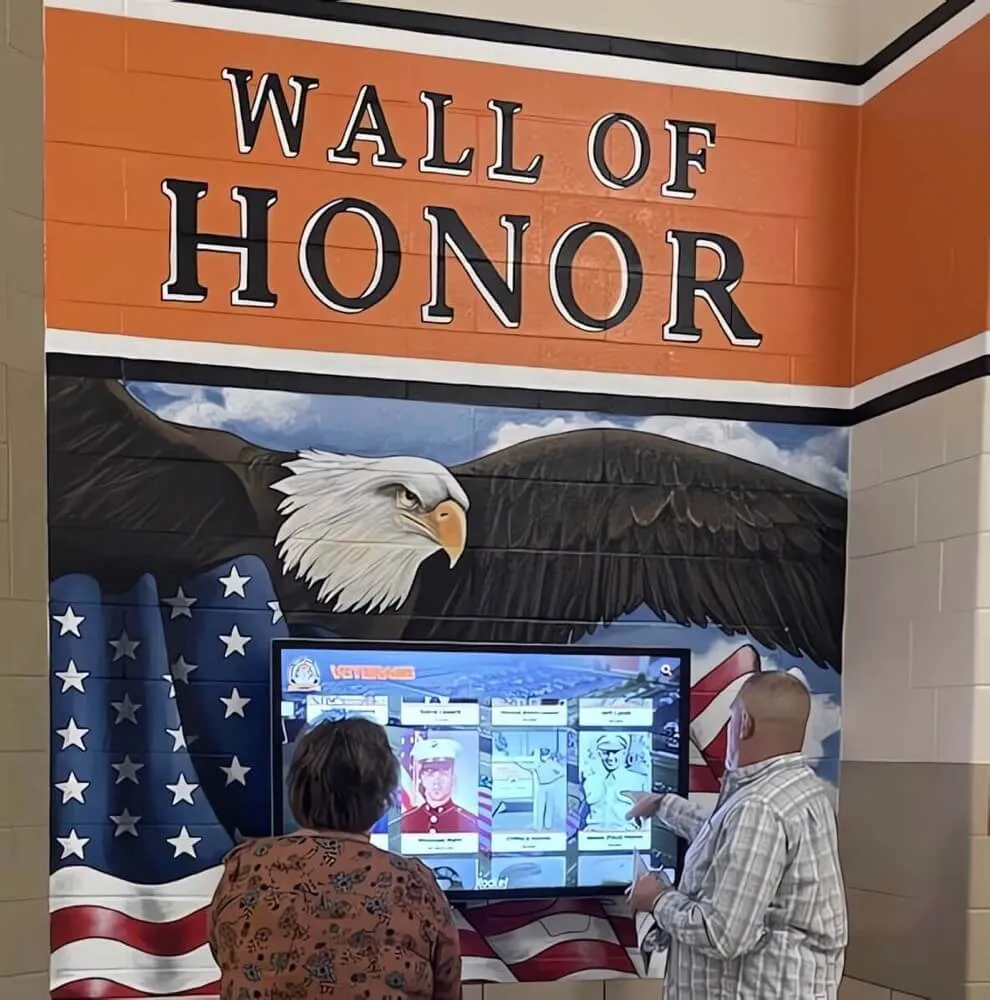
Interactive displays enable students to explore complete MVP award history and connect with program tradition
Youth Sports MVP Adaptations
Younger age groups modify MVP philosophy appropriately:
- Participation emphasis sometimes replacing single MVP designation
- Multiple MVPs ensuring broader recognition
- Sportsmanship and improvement weighting heavily
- Equal recognition across skill levels
- Process-oriented criteria over pure results
- Age-appropriate selection methods and presentation
College and Amateur Athletics
College sports maintain MVP traditions with unique considerations:
- Conference MVP awards carrying recruiting and draft significance
- All-American selections serving as national MVP equivalents
- Team captains often receiving automatic MVP consideration
- Statistical leaders frequently winning MVP recognition
- Academic achievement sometimes integrated with athletic excellence
- NIL opportunities enhancing MVP award visibility and value
How Teams Choose Their MVP: Selection Processes
MVP selection methods vary significantly across sports levels and organizational structures, each approach offering distinct advantages.
Coach-Determined MVP Selection
Many programs vest MVP selection authority with coaching staff:
Head Coach Sole Determination
Single decision-maker approach provides clarity:
- Head coach possesses comprehensive team knowledge and observation
- Understands practice performance beyond public visibility
- Can weight intangibles and leadership appropriately
- Maintains consistent evaluation philosophy
- Accepts accountability for recognition decisions
- Avoids committee compromises potentially diluting criteria
This centralized approach works effectively in programs with strong coaching leadership and where coach-player relationships create trust in selection fairness.
Coaching Staff Collaborative Decision
Multi-coach evaluation reduces individual bias:
- Assistant coaches provide specialized position expertise
- Discussion surfaces considerations individual coaches might miss
- Collaborative process builds staff consensus
- Multiple perspectives reduce favoritism concerns
- Position coaches advocate for their players’ contributions
- Structured deliberation protocols ensure systematic evaluation
Collaborative selection typically produces more comprehensive value assessment while requiring more time and coordination than single-coach decisions.
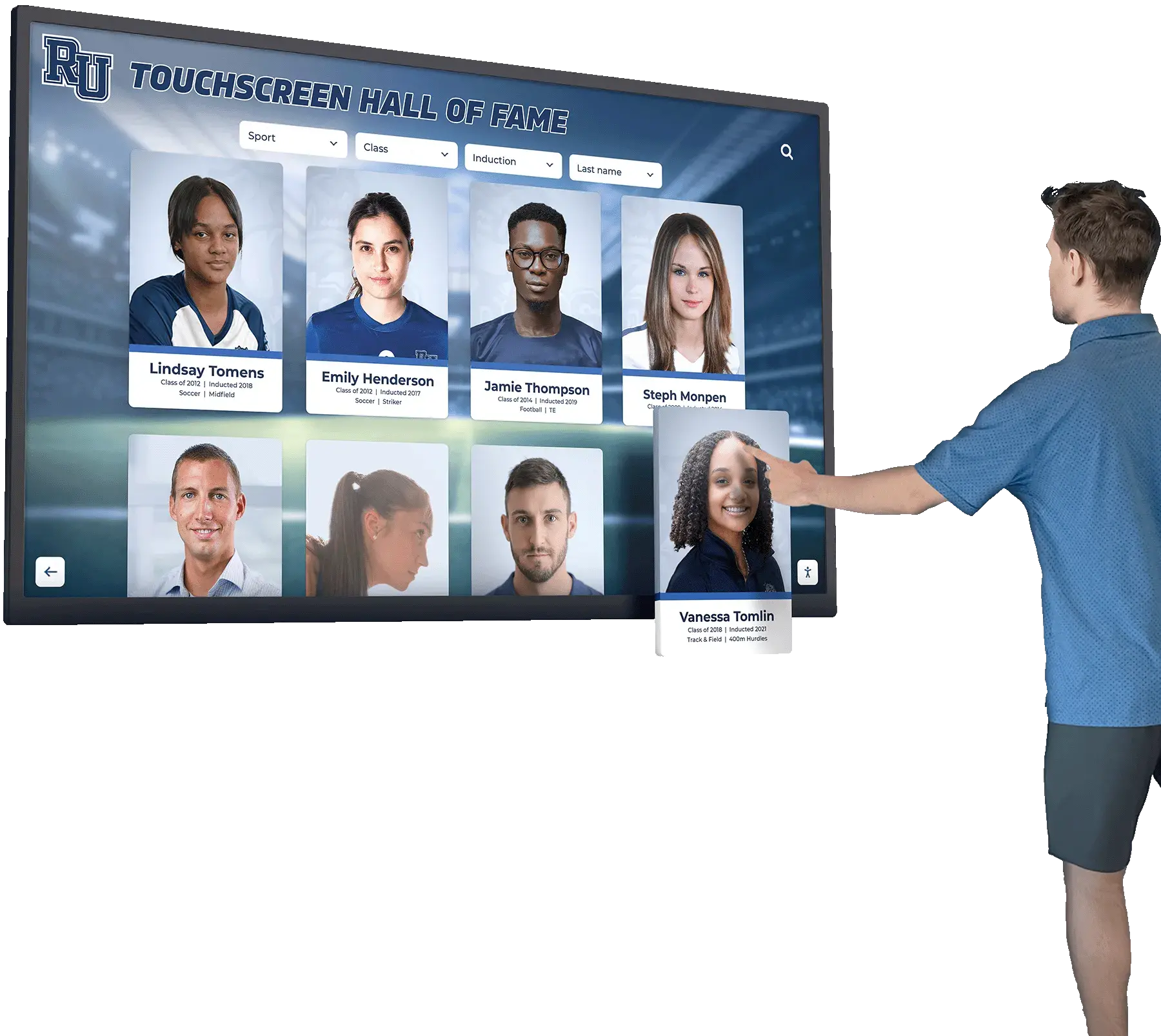
Modern recognition systems provide coaches instant access to MVP award history and player achievement records
Peer-Voted MVP Selection
Team member participation offers unique legitimacy:
Player Voting Approaches
Athletes directly select their MVP:
- Players witness practice effort and behind-scenes leadership coaches might miss
- Peer recognition carries unique emotional weight and validation
- Democratic process increases team buy-in and acceptance
- Reduces perception of coaching favoritism or bias
- Acknowledges contributions teammates value most highly
- Secret ballot protects voters from social pressure
Blended Coach-Player Selection
Combining perspectives balances strengths:
- Coaches provide statistical data and objective performance assessment
- Players contribute intangible observations and chemistry insights
- Weighted voting (e.g., coaches 60%, players 40%) structures influence
- Discussion between coaching staff and team captains
- Final determination incorporating both quantitative and qualitative input
- Transparent process building trust across program
Blended approaches often produce most widely accepted outcomes while maintaining appropriate coaching staff oversight and leadership.
Statistical and Analytics-Based Selection
Data-driven methods provide objective MVP determination:
Traditional Statistics Application
Conventional metrics guide selection:
- Points/goals per game leadership
- All-around statistical excellence across categories
- Efficiency ratings and shooting percentages
- Defensive statistics and plus-minus ratings
- Consistency measures across season
- Game-winning performances and clutch statistics
Advanced Analytics Integration
Sophisticated metrics offer deeper insight:
- Win shares or WAR (Wins Above Replacement) calculations
- Player efficiency ratings accounting for usage and context
- On-off court/field differential showing team performance impact
- Adjusted statistics accounting for competition quality
- Multi-factor models weighting various contributions
- Positional value adjustments recognizing inherent role differences
Programs using analytical approaches must communicate methodology clearly, helping athletes and community understand how value calculations produced MVP selection.
Criteria-Based MVP Selection
Structured evaluation frameworks ensure systematic assessment:
Weighted Criteria Scoring Systems
Quantified value dimensions:
- Performance statistics (e.g., 40% of score)
- Leadership and intangibles (e.g., 25% of score)
- Team success correlation (e.g., 20% of score)
- Improvement and development (e.g., 10% of score)
- Sportsmanship and character (e.g., 5% of score)
- Numerical scores producing objective winner identification
Threshold Requirements
Minimum standards for MVP eligibility:
- Games played or participation minimums ensuring adequate sample size
- Team success requirements (playoff qualification, winning record)
- Conduct and sportsmanship standards
- Academic eligibility and performance thresholds
- Position-specific performance minimums
- Statistical category baseline achievements
Multi-Dimensional Assessment Frameworks
Comprehensive evaluation across value types:
- Offensive contribution assessment
- Defensive impact evaluation
- Leadership and team chemistry influence
- Clutch performance in critical situations
- Practice and preparation commitment
- Community and program representation
These structured approaches reduce subjectivity while ensuring comprehensive value assessment rather than narrow statistical focus.

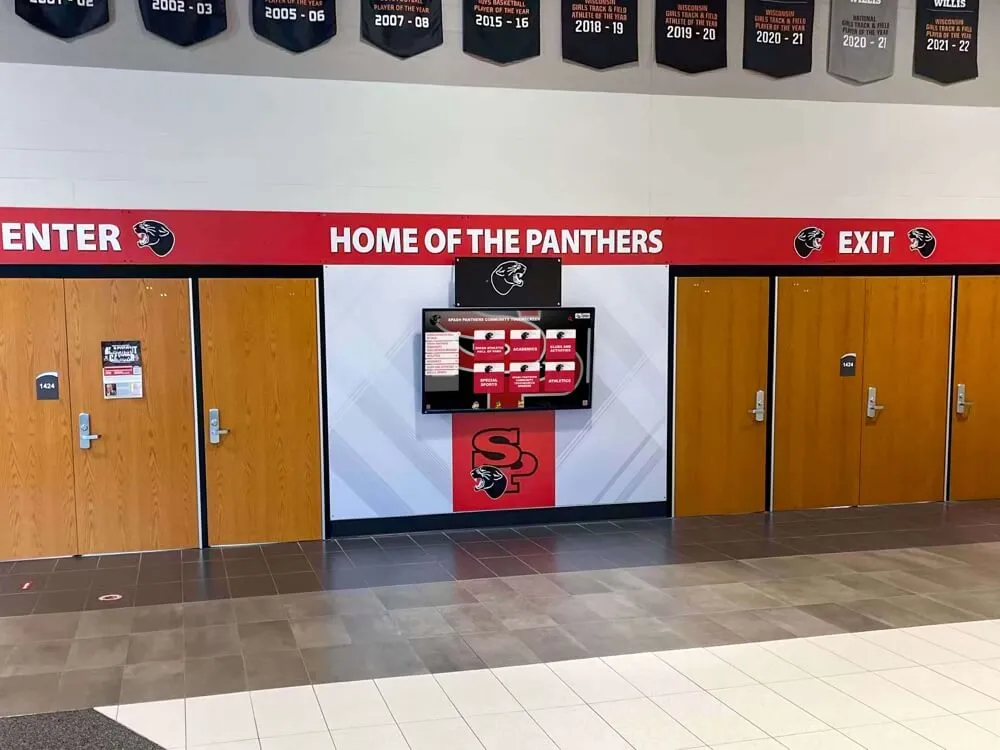
Hallway displays ensure MVP achievement recognition extends throughout facilities, creating program pride
Sport-Specific MVP Selection Considerations
Different sports require adapted MVP criteria reflecting their unique dynamics and value creation.
Team Sport MVP Selection
Collaborative sports present distinct value assessment challenges:
Basketball MVP Criteria
Basketball’s pace and statistics create clear value indicators:
- Scoring, rebounding, and assists as traditional value measures
- Plus-minus ratings showing team performance differential
- Usage rate and efficiency balancing volume with effectiveness
- Defensive impact through steals, blocks, and opponent field goal percentage
- Clutch performance in close games and playoffs
- Leadership both on-court (play-calling) and off-court (team culture)
For comprehensive basketball recognition including MVP awards, see basketball awards ideas covering diverse achievement categories.
Football MVP Criteria
Football’s positional specialization complicates value comparison:
- Quarterback bias reflecting position’s outsized impact
- Offensive and defensive MVP separations acknowledging different value types
- Statistical leaders at each position receiving consideration
- Impact plays (touchdowns, sacks, interceptions, turnovers created)
- Team success heavily influencing MVP selection
- Awards like football helmet stickers complementing season-end MVP recognition
Soccer MVP Criteria
Soccer’s flow and limited scoring create unique measurement challenges:
- Goals and assists as primary statistical indicators
- Defensive contributions through tackles, clearances, interceptions
- Passing accuracy and possession contribution
- Goalkeeper-specific criteria (saves, clean sheets, goals against average)
- Work rate and field coverage measurements
- Game-changing plays beyond statistical categories
Baseball/Softball MVP Criteria
Baseball’s individual confrontations enable precise measurement:
- Batting statistics (average, on-base percentage, slugging, home runs)
- Pitching dominance (ERA, strikeouts, wins, saves)
- Defensive excellence (fielding percentage, range, errors)
- Position scarcity creating value differentials (shortstops vs. first basemen)
- Complete player assessment (hitting, fielding, baserunning, arm strength)
- Clutch hitting in key games and pressure situations
Individual Sport MVP Selection
Solo sports adapt MVP concepts differently:
Track and Field Recognition
Individual events with measurable results:
- Points scored at meets and championships
- Record-breaking performances and personal bests
- Versatility across multiple events
- Consistency throughout season
- Championship meet performance
- School and conference record achievements
For comprehensive track recognition, see track and field records display approaches preserving performance history.
Swimming MVP Criteria
Pool sports with precise timing:
- Individual event victories and placements
- Relay contributions and team scoring
- Time improvements and cut achievements
- State qualification and advancement
- Record-setting performances
- Leadership in practice and team culture
Wrestling MVP Criteria
Combat sport with head-to-head competition:
- Win-loss record and winning percentage
- Pinning rate and dominant victories
- Tournament placements and championships
- Weight class competitiveness
- Improvement trajectory across season
- Leadership and practice room intensity
Tennis MVP Criteria
Racquet sport balancing singles and doubles:
- Singles ranking and match record
- Doubles contributions and championships
- Position in lineup (higher positions face tougher opponents)
- Conference and state tournament results
- Challenge match results determining lineup spots
- Team scoring contributions across season
Common MVP Selection Challenges
MVP determination faces recurring complications requiring thoughtful management:
Handling Multiple Deserving Candidates
Exceptional seasons sometimes produce several legitimate MVP candidates:
Co-MVP Recognition
Shared awards acknowledge equal contribution:
- Two (occasionally three) players named co-MVPs
- Appropriate when value contribution genuinely equal
- Avoids forced choice diminishing recognition meaning
- Preserves relationships and team chemistry
- Creates precedent requiring consistent future application
- Some traditionalists view co-MVPs as diminishing award prestige

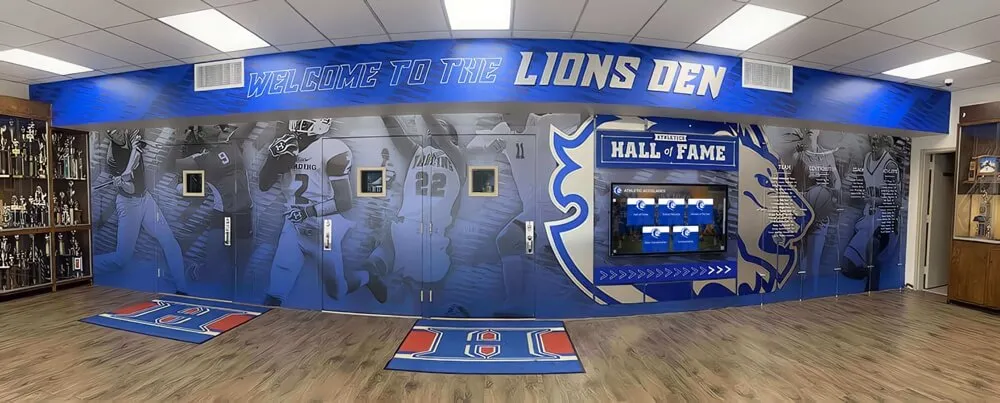
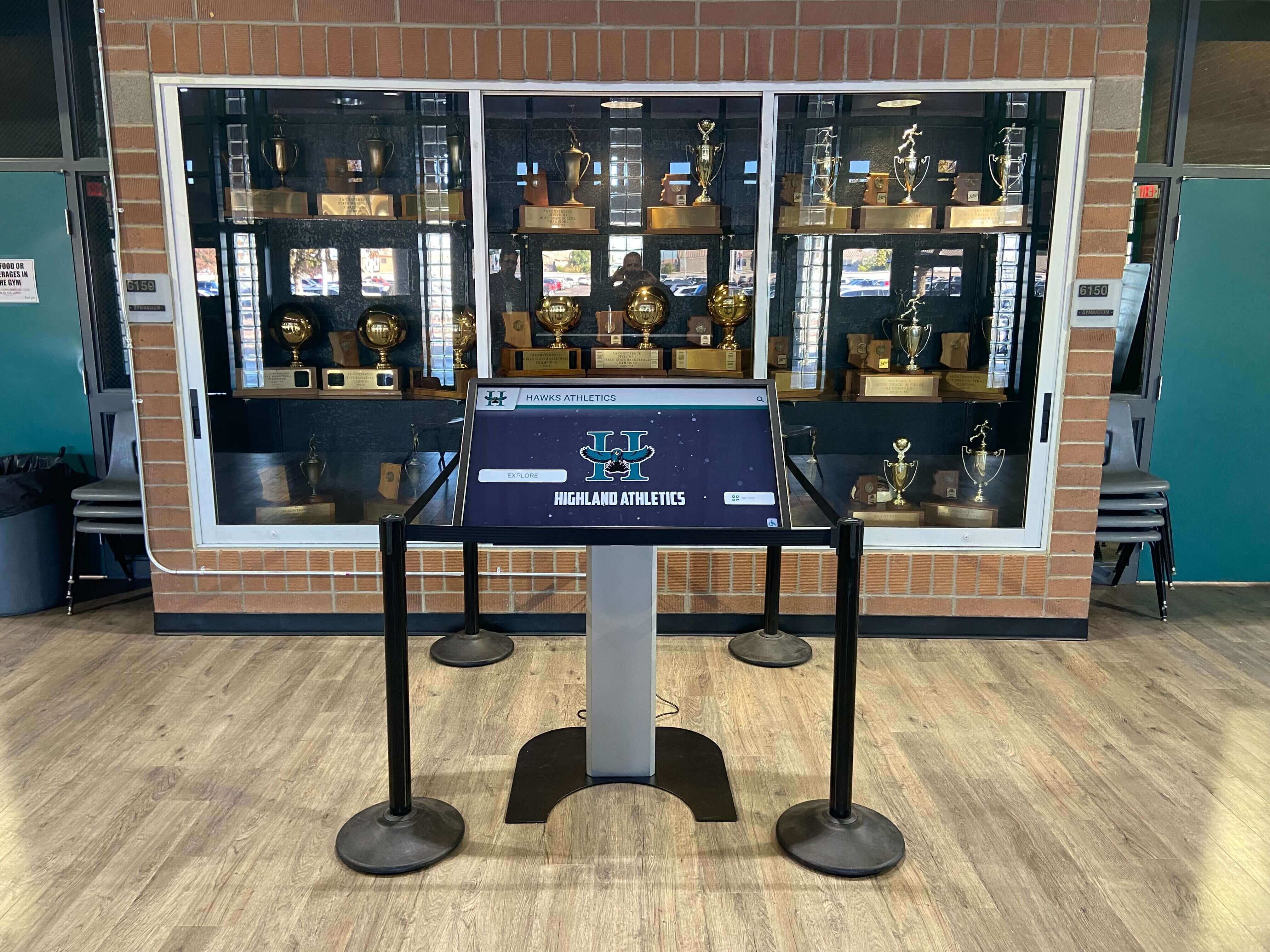
Traditional trophy displays combined with murals create inspiring recognition environments celebrating MVP excellence
Runner-Up Recognition
Acknowledging other top candidates:
- Second and third place MVP voting recognition
- All-conference or all-league selections honoring additional excellence
- Position-specific MVP awards creating multiple winners
- Offensive and defensive MVP separations
- Special recognition categories for other outstanding contributions
- Sport-specific end-of-year awards providing additional recognition opportunities
Multiple Award Categories
Expanding recognition structure:
- Separate MVPs for offense and defense
- Season MVP versus championship/tournament MVP
- Regular season and postseason MVP distinctions
- Rookie/newcomer MVP for first-year excellence
- Position-specific most valuable performers
- Character and leadership awards complementing performance MVPs
Balancing Statistics with Intangibles
Measurable performance versus unmeasurable contributions creates tension:
Statistical Dominance vs. Leadership Value
Numbers don’t capture complete contribution:
- Scoring leader might not be best team leader
- Vocal captain’s chemistry building resists quantification
- Practice intensity setting standards doesn’t appear in box scores
- Mentorship of younger players produces delayed team benefits
- Defensive communication and organization invisible in statistics
- Sacrifice of personal statistics for team success
Team Success Attribution
Determining individual credit for collective achievement:
- Star players on mediocre teams versus good players on great teams
- Surrounding talent affecting individual statistical opportunities
- Coaching system optimization for specific players
- Role players enabling stars’ statistical production
- Championship team membership enhancing MVP credentials
- Losing team MVP candidates facing credibility challenges
Recency Bias Management
Late-season performance disproportionately influencing selection:
- Playoff excellence overshadowing regular season body of work
- Late-season slumps diminishing earlier excellence
- Championship game performances creating lasting impressions
- End-of-season awards timing emphasizing recent memory
- Season-long documentation preventing recency overemphasis
- Weighted evaluation ensuring complete season assessment
Position Bias and Structural Value
Certain positions inherently create more value than others:
High-Value Position Considerations
Some roles matter more than others:
- Quarterbacks touching every offensive play in football
- Point guards controlling basketball offense and tempo
- Goalies in hockey and soccer determining game outcomes
- Pitchers in baseball controlling opponent scoring
- Setters in volleyball orchestrating all offensive plays
- Awareness that position structures don’t reflect individual merit
Balancing Positional Value Against Performance
Comparing across roles:
- Elite performance at lower-value position versus solid performance at critical position
- Creating position-specific MVP awards when appropriate
- Acknowledging both performance level and positional importance
- Avoiding automatic position bias while recognizing structural realities
- Statistical adjustments accounting for position-specific opportunities
- Multiple award categories enabling recognition across positions

Searchable digital systems enable quick access to complete MVP award history across program generations
MVP Award Presentation Best Practices
How teams present MVP awards significantly impacts recognition meaning and motivational value.
Timing and Setting for MVP Announcements
Strategic presentation maximizes impact and meaning:
End-of-Season Banquet Presentation
Traditional formal recognition setting:
- Comprehensive audience including families, alumni, and community
- Context within complete awards program honoring diverse achievements
- Suspense building through sequential award announcements
- Equal prestige established through presentation order and ceremony quality
- Photo opportunities and formal documentation
- Permanent keepsake presentation in memorable environment
For banquet planning guidance, see athletic banquet planning approaches celebrating complete seasons.
Championship Celebration Announcement
Immediate post-season recognition:
- Emotional peak following championship achievement
- Team-focused environment celebrating collective success
- Spontaneous celebration and genuine team reaction
- Media coverage opportunity amplifying recognition
- Championship context elevating MVP meaning
- Integration of individual recognition with team triumph
Private Team Meeting Revelation
Intimate recognition before public announcement:
- Team-internal acknowledgment emphasizing peer respect
- Opportunity for genuine emotion without public performance pressure
- Coaching staff personal communication of decision rationale
- Questions and discussion in comfortable environment
- Relationship building between MVP and teammates
- Subsequent public announcement with team already informed
Multi-Phase Recognition Approach
Combining presentation methods:
- Initial private team notification
- Public banquet or ceremony formal recognition
- Social media and school communication amplification
- Facility display integration showing historical MVP context
- Media coverage extending recognition reach
- Permanent preservation in program archives and displays
Crafting Meaningful MVP Presentations
Presentation quality affects recognition impact:
Telling the MVP Story
Effective presentations provide context and specificity:
- Statistical evidence supporting MVP selection
- Specific game examples illustrating value contribution
- Leadership and intangible contributions description
- Season narrative arc featuring MVP’s journey
- Coaching staff observations about impact
- Teammate testimonials or quotes about value
- Historical context connecting MVP to program tradition
Balancing Individual Honor with Team Success
MVP presentation must honor player while acknowledging team context:
- Emphasizing how MVP elevated teammates’ performance
- Acknowledging supporting cast enabling MVP excellence
- Connecting individual award to team achievement
- MVP acceptance speech opportunity to recognize teammates
- Framing MVP as team honor more than purely individual
- Preventing resentment through inclusive presentation approach
Physical Award Selection
Tangible recognition reinforces MVP honor:
- High-quality trophy reflecting award prestige
- Personalization with player name, year, sport, achievement details
- Consistent design within program’s recognition family
- Display-worthy size and appearance
- Engraving specificity (regular season MVP, championship MVP, etc.)
- Durable construction serving as lasting keepsake
- Optional jersey display case integration for comprehensive senior recognition
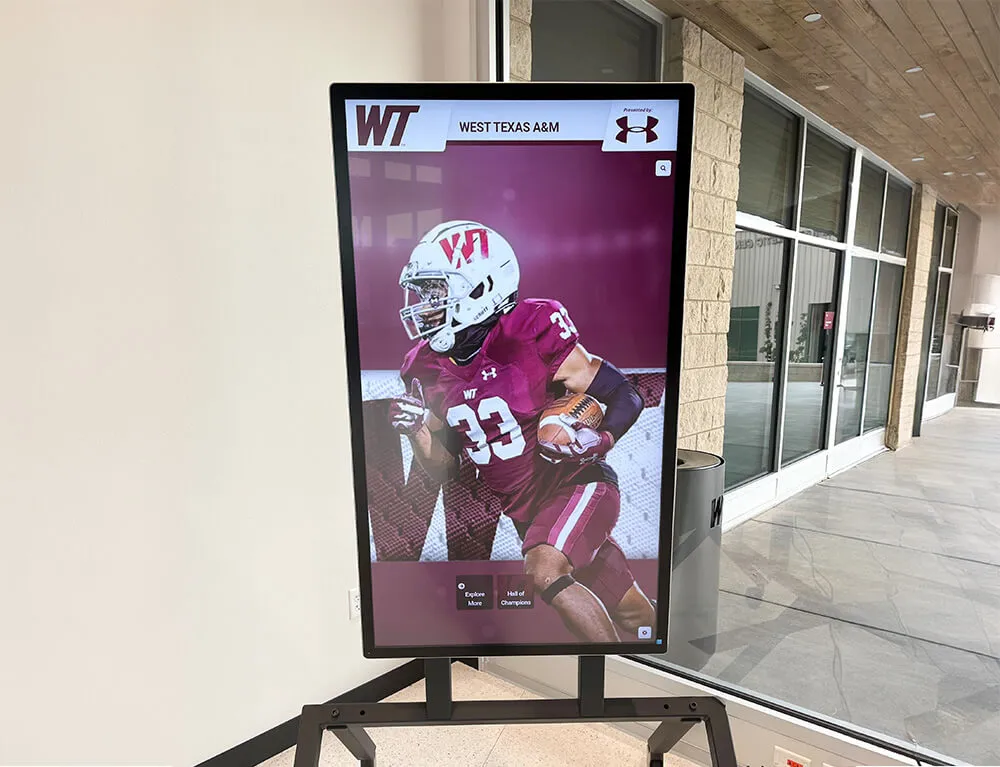
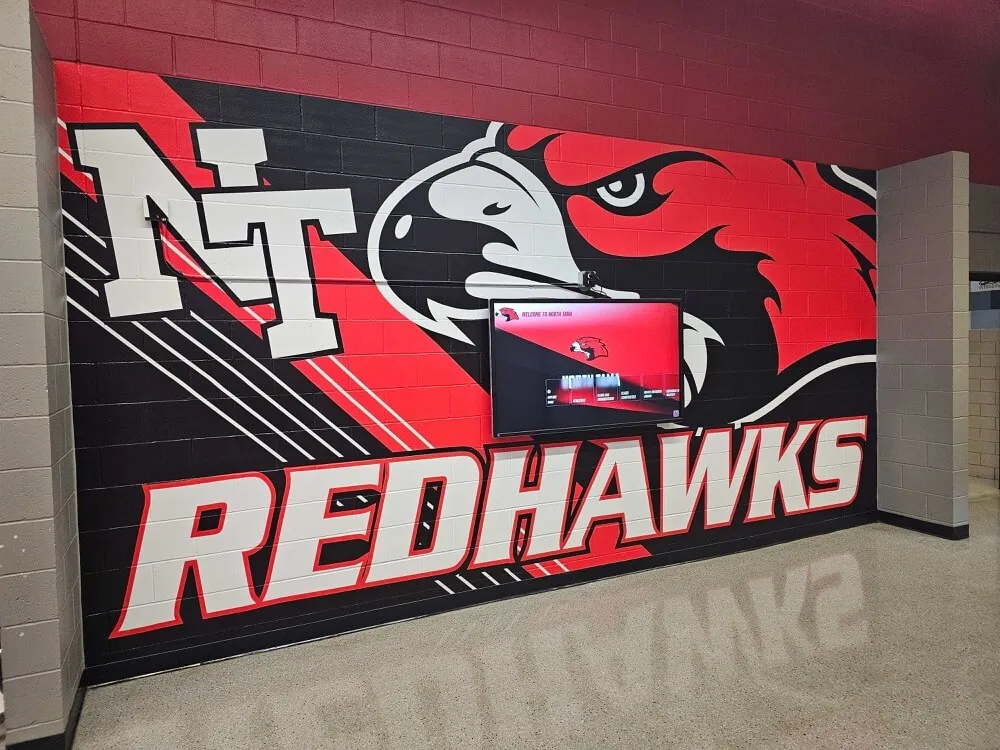
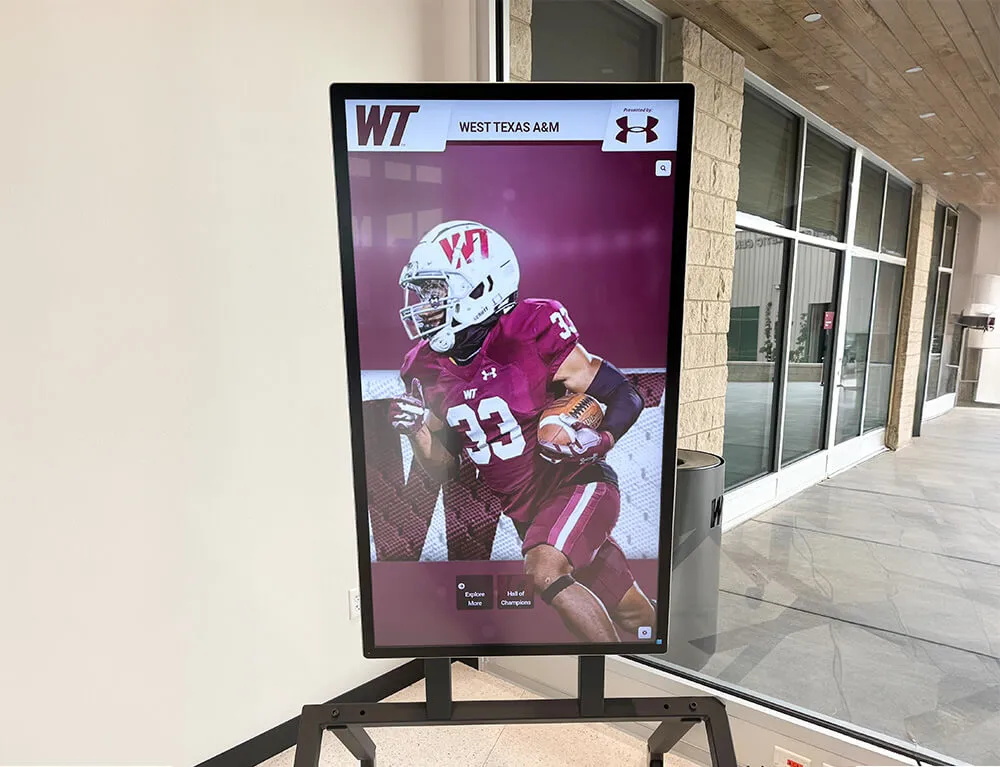
Large-format displays in high-traffic areas ensure MVP recognition reaches diverse stakeholders including visitors and recruits
Preserving MVP Recognition History
Systematic documentation creates lasting program tradition while inspiring future athletes.
Creating MVP Recognition Archives
Permanent preservation prevents achievement loss:
Essential MVP Documentation
Comprehensive record-keeping requirements:
- Complete list of all MVP award winners by year and sport
- Statistical support and performance data justifying selections
- Photos of each MVP receiving award at presentation
- Written narratives explaining selection rationale and season context
- Team success correlation with MVP performance
- Post-graduation updates tracking continued achievement
Historical Context Integration
Connecting MVPs to broader program history:
- Championship teams and their MVP winners
- Multi-year MVP winners and sustained excellence
- Family legacy tracking multiple-generation MVPs
- Coaching era comparison across different leadership periods
- Historical statistical rankings placing MVPs in context
- Alumni achievement updates connecting MVP award to later success
Digital Archive Accessibility
Modern technology makes history accessible:
- Searchable databases enabling quick MVP reference by year, name, or sport
- Web-accessible platforms for alumni and community exploration
- Mobile-friendly viewing for families and prospective recruits
- Social media integration celebrating historical MVPs
- Digital hall of fame displays showcasing complete MVP history
- Interactive touchscreen installations in athletic facilities
Modern MVP Display Solutions
Digital recognition systems transform how programs honor MVPs:
Interactive Touchscreen Recognition
Technology-enabled preservation offers significant advantages:
Unlimited Recognition Capacity
Digital systems overcome physical space limitations:
- Single display showcases unlimited MVPs across all years and sports
- Complete program history preserved permanently without space constraints
- Every MVP receives equal recognition regardless of era
- No removal of historical achievements to accommodate current seasons
- Comprehensive record books documenting all-time program excellence
- Multi-sport integration showing athletic program breadth
Rich Multimedia Content
Digital platforms support content impossible with static displays:
- Individual MVP profiles with photos, statistics, and achievements
- Season highlight videos and championship footage
- Game action photography and memorable moment documentation
- Statistical comparisons across eras enabling historical evaluation
- Coach and teammate quotes about MVP contributions
- Post-graduation achievement updates maintaining alumni connection
Remote Content Management
Cloud-based systems simplify recognition administration:
- Add new MVPs immediately after selection without physical installation
- Update information or correct historical records from anywhere
- Schedule content for automatic publication on specific dates
- Manage multiple displays across campus from single dashboard
- Cost savings eliminating engraving, plaque production, and installation labor
- Real-time updates as records are broken or new achievements occur
Programs implementing digital MVP recognition report 90%+ reduction in administrative time versus maintaining physical trophy cases while creating more engaging, comprehensive displays that visitors actually explore rather than passively observe.
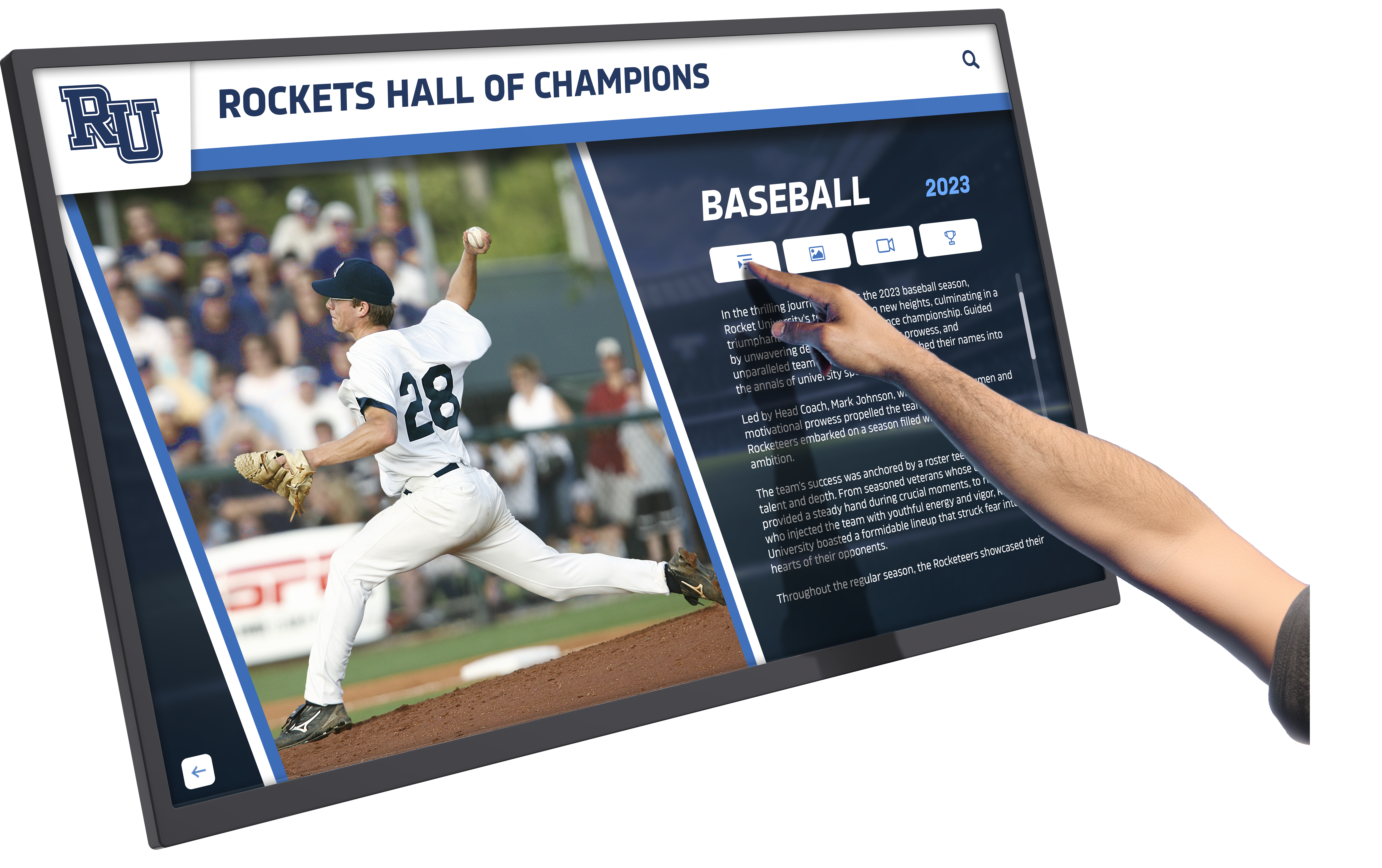
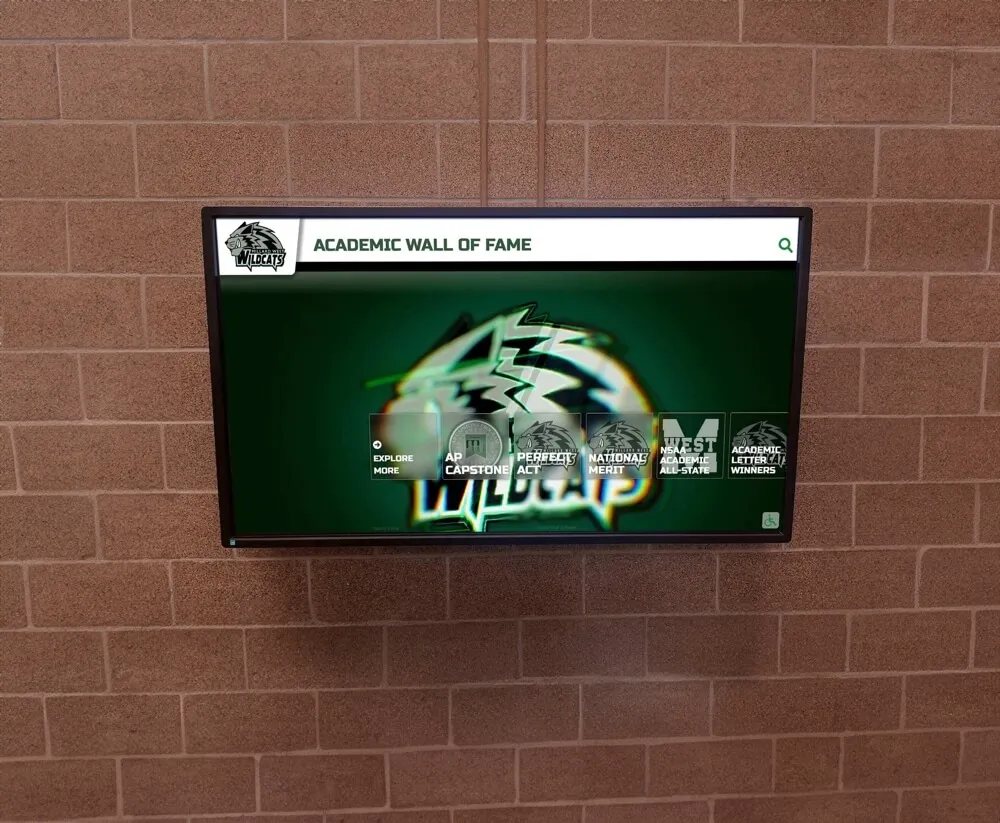
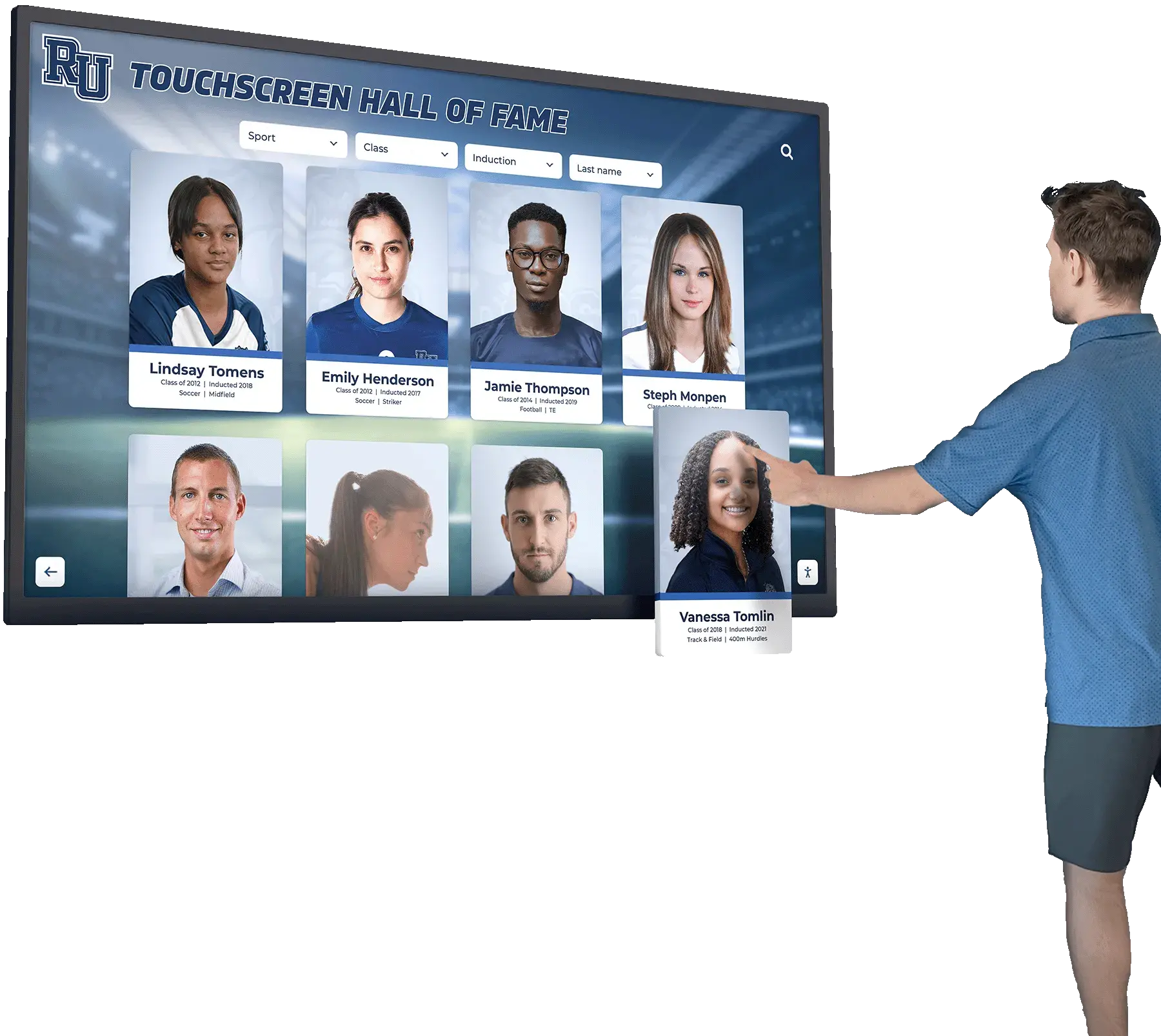
Touch-enabled interfaces create engaging exploration of MVP award history connecting current athletes to program tradition
Leveraging MVP History for Program Culture
Historical MVP recognition creates powerful motivational effects:
Inspiring Current Athletes
Past excellence motivates present performance:
- Preseason presentations featuring previous MVPs establishing standards
- Current athlete comparison to historical MVPs showing progress toward recognition
- Alumni MVP return visits connecting generations
- Visual displays throughout facilities providing constant inspiration
- Specific skill or statistical targets based on MVP requirements
- Understanding that excellence receives permanent recognition and celebration
Recruiting Advantage
MVP recognition tradition attracts talent:
- Facility tours showcasing complete MVP history demonstrating commitment to recognition
- Discussion of selection process showing fair, merit-based evaluation
- Alumni MVP testimonials about award meaning and program experience
- Parent appeals based on comprehensive recognition program
- Competitive advantage versus programs lacking systematic MVP acknowledgment
- Media coverage of MVP tradition attracting community attention
Alumni Engagement
Historical MVPs create lasting program connection:
- Alumni MVP recognition events and reunions
- Current team meetings with historical MVP speakers
- Social media throwback features celebrating past MVPs
- Mentorship programs connecting alumni MVPs with current athletes
- Fundraising opportunities honoring MVP tradition
- Legacy giving campaigns supporting recognition program enhancement
For comprehensive recognition program planning including MVP awards, explore digital recognition displays transforming athletic program culture.
Building Championship Culture Through MVP Recognition
Strategic MVP programs reinforce values extending beyond individual awards.
Connecting MVP Standards to Team Success
MVP criteria should align with program championship goals:
Championship-Caliber Performance Expectations
MVP requirements establishing team standards:
- Statistical thresholds reflecting excellence not just participation
- Leadership expectations requiring vocal and example-based guidance
- Practice intensity standards setting team-wide commitment levels
- Competitive mentality requirements emphasizing winning orientation
- Academic and conduct expectations maintaining program integrity
- Multi-sport athletic participation demonstrating complete athletic dedication
Value Definition Reflecting Program Philosophy
MVP criteria communicating what coaching staff prizes:
- Unselfish play and team-first mentality emphasis
- Defensive commitment weighted equally with offensive production
- Consistency and reliability valued over sporadic excellence
- Character and sportsmanship integrated with performance
- Development and improvement trajectory consideration
- Complete player evaluation beyond single-dimension excellence
Creating Multiple Recognition Pathways
MVP awards complemented by comprehensive recognition:
- Position-specific awards enabling recognition across roster
- Improvement awards celebrating growth trajectories
- Character awards honoring intangibles
- Underclassman awards providing future-oriented recognition
- Specialist recognition for unique contributions
- Team awards acknowledging collective achievement
This multi-category approach prevents MVP from becoming exclusive club while maintaining prestige through selective championship-level standards.
MVP Legacy and Multi-Year Excellence
Sustained MVP-caliber performance deserves special recognition:
Repeat MVP Winners
Multiple MVP awards signify extraordinary excellence:
- Historical rarity of back-to-back or multiple MVP selections
- Enhanced recognition for sustained excellence versus single-season peak
- Special designation or honor for repeat MVPs
- Historical comparison to program’s greatest athletes
- Automatic consideration for hall of fame induction
- Legacy establishment as program standard-bearer
Career Achievement Integration
MVP awards within broader career recognition:
- Senior career achievement awards acknowledging sustained excellence
- Four-year varsity letter recognition for complete commitment
- Career statistical milestone achievements
- Academic and athletic excellence balance across career
- Leadership development from underclassman to senior captain
- Post-graduation achievement tracking alumni success
Creating MVP Tradition and Continuity
Connecting current MVPs to program history:
- Named awards honoring legendary previous MVPs
- Alumni MVP mentorship of current team leaders
- Historical display integration showing MVP lineage
- Annual recognition of all-time great MVPs
- Reunion events celebrating MVP tradition across generations
- Media features connecting past and present excellence
Implementing Your MVP Recognition Program
Creating systematic MVP programs requires strategic planning:
Program Design Considerations
Selection Method Determination
Choose approach matching program philosophy:
- Coach-determined, player-voted, or blended selection
- Statistical weights versus intangible consideration
- Transparent criteria versus subjective judgment
- Single MVP or multiple award categories
- Regular season versus championship MVP distinctions
- Age-appropriate modifications across competition levels

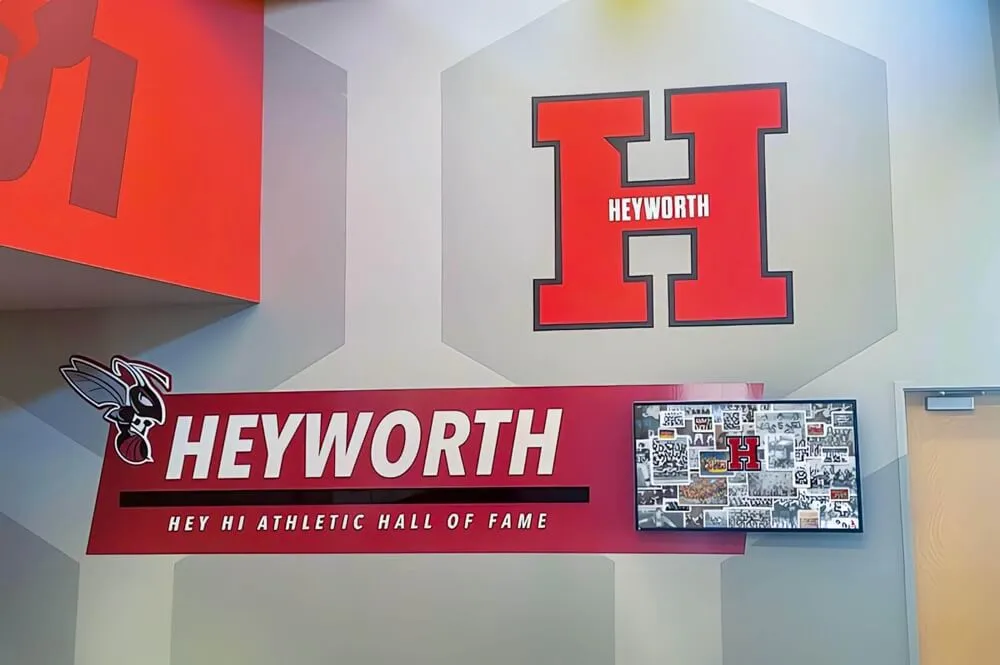
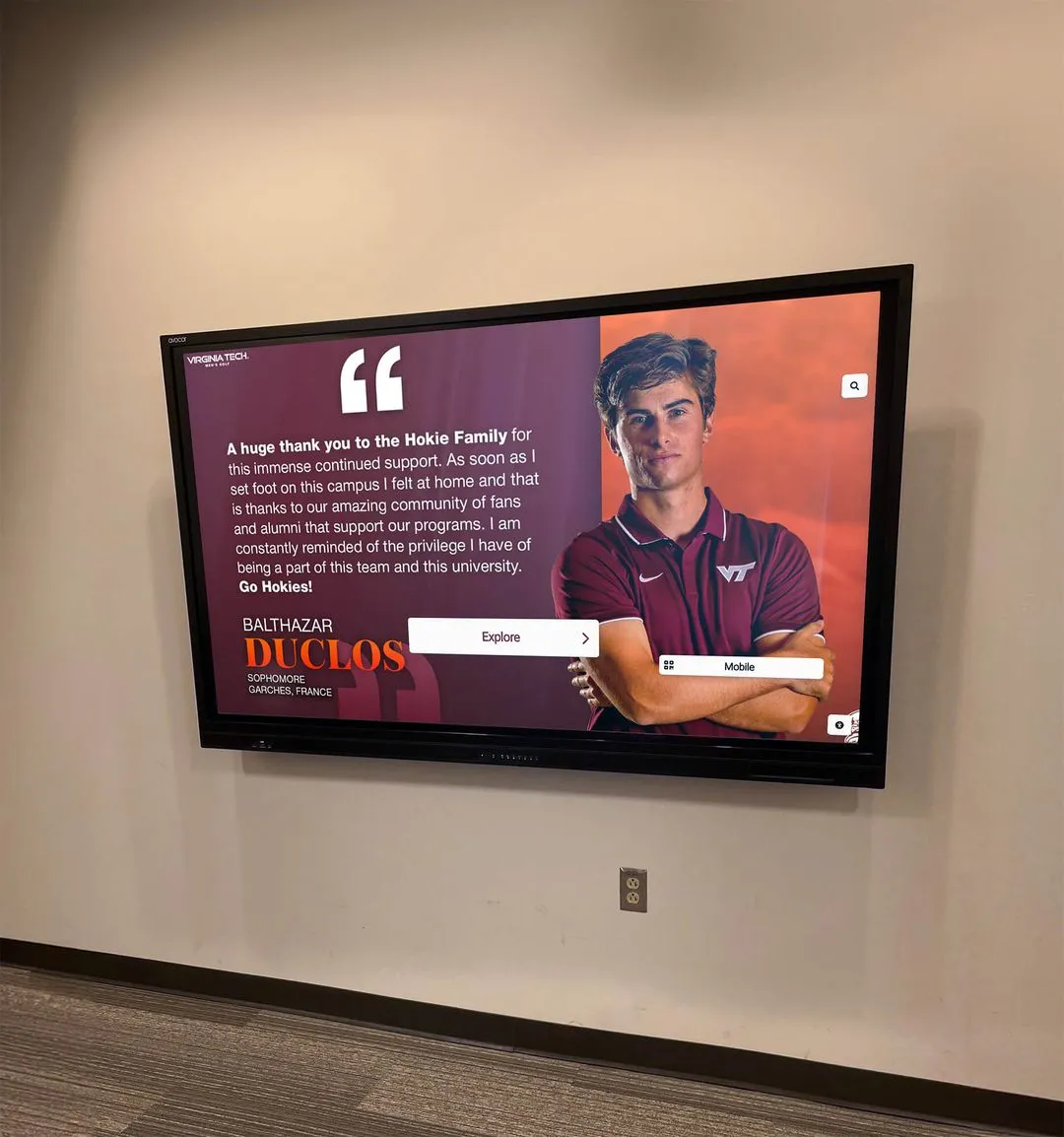
Professional-quality displays elevate MVP recognition while showcasing program excellence to all facility visitors
Communication and Transparency
Clear explanation builds trust and buy-in:
- Published criteria and selection process documentation
- Timeline communication about when MVP will be selected
- Explanation of decision rationale at presentation
- Opportunity for questions and discussion with team
- Consistent application across years building tradition
- Documentation enabling future coaching staff continuity
Budget and Resource Allocation
Sustainable recognition requires planning:
- Trophy and physical award budget allocation
- Presentation ceremony and banquet costs
- Digital display system investment for permanent recognition
- Photography and documentation expenses
- Media coverage and communication costs
- Long-term maintenance and update planning
Integration with Comprehensive Recognition
MVP awards should complement broader programs:
Award Hierarchy and Prestige
Creating recognition system with clear tiers:
- MVP as highest or among highest individual honors
- Supporting awards at second tier (offensive/defensive player of year)
- Broader recognition categories for diverse contributions
- Participation acknowledgment distinct from performance excellence
- Clear communication about relative prestige and meaning
- Balance preventing dilution through excessive awards
Facility Display Integration
Physical and digital recognition placement:
- Prominent positioning in athletic facilities and high-traffic areas
- Trophy case organization highlighting MVP awards
- Digital wall of fame displays preserving complete history
- Lobby installations engaging visitors and community
- Locker room motivation through MVP historical displays
- Training facilities featuring MVP achievement standards
Cross-Program Consistency
Coordinated recognition across sports:
- Parallel MVP structures for all athletic teams
- Equivalent prestige and presentation quality
- Gender equity ensuring equal recognition for boys and girls programs
- Resource allocation balance across sports
- Unified display systems showcasing multi-sport excellence
- Coordinated timing preventing scheduling conflicts
For comprehensive athletic recognition planning, explore solutions that integrate MVP awards with championship recognition, record displays, and historical preservation.
Conclusion: Creating Meaningful MVP Recognition
Most Valuable Player awards represent far more than individual honor—they embody program values, establish performance standards, and create lasting traditions connecting generations of athletes. When implemented thoughtfully with clear criteria, fair selection processes, and meaningful presentation, MVP awards motivate current athletes while celebrating extraordinary contributions that define team success.
The recognition approaches explored throughout this guide provide frameworks for implementing MVP programs that honor genuine value across multiple dimensions—statistical excellence, leadership impact, team success contribution, and intangible qualities that resist measurement but define championship cultures. Whether selecting MVPs through coaching determination, player voting, analytical evaluation, or blended approaches, the core principles remain constant: comprehensive value assessment, transparent selection, and permanent preservation ensuring MVP recognition inspires current and future athletes.
Preserve Your MVP Award Legacy Permanently
Discover how interactive touchscreen displays can help you honor every MVP award winner across all sports and eras, creating engaging recognition that families and future teams can explore for generations while maintaining complete program achievement records accessible year-round.
Request a DemoMost importantly, effective MVP recognition communicates that excellence receives acknowledgment—motivating athletes throughout seasons as they pursue this prestigious honor while demonstrating that programs value and celebrate those whose contributions prove most essential to team success. These recognition systems validate the dedication, skill development, leadership growth, and competitive excellence required to achieve MVP status, inspiring commitment throughout athletic careers.
Whether your program operates with substantial resources or modest budgets, the fundamental elements of meaningful MVP recognition remain accessible: clear criteria reflecting true value, fair selection processes building trust, thoughtful presentation honoring recipients appropriately, and permanent preservation preventing achievement loss as years pass. Modern technology solutions now enable even resource-constrained programs to provide comprehensive MVP documentation and display that previous generations could only achieve through extensive space and ongoing financial investment.
Digital recognition platforms eliminate traditional constraints that forced programs to choose which MVPs and which seasons received prominent display space. With unlimited capacity, every MVP who ever earned your highest honor can be celebrated permanently alongside championship teams, record-setters, and hall of fame inductees—creating truly comprehensive recognition that strengthens program culture and alumni connection across decades.
Start building or enhancing your MVP recognition program today with confidence that systematic attention to criteria definition, selection methodology, presentation approaches, and permanent preservation will create traditions your athletes never forget. Every MVP honored appropriately reinforces your program’s culture and inspires the next generation of athletes to pursue the excellence this prestigious recognition celebrates.
Ready to transform how your program honors MVPs? Explore Touch Archive solutions for comprehensive athletic recognition and complete team history preservation, or request a demo to see how your MVP award winners—from championship seasons to record-breaking performances, from statistical dominance to leadership excellence—can be preserved and celebrated permanently through interactive displays that engage current teams, returning alumni, and prospective recruits for generations to come.