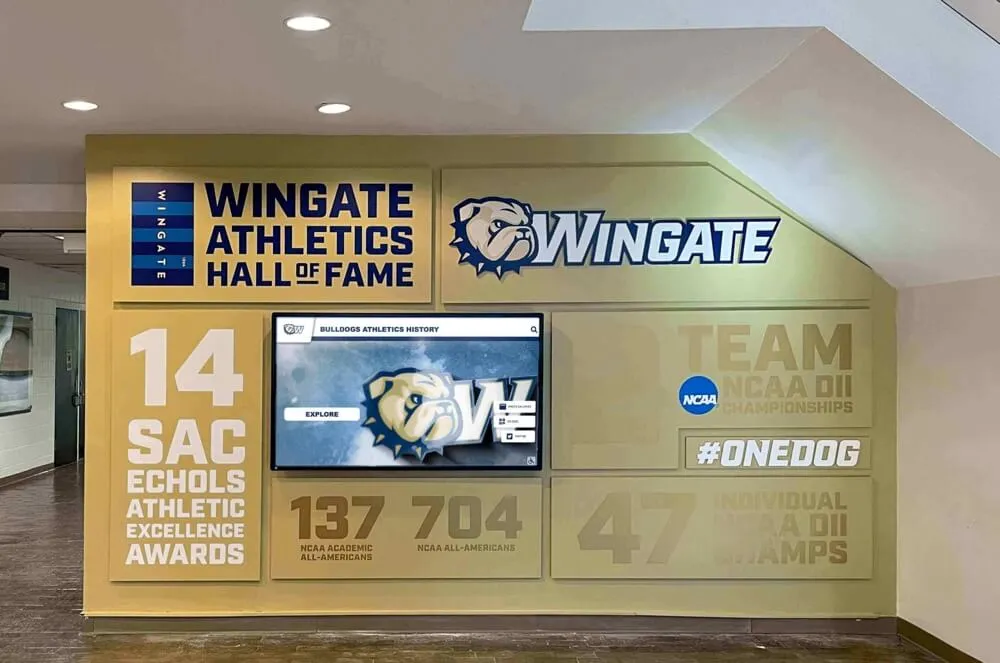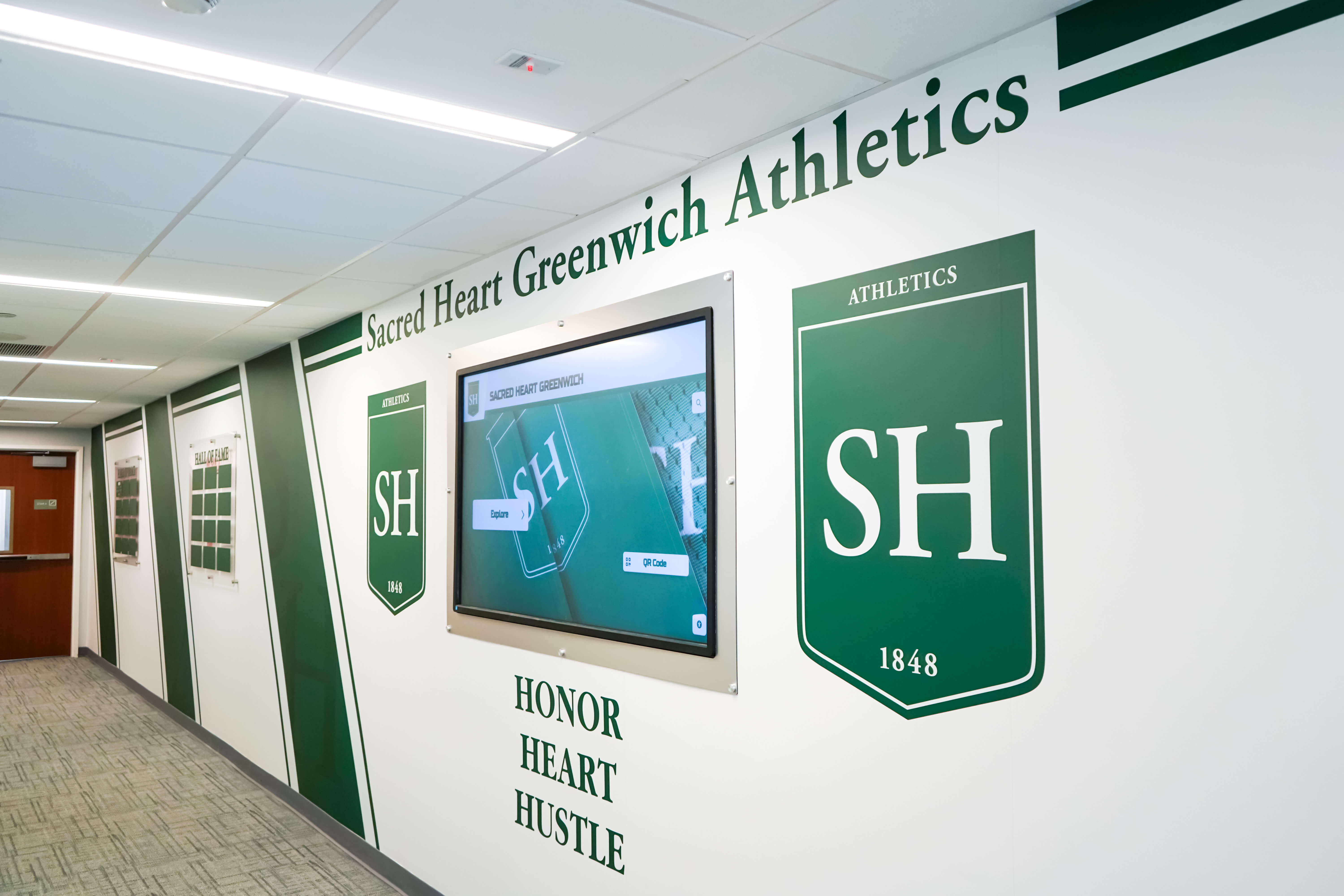




Walk into the athletic wing of any school that has been competing for a century and you will find the same scene: trophies stacked three rows deep in glass cases that no longer close properly, championship banners layered over each other in gymnasium rafters, team photos stacked in storage boxes because the hallway walls ran out of room two decades ago. The history is all there—it is just not accessible.
Schools with multi-decade athletic traditions face a recognition problem that gets harder to solve with each passing season. Physical space is finite. Budget for new plaques and cases is limited. And somewhere in that tangle of fading photographs and dusty hardware sits a story worth telling: a hundred years of coaches who built programs from scratch, student-athletes who went on to professional careers, championship runs that defined communities, and rivalry games that entire towns remember to this day.
A well-designed school athletic history wall solves this problem by bringing the full arc of a program’s history into one coherent, engaging, and permanent display. This guide walks through the planning, physical elements, digital integration, and practical implementation required to consolidate a century of athletic heritage into a single installation that serves current students, returning alumni, and every visitor who walks through the door.
The goal of a school athletic history wall is not simply to hang more trophies. It is to create a living archive—one that honors every era of competition, makes records searchable, and gives visitors a genuine sense of what your athletic program has meant to this school and this community across generations.

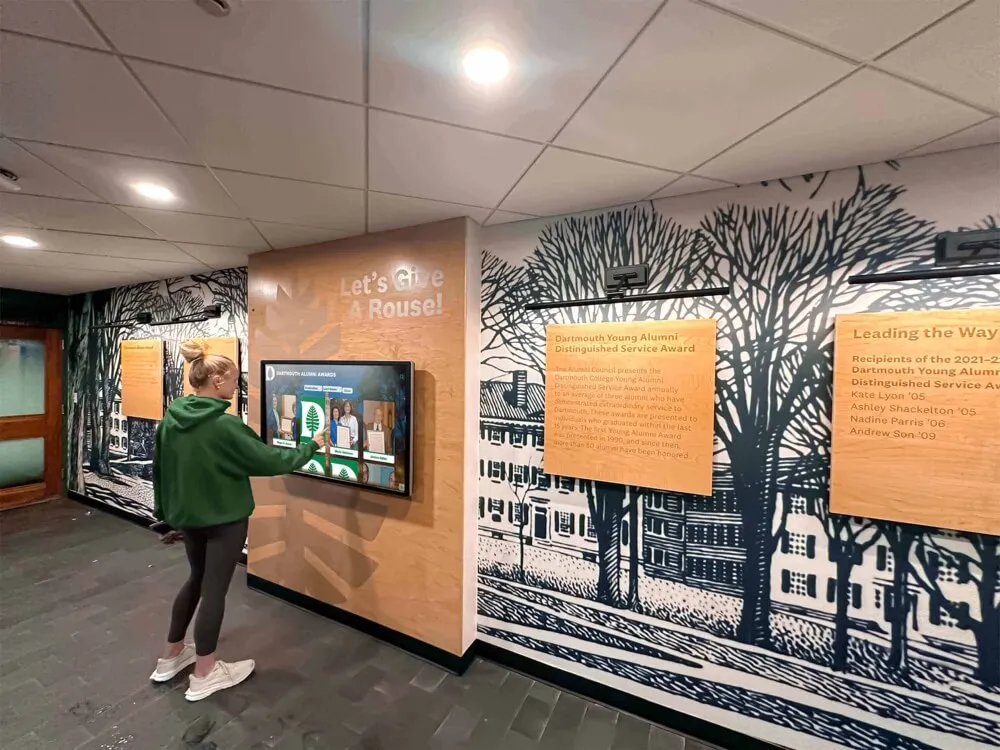
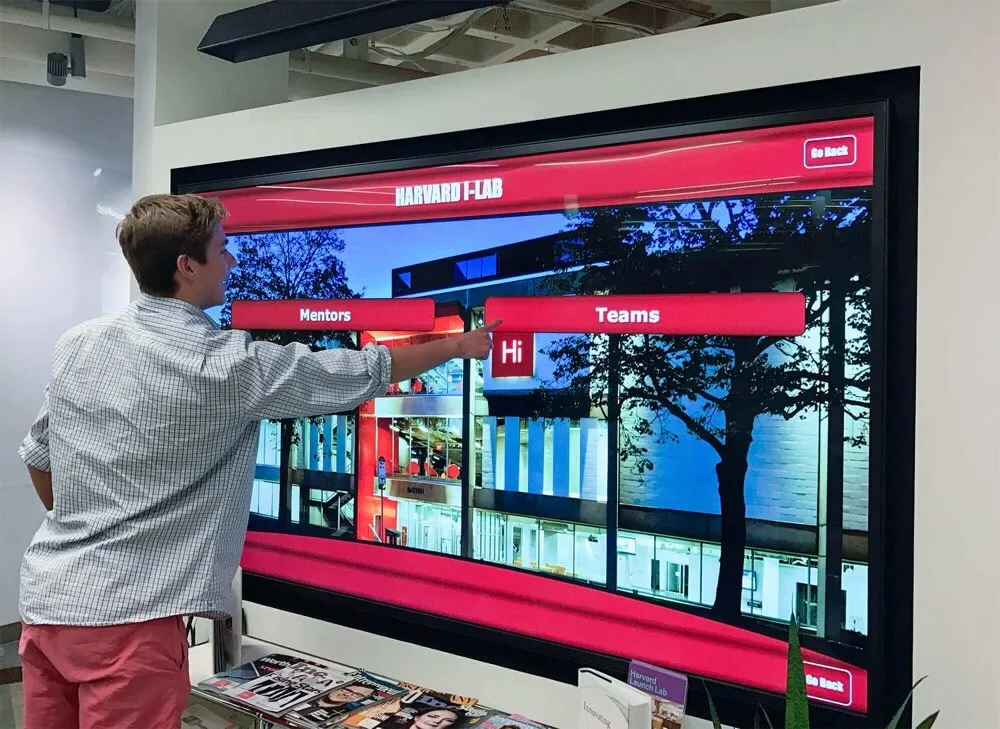
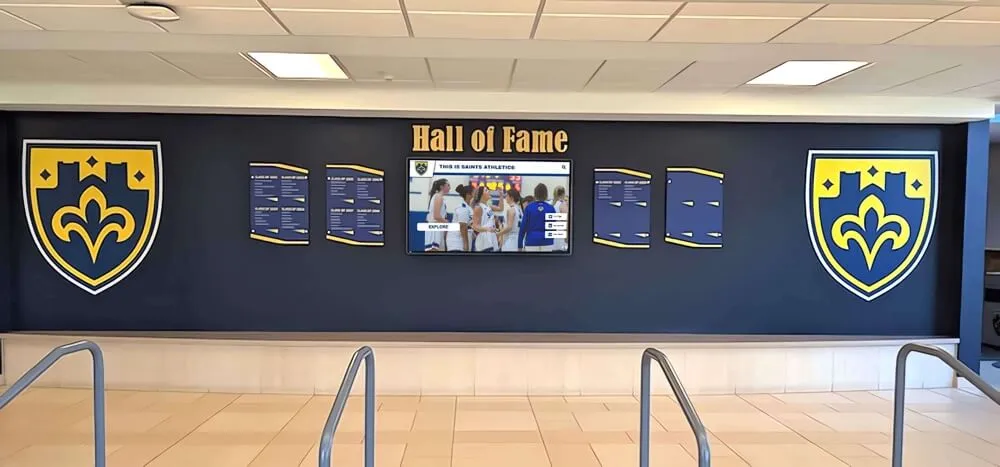
A well-designed school athletic history wall organizes decades of achievement into a coherent visual statement that honors every era of competition
Starting with an Audit: What Does a Century of Athletics Actually Look Like?
Before planning any display, athletic directors need a clear picture of what they are working with. Schools that have been competing for a hundred years typically hold more historical material than anyone realizes—scattered across multiple storage locations, maintained by different staff members, and documented in inconsistent formats.
Categories of Athletic Heritage to Inventory
A thorough audit should account for:
Championship Hardware and Trophies
- State and regional championship trophies by sport and year
- Tournament and invitational hardware
- Coach of the year and program awards
- League and conference titles
Printed and Photographic Records
- Team photos from each sport and season
- Individual athlete portrait cards
- Action photography from notable games
- Newspaper clippings and game programs
- Yearbook athletic sections across decades
Fabric and Textile Memorabilia
- Championship banners currently hanging in the gymnasium
- Retired jersey numbers and game-worn uniforms
- Letter jackets donated by alumni
- Warmup gear from significant seasons
Records and Statistical History
- School records by event and sport
- All-state and all-conference honorees by year
- College signing history
- Coaches’ career win-loss records
Notable Alumni Documentation
- Profiles of athletes who competed professionally
- Alumni who became coaches, athletic directors, or administrators
- Community figures who participated in school athletics
Completing this inventory—even at a summary level—typically reveals that most schools are sitting on far more history than their current displays suggest. That gap between what exists and what is currently visible is exactly what a comprehensive history wall is designed to close. A systematic approach to digitizing athletic team photos and building a searchable photo archive makes the audit process far more manageable for schools with decades of unorganized photographic records.
Planning Your School Athletic History Wall Layout
Once you know what you have, the next step is deciding how to organize and display it. Schools approaching this for the first time often make the mistake of thinking about display cases first and layout second. The better approach reverses that order.
Defining the Experience You Want to Create
Ask what you want a first-time visitor to feel after spending five minutes with your athletic history wall. Should they understand the full scope of your program across sports? Should they be able to search for a specific athlete or year? Should they feel the emotional weight of your program’s biggest championships? The answers to these questions shape every subsequent decision.
Most schools land on some combination of three goals:
- Comprehensiveness — Every sport, every era, every significant achievement represented
- Navigability — Visitors can find specific athletes, seasons, or records quickly
- Emotional resonance — The display conveys pride, tradition, and community identity
Physical Space Considerations
Your available wall space will constrain your options, but smart planning can extend that space considerably:
- Identify the primary display zone (main athletic lobby, hallway adjacent to gym, dedicated hall of fame corridor)
- Note ceiling height—banner installations require clearance and mounting hardware
- Identify electrical access points for any illuminated or digital components
- Measure available linear footage for cases, murals, and screen mounting
- Account for ADA clearance requirements if freestanding kiosks are part of the plan
Schools that have tackled corridor-based recognition installations often draw inspiration from hallway display ideas that transform ordinary school spaces into engaging recognition environments—a useful reference before finalizing your layout approach.
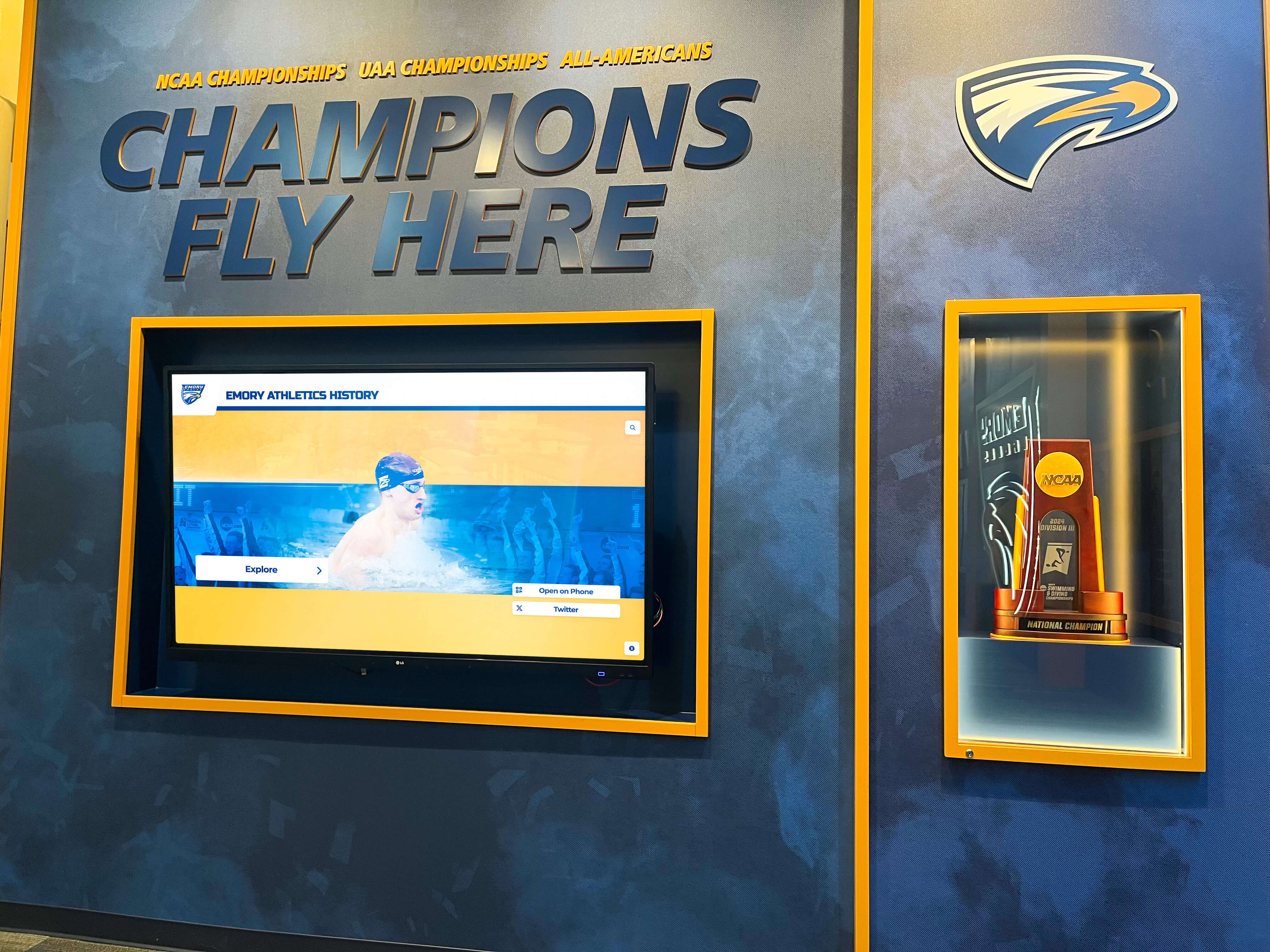
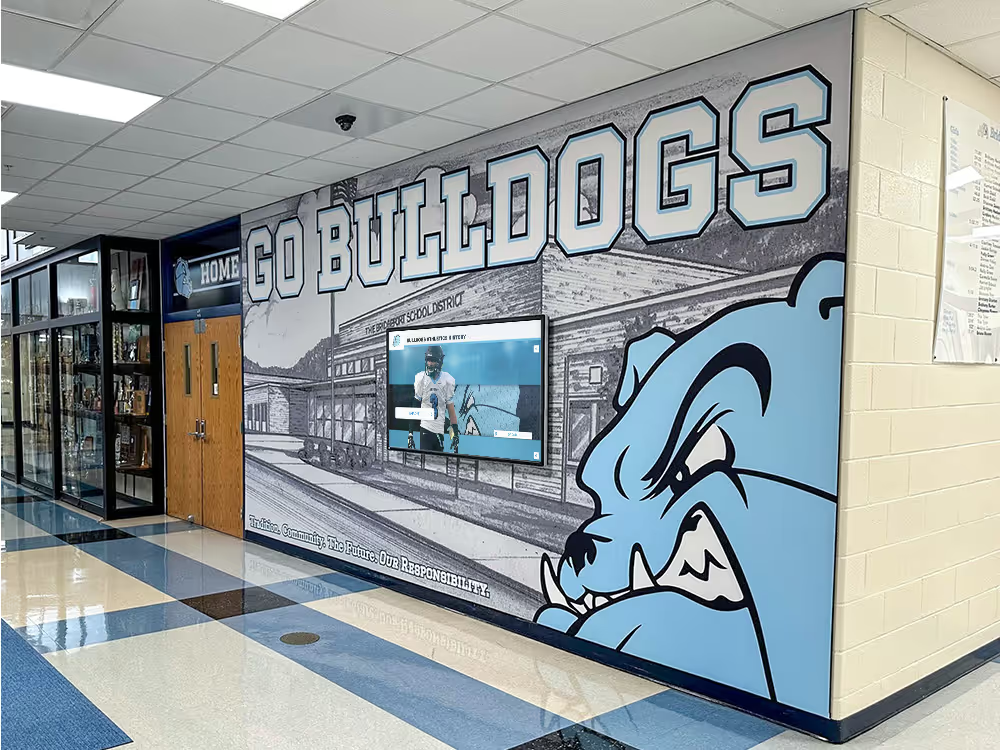
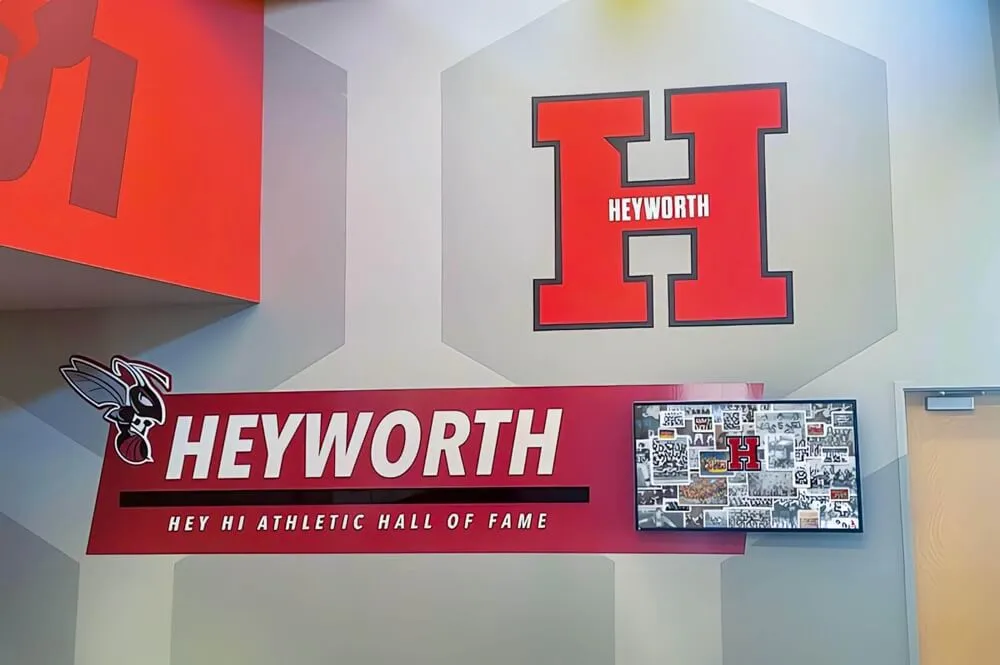
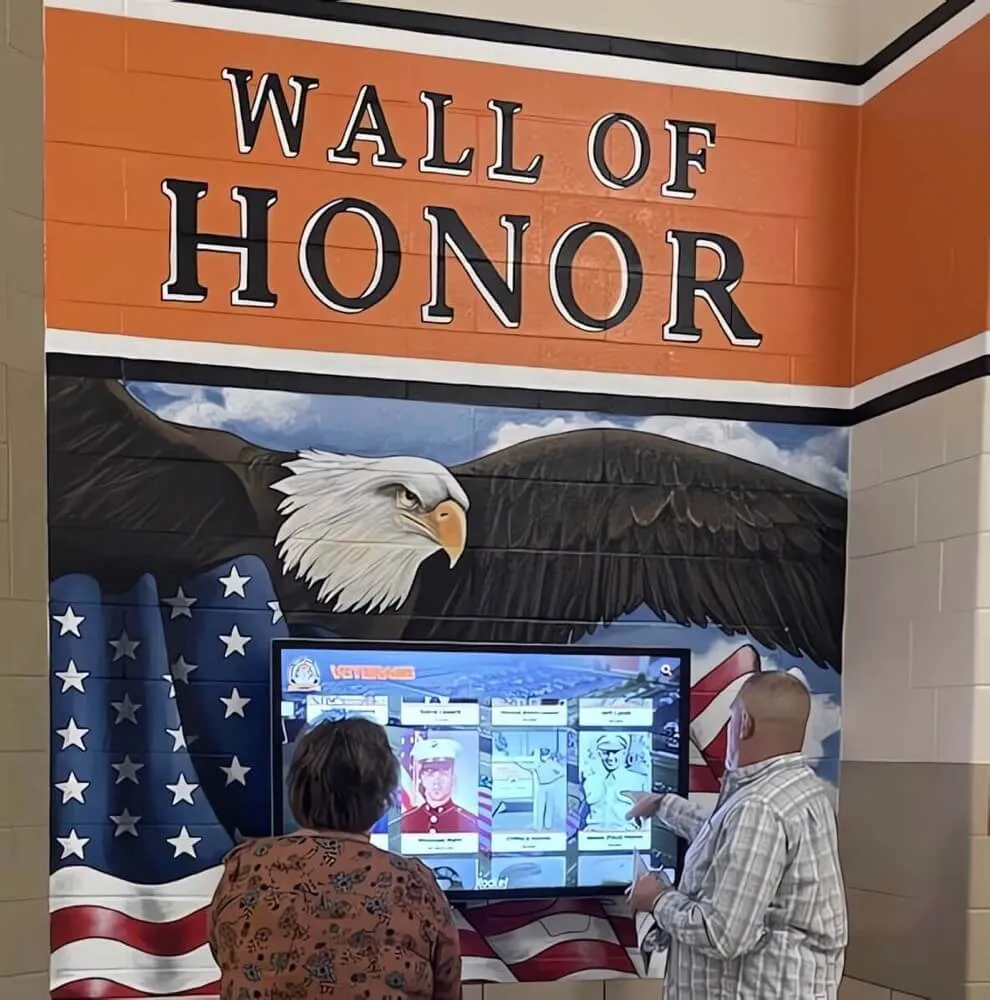
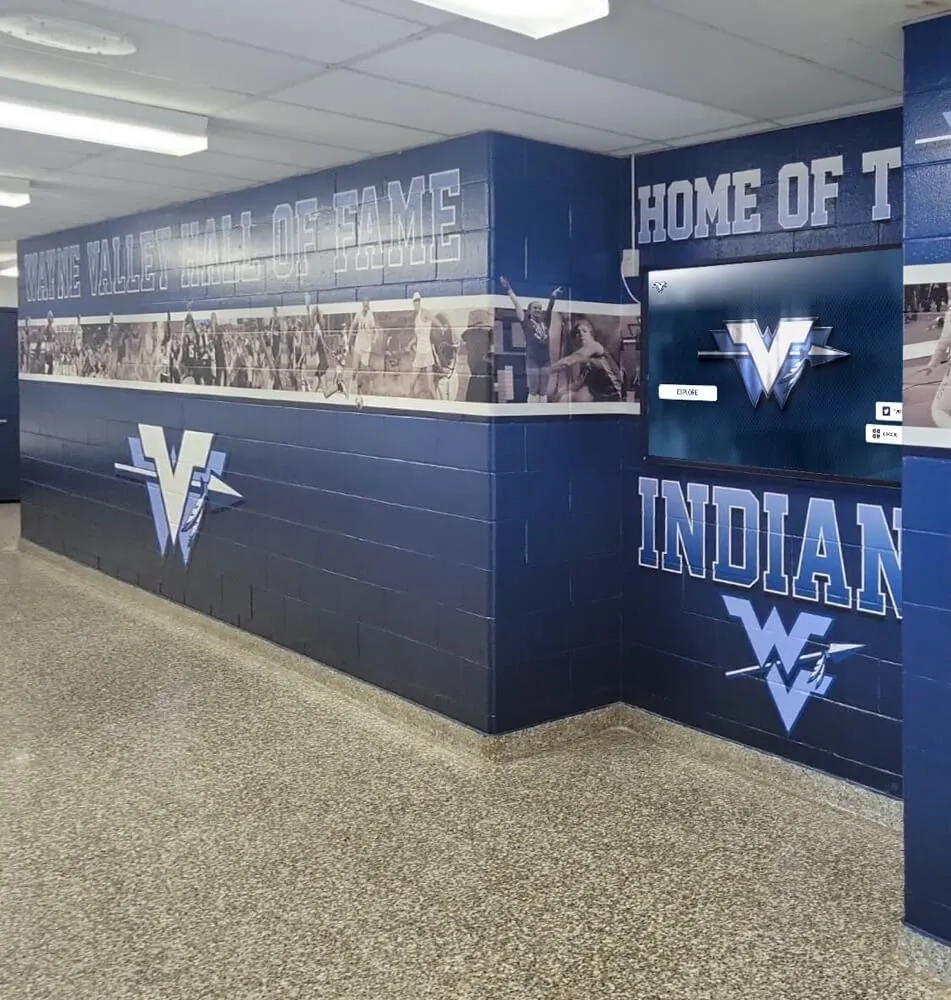
Well-organized athletic recognition walls give each sport its own visual presence while creating a unified display environment that tells the program's complete story
Physical Display Elements: Building the Foundation
Even in an era of digital recognition, physical display elements remain essential for a school athletic history wall. Physical artifacts carry a credibility and emotional weight that no screen fully replicates. The key is choosing which physical elements to feature and how to integrate them with digital components.
Trophy and Award Cases
Glass-fronted trophy cases remain the workhorse of physical athletic recognition. For a century-spanning installation, a few principles apply:
Curate, don’t warehouse. The goal is not to display every piece of hardware the school has ever won. Select the items that represent program-defining achievements—state championships, national recognition, milestone trophies—and store the rest in archivable condition. A single state championship trophy displayed in a dedicated, well-lit case makes a stronger statement than sixty trophies crammed behind fogged glass.
Group by era or by sport. Organizing cases chronologically or by sport program helps visitors understand context. A case dedicated to the football program’s four-decade run of state appearances tells a clearer story than a mixed case with hardware from six different sports.
Label everything. Every trophy should carry a label with sport, year, and the achievement it represents. This seems obvious, but a surprising number of school trophy cases include hardware with no context at all—meaning the history they are supposed to convey is invisible to anyone who was not there.
Modern approaches to trophy case display that go beyond traditional glass cases offer schools practical design frameworks that maximize visual impact while accommodating a hundred years of accumulated hardware.
Retired Jerseys and Memorabilia Displays
For items that do not fit traditional trophy cases—retired jerseys, signed equipment, game-worn cleats from a championship season—dedicated shadow box and memorabilia installations offer a compelling way to present individual artifacts with appropriate context and visual impact. Recognizing retired jersey numbers at the high school level is one of the most emotionally resonant forms of recognition a school can offer, honoring the athletes who defined program identity across eras.
Championship Banners
Championship banners remain one of the most powerful physical recognition elements in any school athletic space. When planning your history wall:
- Audit existing banners for condition and legibility—older banners often need replacement rather than reinstallation
- Consider a systematic banners program with consistent sizing, color, and typography so new banners added each season visually integrate with historical ones
- Reserve gymnasium ceiling space for the most significant championships; use hallway or lobby mounting for longer historical runs
Murals and Environmental Graphics
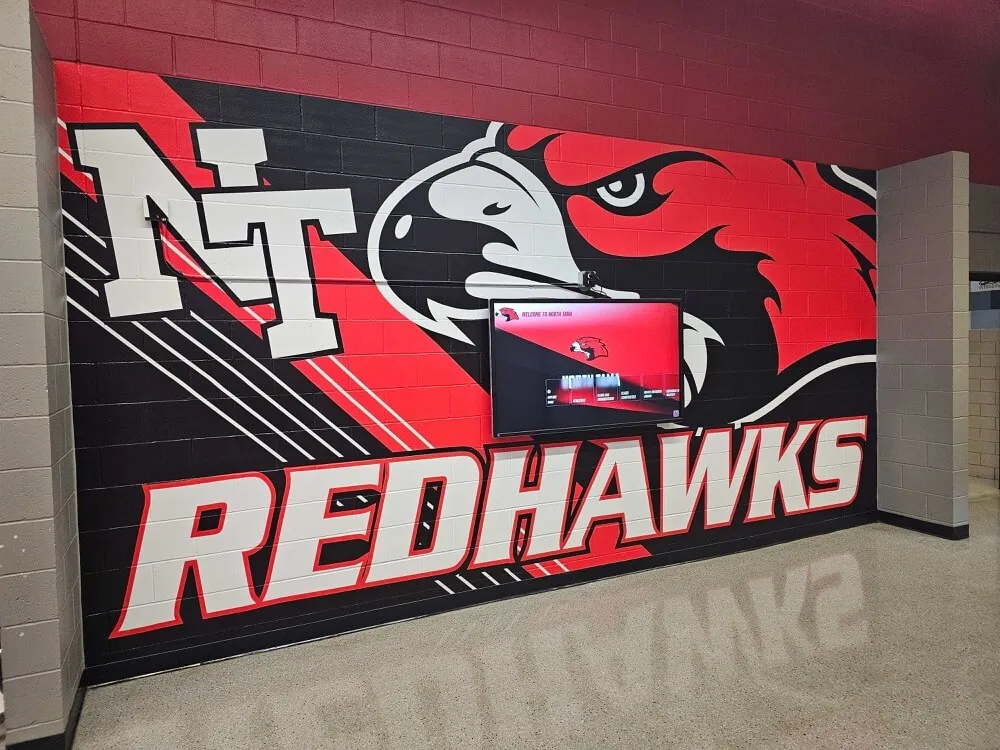
Large-format murals anchored around mascots, program imagery, and historical milestones create a visual environment that sets the tone for your entire athletic history wall. Schools with strong traditions often incorporate:
- Program-founding year and current year in the mural design
- Silhouettes of signature athletes or championship moments
- Sport-specific imagery honoring the programs with the deepest histories
- Color palettes consistent with current school branding to connect past and present
Preserving and Digitizing the Archive
Physical displays address the artifacts you can see. Digitization addresses everything else: the photographs stored in boxes, the records in spreadsheets, the athlete profiles that exist only in aging program booklets. For a school with a century of history, the digitization challenge is substantial—but the payoff is access.
Scanning Historical Photos and Documents
The process begins with a systematic scan of whatever photographic record exists:
- Team photos from every available season should be scanned at minimum 600 DPI for print-quality reproduction
- Individual athlete portraits, where available, should be cataloged with athlete name, sport, and graduation year
- Newspaper clippings and game programs can be scanned at 300 DPI and organized by date
- Any video footage—even low-quality VHS from the 1980s—is worth digitizing before physical media degrades further
A comprehensive approach to preserving and organizing historical school photos through digital archiving provides a practical methodology for schools tackling large photographic collections for the first time.
Building a Digital Athlete Database
A searchable database of athletes, coaches, and seasons transforms scattered historical records into a navigable archive. At minimum, each entry should capture:
- Athlete name and graduation year
- Sport(s) and position
- Significant achievements (all-state, records, championship contributions)
- Post-graduation outcomes where documented (college programs, professional careers)
- Available photographs
This database becomes the backbone of any interactive display system and makes future additions far easier to manage. Schools that have digitized class photos and athlete portraits across multiple decades find that digital solutions for consolidating historical class and team photo collections give them a scalable framework that grows cleanly as new seasons are added each year.
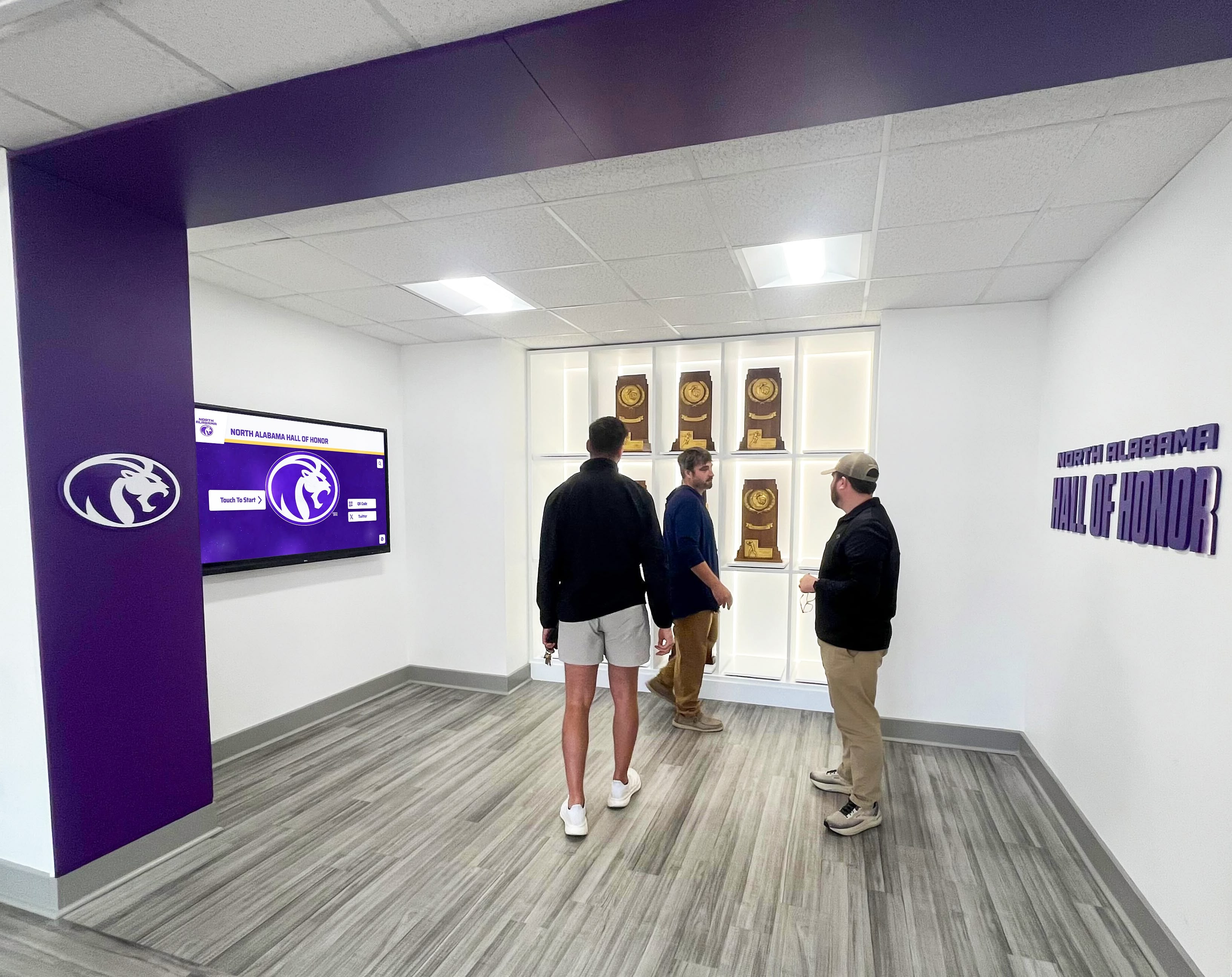
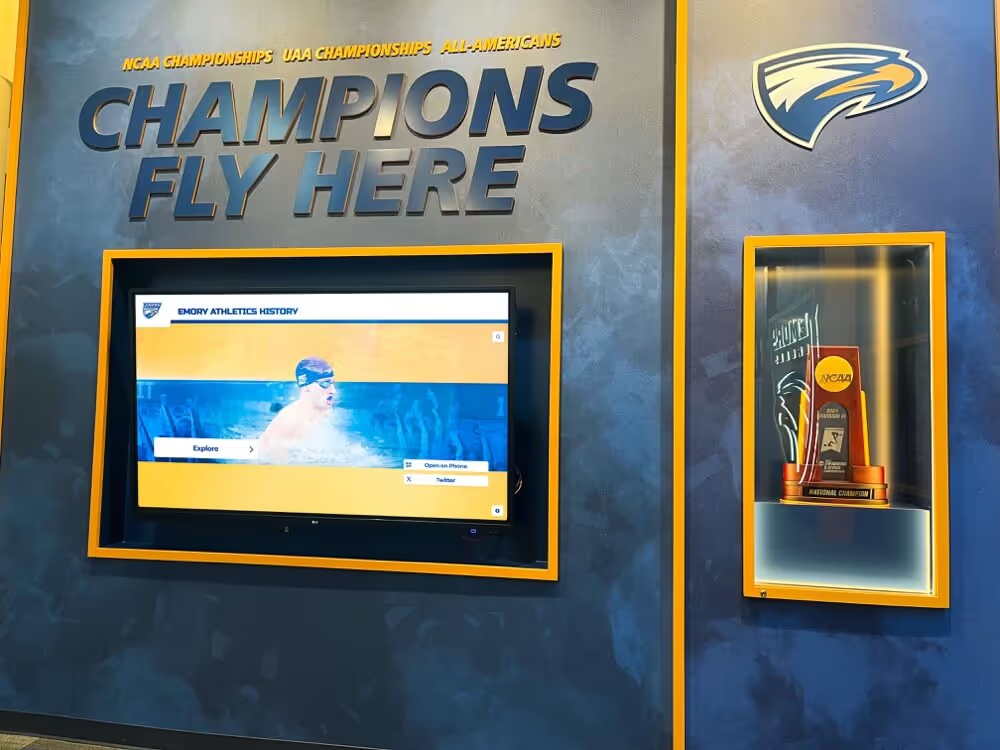
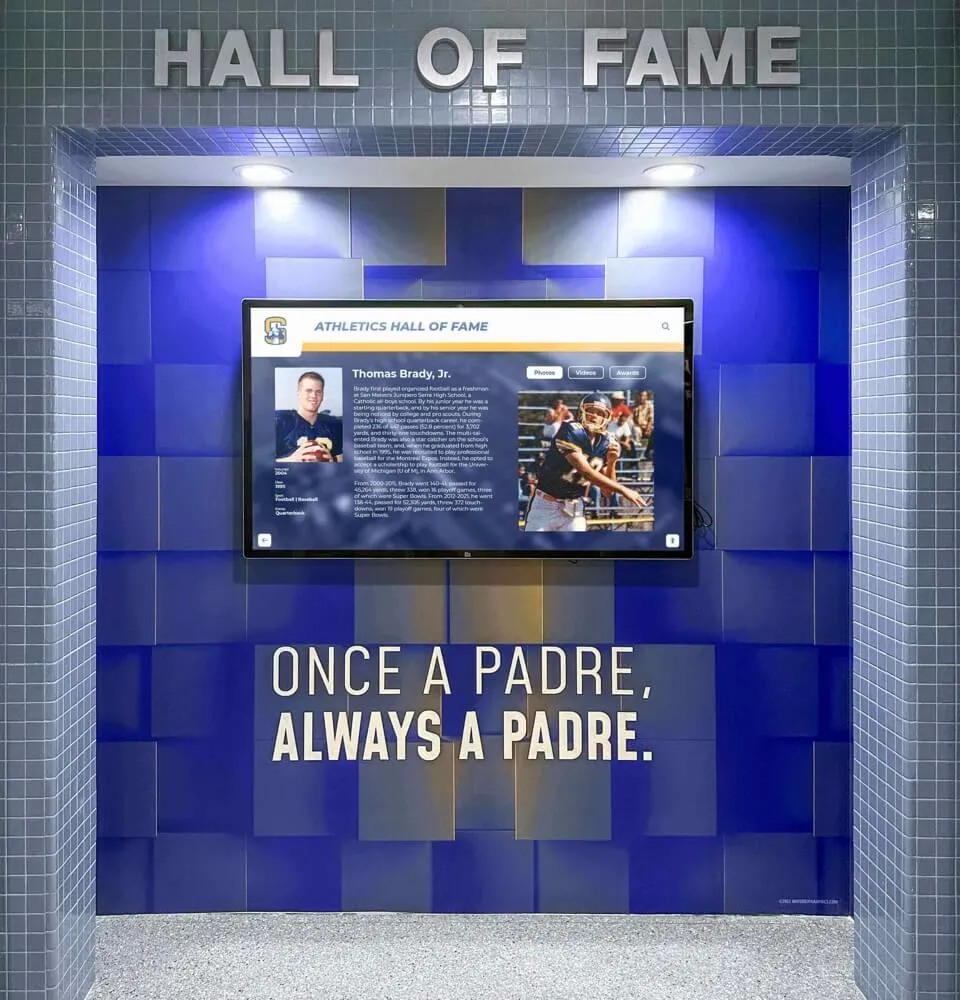
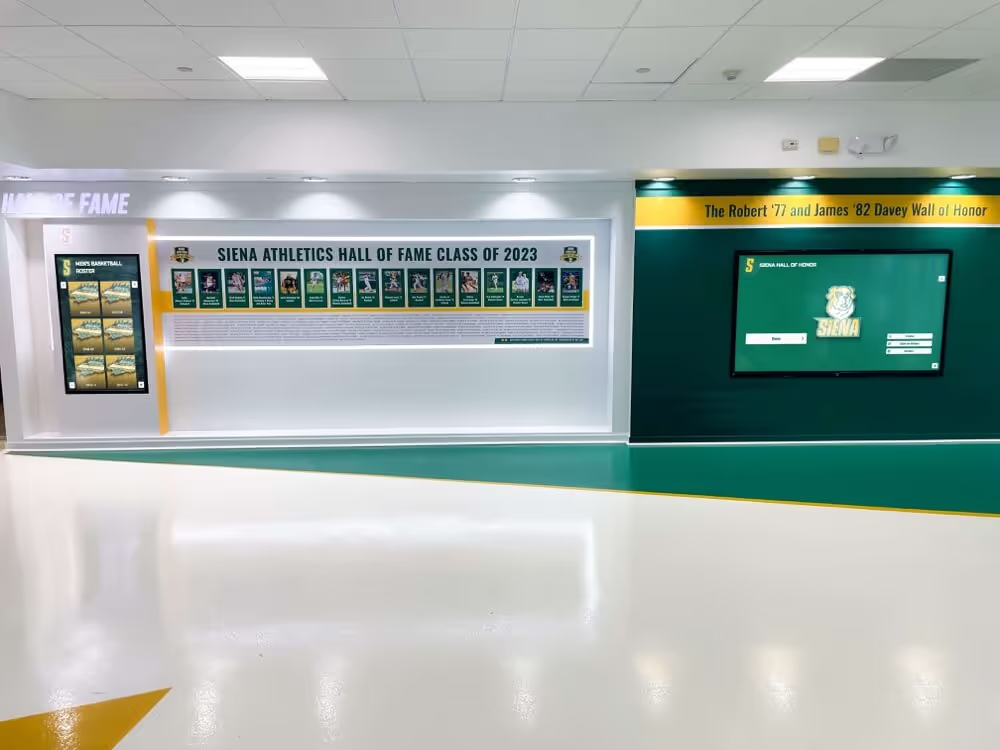
Well-designed trophy and recognition spaces draw visitors in and invite extended exploration of athletic heritage across decades of competition
Interactive Year-by-Year Navigation: The Digital Touchscreen Layer
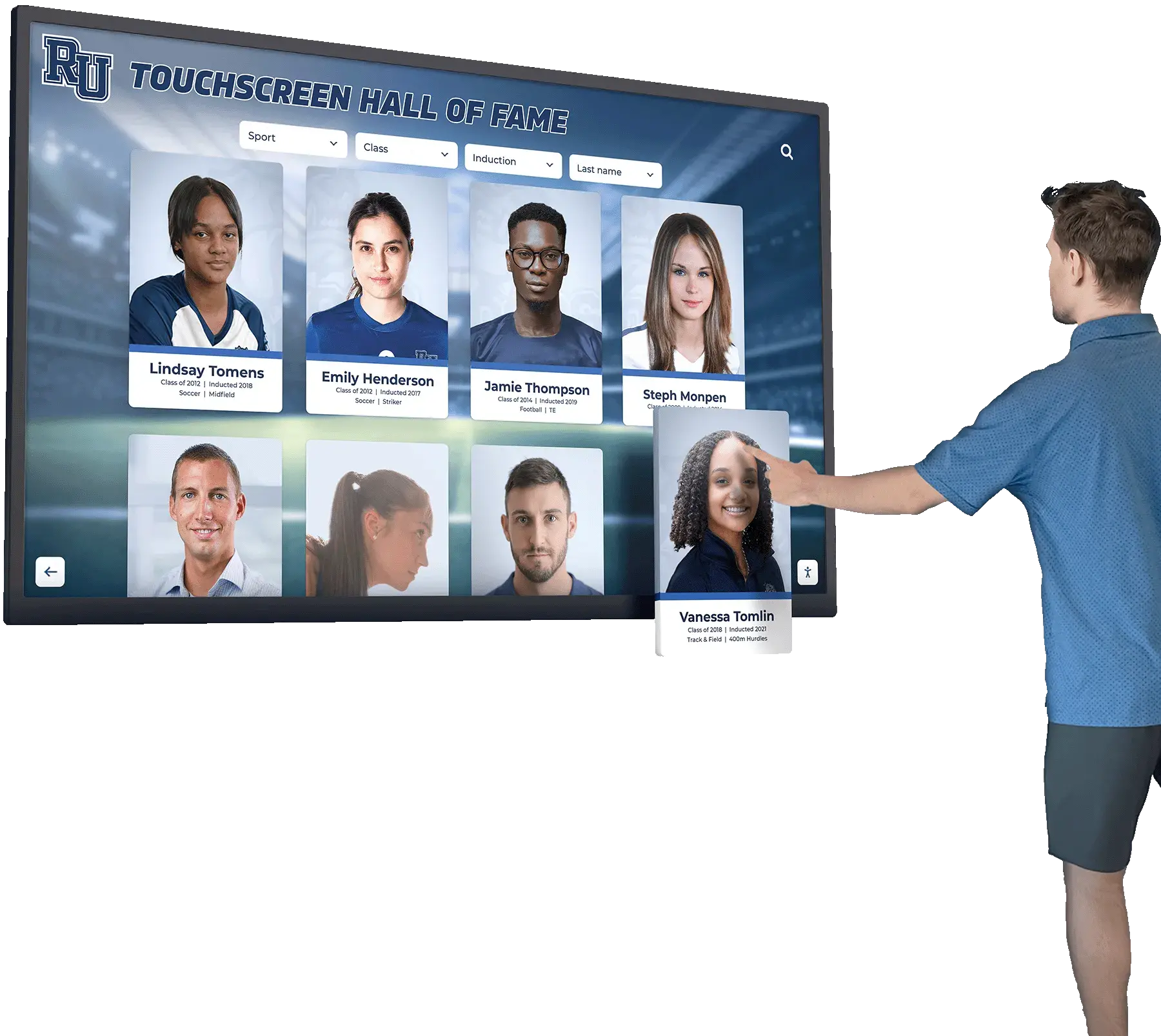
Physical displays establish presence. Digital touchscreen systems establish depth. For a school with a hundred years of athletic history, a touchscreen archive with year-by-year navigation is what transforms a wall into a true historical experience.
What Year-by-Year Navigation Unlocks
Interactive timeline displays allow visitors to:
- Select any season going back to the program’s founding and see who competed, what records were set, and what championships were won
- Browse individual athlete profiles with photographs, statistics, and post-graduation information
- Navigate by sport, finding every football season or every state-qualifying swimmer in a few taps
- Explore rivalry history year by year—a feature that resonates deeply with alumni who remember specific matchups decades later
- Watch video highlights from championship games or significant moments where footage is available
This navigation depth is simply not achievable through physical displays alone. No trophy case can show visitors every athlete from every season of every sport. But a properly built digital archive can. Understanding the technical considerations that go into implementing a digital wall of fame helps athletic directors evaluate systems intelligently before committing to a platform.
Touchscreen Kiosk Integration
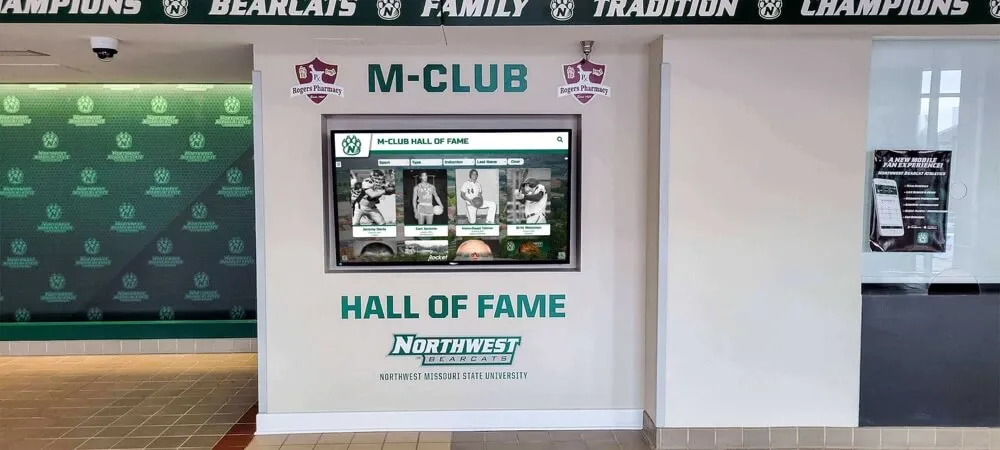
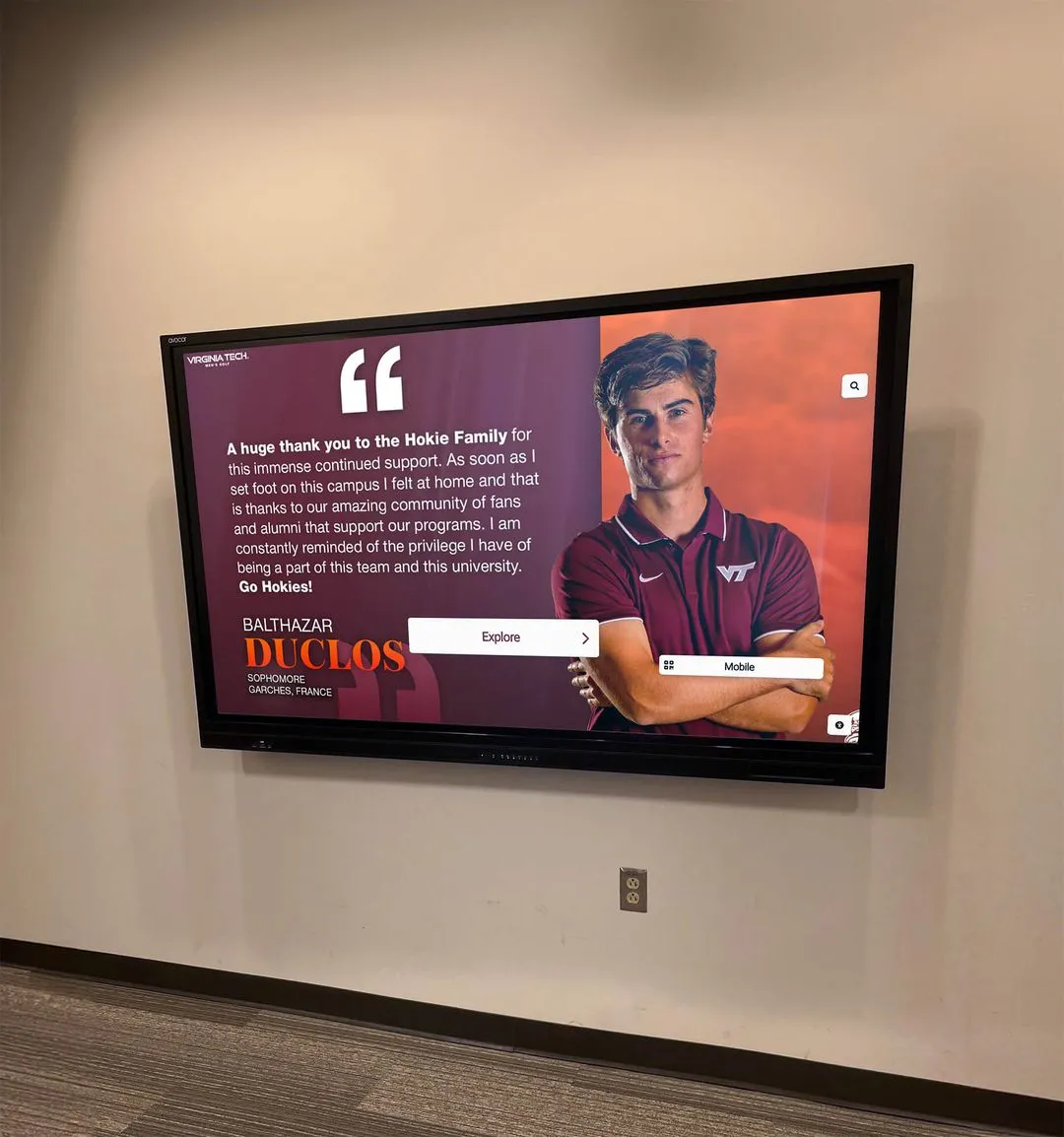
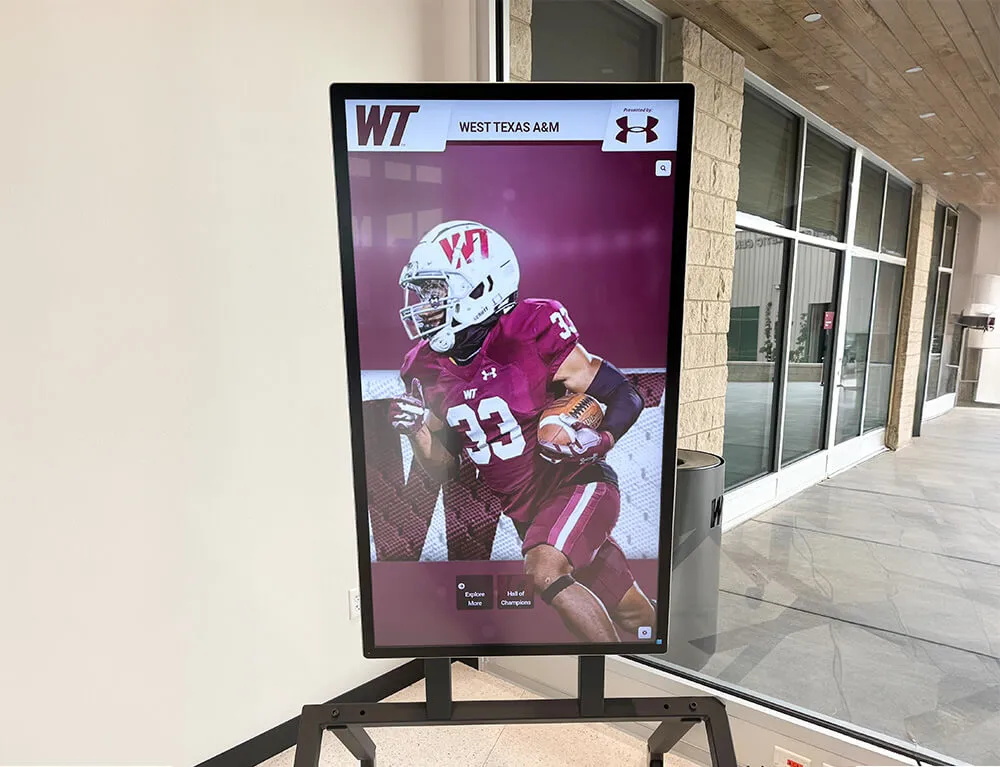
For most schools, a touchscreen kiosk mounted in or adjacent to the primary athletic display area is the practical delivery mechanism for a digital archive. These systems work as self-service stations—visitors browse without staff assistance, returning alumni can search for themselves or former teammates, and current students discover history they never knew existed.
The key capabilities to look for in a touchscreen digital hall of fame wall for interactive awards and athletic recognition include year-by-year timeline navigation, individual athlete search, sport-specific browsing, and a content management system that non-technical staff can update without outside assistance.
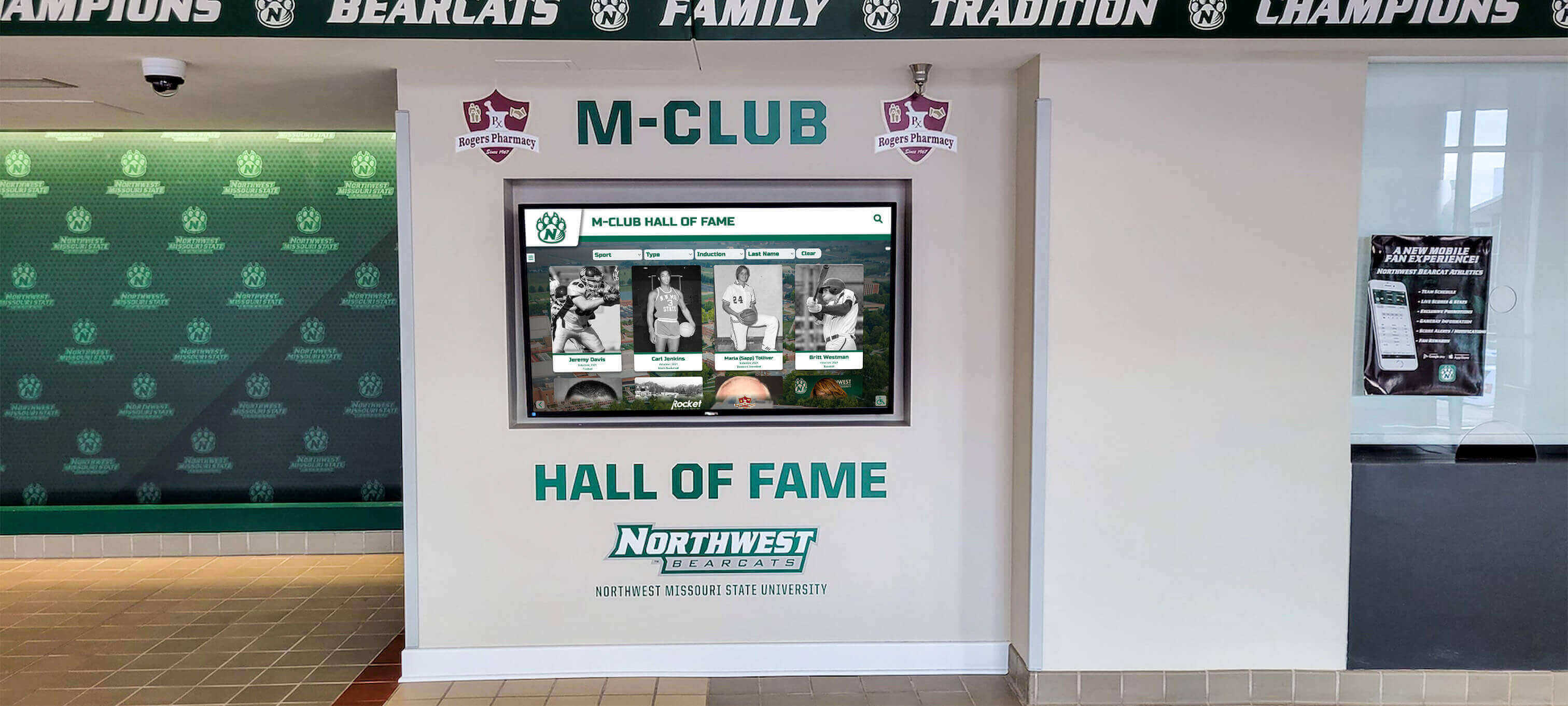
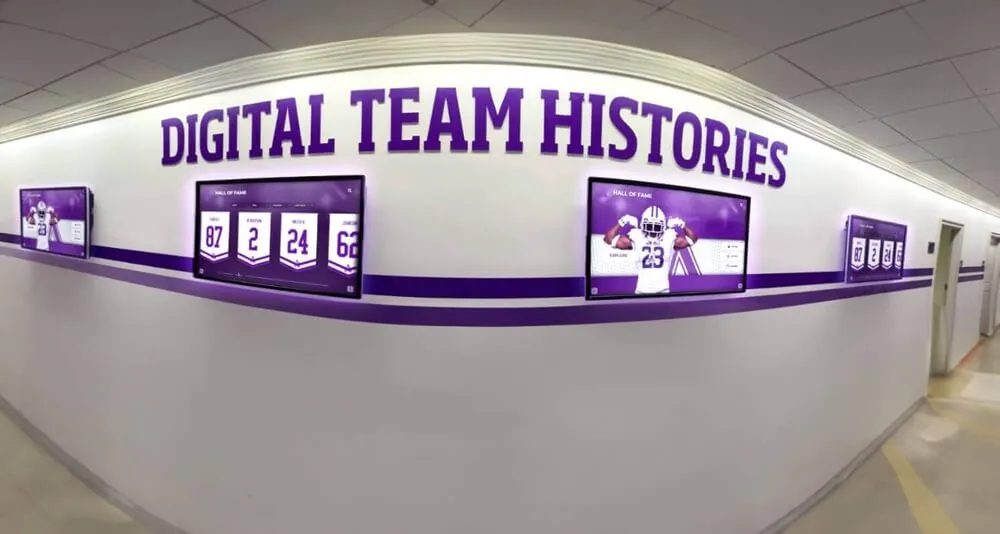
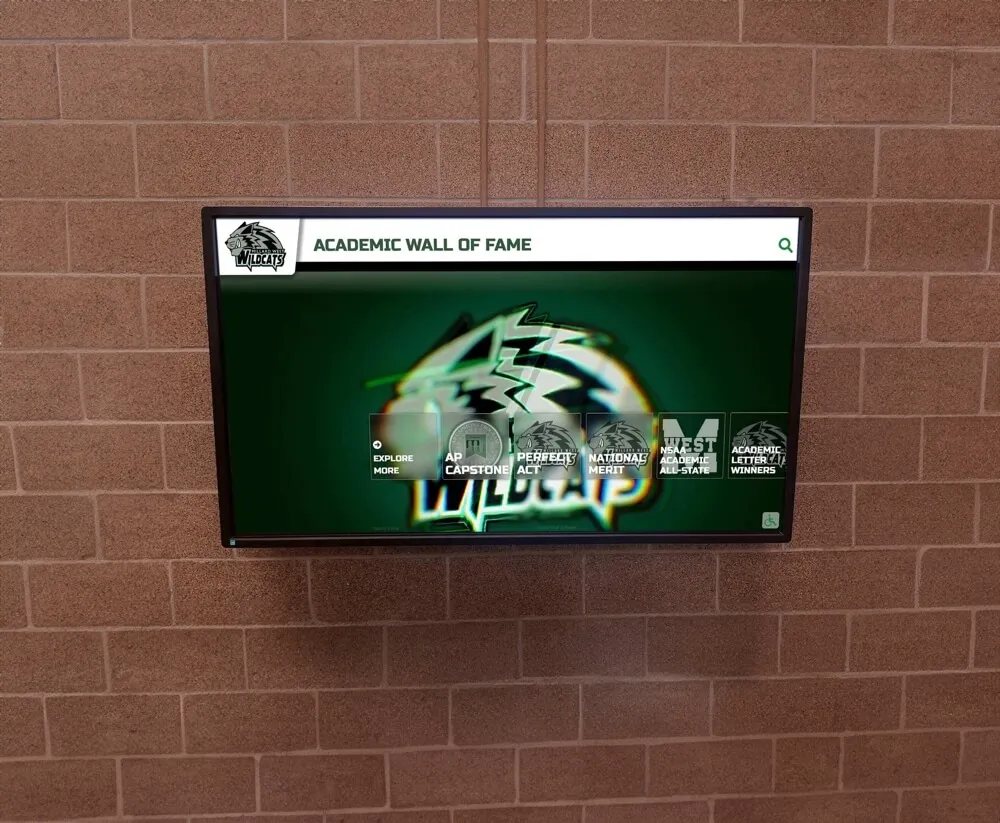
Dedicated digital display corridors allow schools to surface decade-spanning team histories without physical space constraints limiting what can be recognized
Recognizing Notable Alumni Across the Decades
Every school with a hundred-year athletic tradition has produced athletes who went on to compete professionally, coach at higher levels, enter public service, or become significant community figures. Recognizing these alumni—and connecting them to the programs and coaches that shaped them—is one of the most powerful things an athletic history wall can do.
Building the Notable Alumni Record
Identifying every notable alumnus across a century of athletics requires systematic outreach:
- Review historical yearbooks and program books for athletes who received significant recognition at graduation
- Cross-reference state athletic association records for alumni who set records or won individual championships
- Reach out to local media archives for coverage of alumni who competed at the college or professional level
- Engage the alumni community directly through reunion events and alumni communications, inviting nominations
A well-maintained database of notable alumni grows over time as current students become future alumni and as deeper research surfaces names that had been forgotten. Strong alumni engagement strategies help schools keep alumni connected year-round, which in turn generates a steady flow of updated information, historical photos, and milestone achievements that enrich the archive continuously.
Presenting Alumni Stories Effectively
The most engaging alumni presentations on athletic history walls go beyond name and sport:
- Include the athlete’s story arc: where they came from, what they achieved at your school, and where their athletic career took them
- Connect them to the coaches and teammates who shaped their development
- Where possible, include the athlete’s own words about what the program meant to them
- Attach them to specific seasons and championships so visitors see them in context
Multi-Sport Coverage: Every Program Deserves Its Place
One of the most common failures of school athletic history walls is implicitly prioritizing the revenue sports—football and basketball—while leaving swimming, wrestling, volleyball, track, and smaller programs with minimal recognition. This creates a recognition environment that does not reflect the full scope of the school’s athletic identity.
A comprehensive school athletic history wall gives every program its own documented history. This matters for several reasons:
- Athletes in less-visible sports are just as deserving of permanent recognition as those in high-profile programs
- Multi-sport athletes—common throughout the twentieth century—appear in multiple program histories, showing the breadth of their contributions
- Programs that may have had their strongest eras in earlier decades get the recognition they earned even when those athletes are no longer connected to the school day-to-day
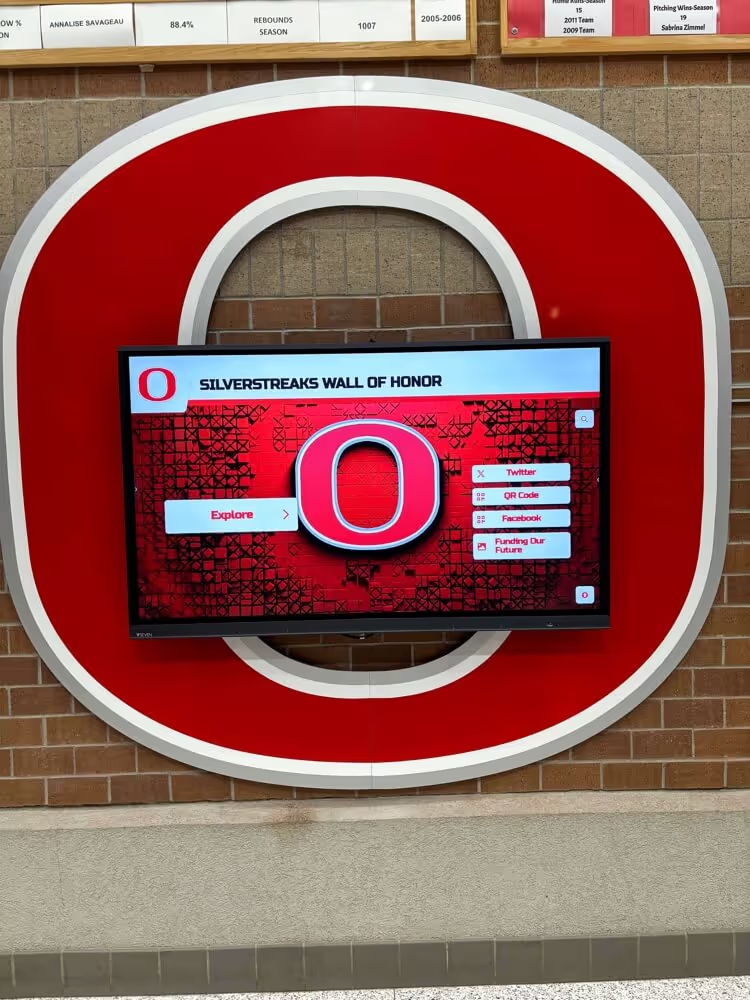
Touchscreen-based recognition solves the physical space problem that forces schools to choose which sports receive attention. Every program can have its own dedicated section in a digital archive, with depth that no hallway trophy case can replicate.
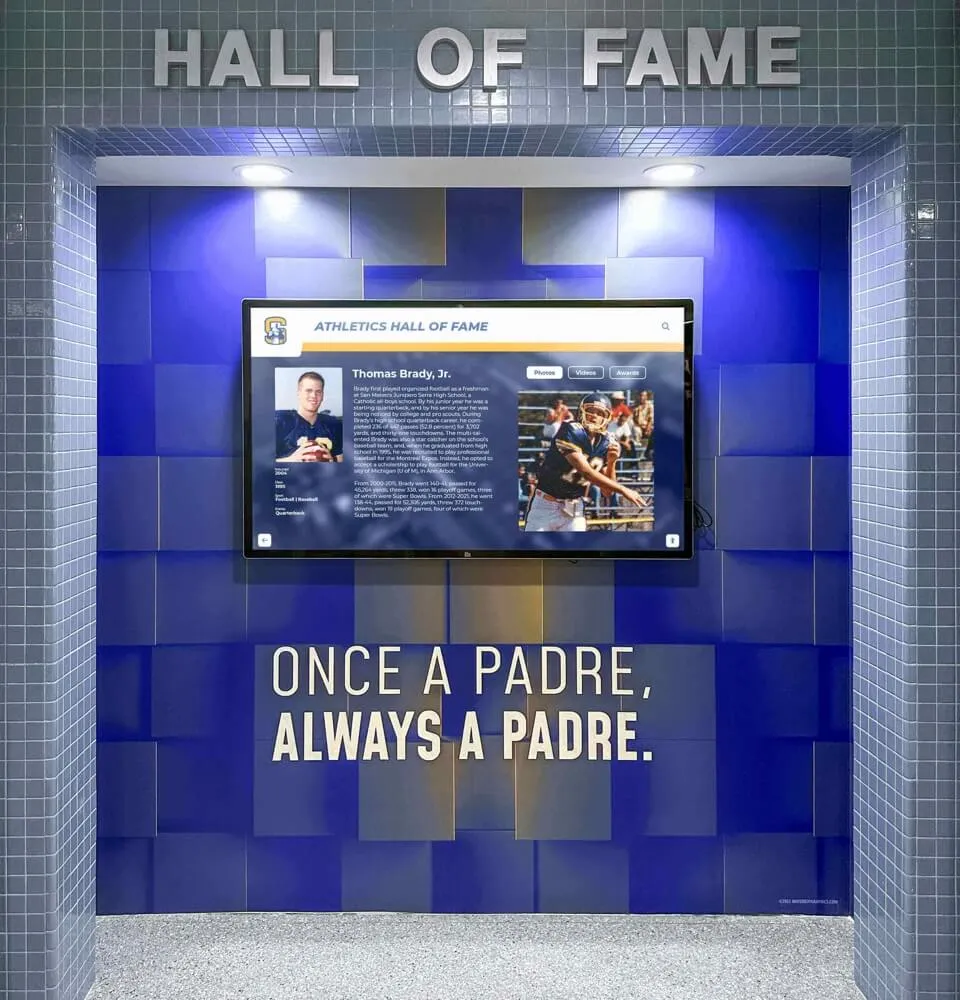
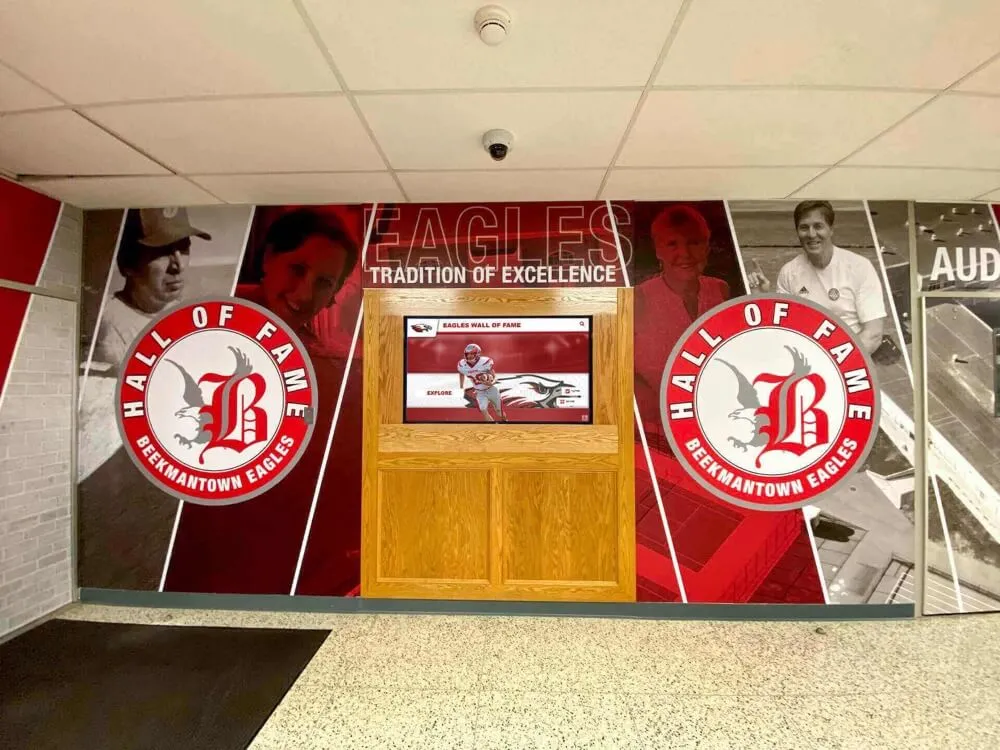
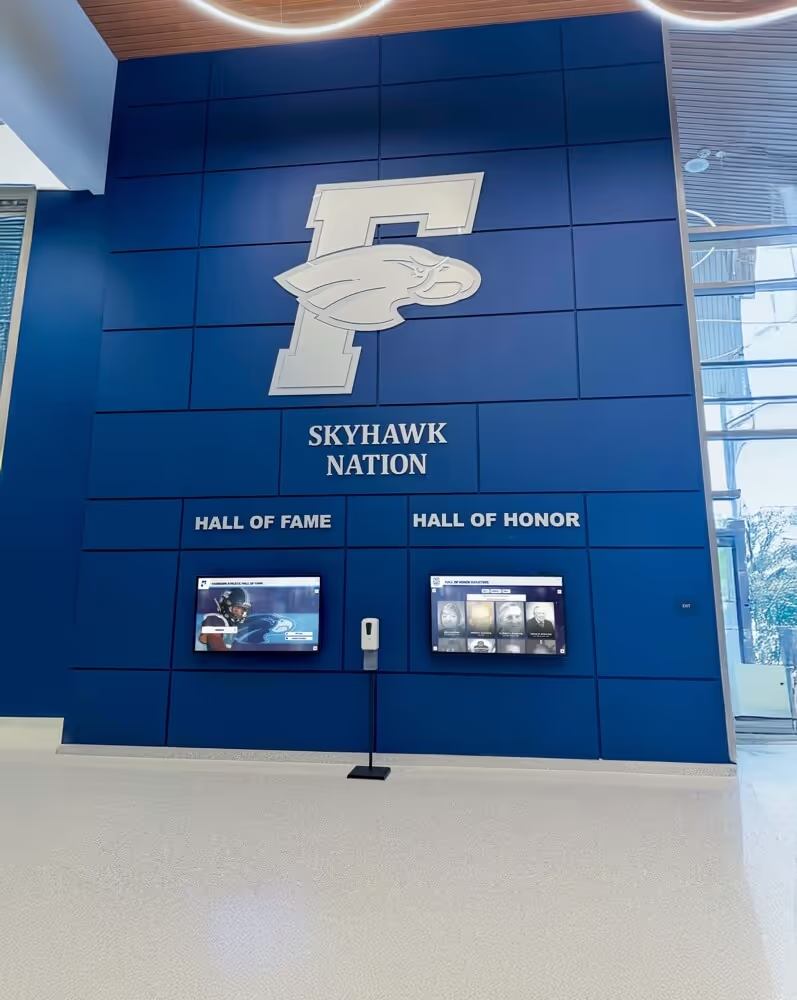
A wall of honor combining physical recognition elements with a digital screen gives schools unlimited depth for recognizing every sport and every era
Funding and Phasing: Making a Century-Scale Project Manageable
Consolidating a hundred years of athletic history into one coherent display is not a single-year project, and it should not be treated as one. Realistic planning acknowledges that the work unfolds in phases, funded through a combination of sources.
Phase Structure
Phase 1 — Foundation (Year 1)
- Complete the archive audit and begin digitization of photographs and records
- Install or renovate primary trophy cases for the school’s signature achievements
- Install championship banner system covering the most significant titles
- Begin building the digital athlete database
Phase 2 — Digital Infrastructure (Year 1–2)
- Install touchscreen kiosk or display screen with basic year-by-year navigation
- Populate digital archive with complete team-level history going back to program founding
- Launch notable alumni profiles for the most well-documented honorees
Phase 3 — Depth and Coverage (Years 2–3)
- Add individual athlete profiles across all sports
- Expand rivalry history and milestone documentation
- Integrate video content where available
- Complete recognition of smaller sport programs
Funding Sources
Schools have successfully funded athletic history wall projects through:
- Booster clubs and athletic foundations — Major donors often respond well to capital campaigns framed around preserving program legacy
- Alumni giving campaigns — Class-year campaigns that tie donations to specific recognition content have worked well at schools with engaged alumni networks
- Naming rights — Individual display elements, kiosks, or cases can carry named recognition for significant donors. A comprehensive guide to digital donor walls for schools outlines how schools have integrated donor recognition into athletic history displays without compromising the recognition environment
- Grant funding — Some state arts councils and educational foundations fund archival and preservation projects, including digital archives
Maintenance and Scalability: Building for the Next Hundred Years
A school athletic history wall is not a project you complete and forget. The installation is a living system that requires ongoing attention to remain current and to accumulate value over time.
Annual Update Cycle
At a minimum, plan for:
- Post-season updates to digital records reflecting the completed year’s achievements
- Physical banner additions for new championships
- New athlete profiles for graduating seniors who earned significant recognition
- Review and refresh of notable alumni entries as more post-graduation information becomes available
Hardware and Content Longevity
Digital display hardware has a functional lifespan of approximately five to ten years depending on usage and environment. Planning for hardware refresh cycles in your budget avoids a situation where a system that took years to build becomes inaccessible because the underlying display technology fails without a replacement plan.
Content stored in cloud-based systems remains accessible independent of any specific piece of hardware—meaning that even if a kiosk is replaced after a decade, the century of data it displayed migrates to the new system without rebuilding.
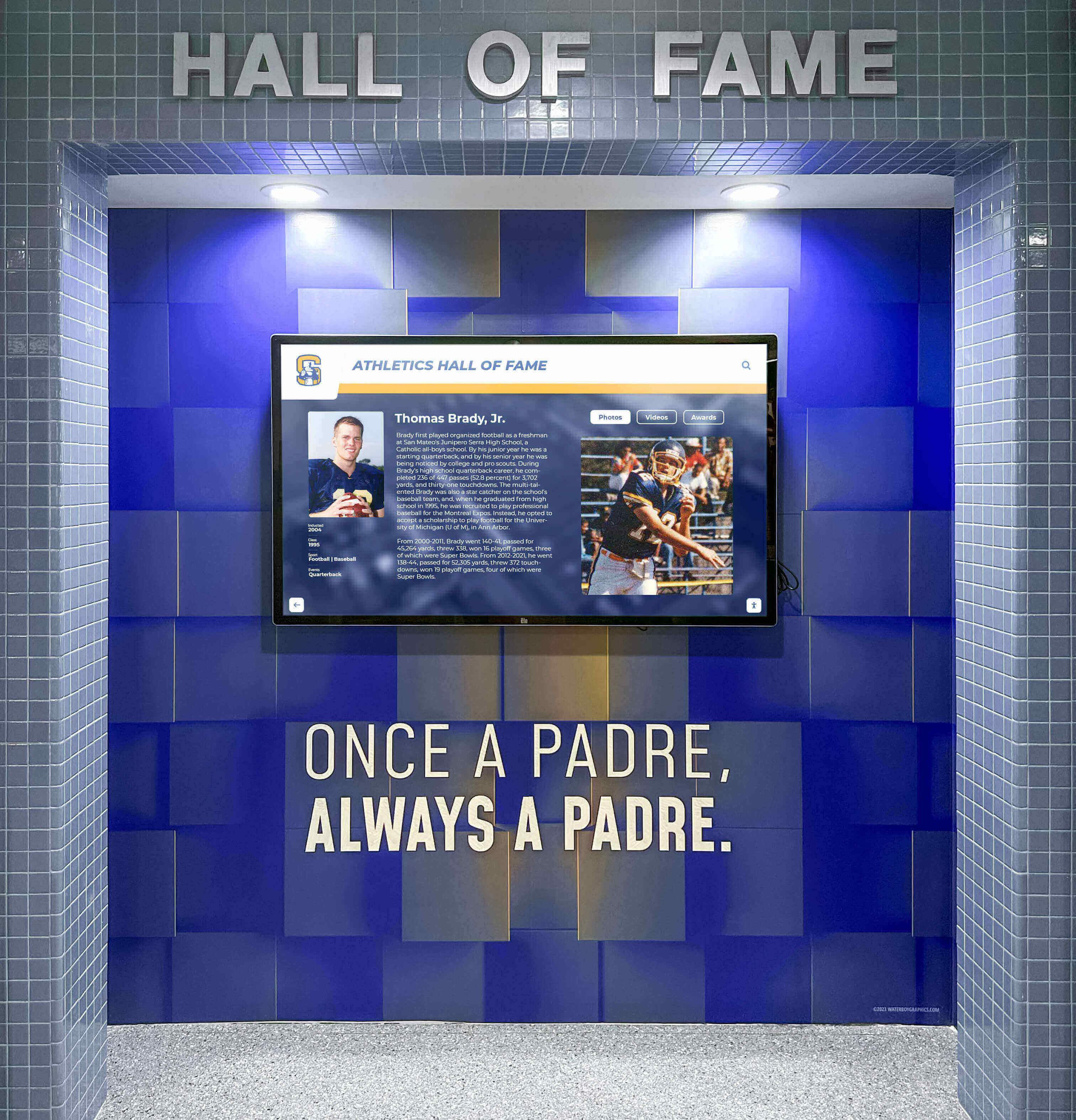
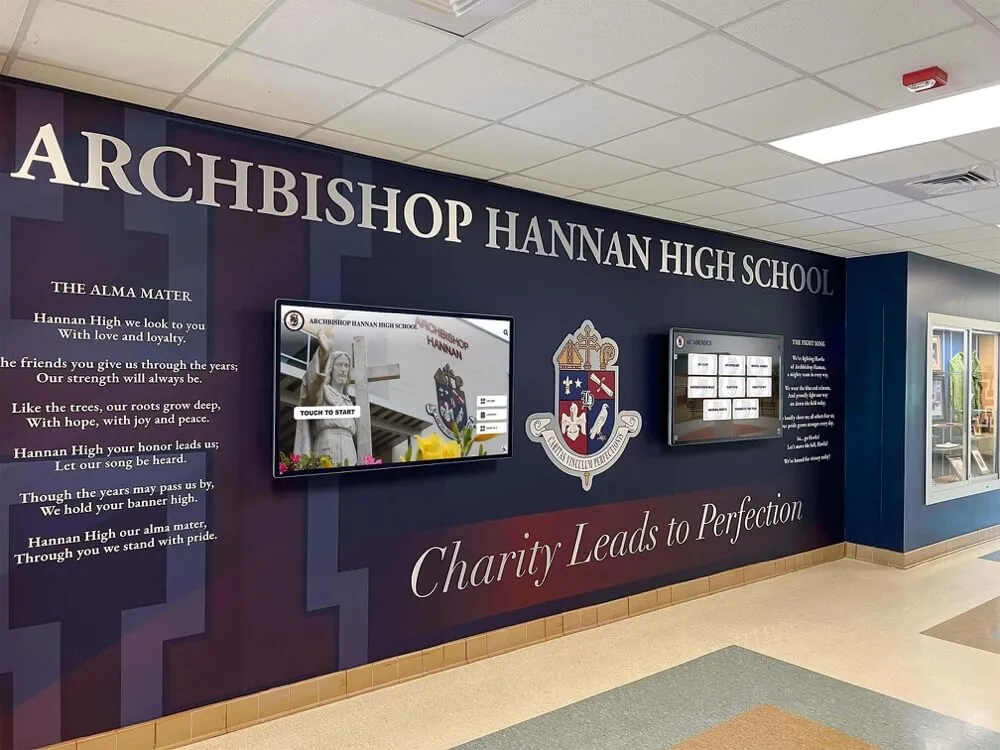
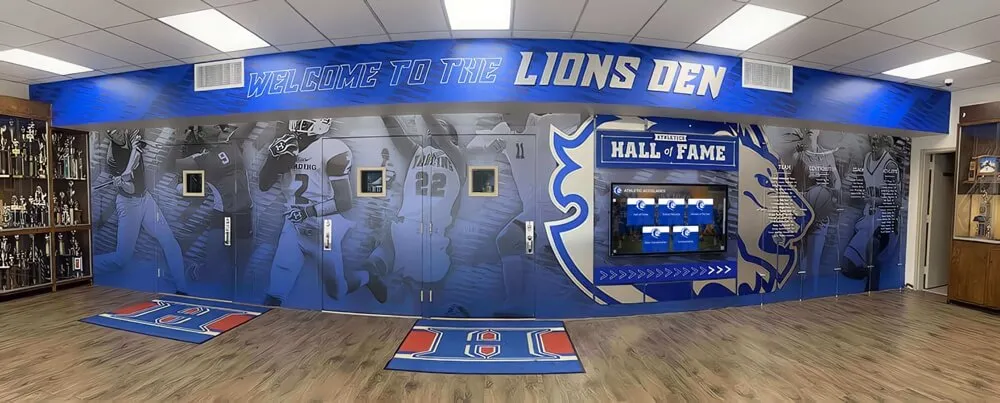
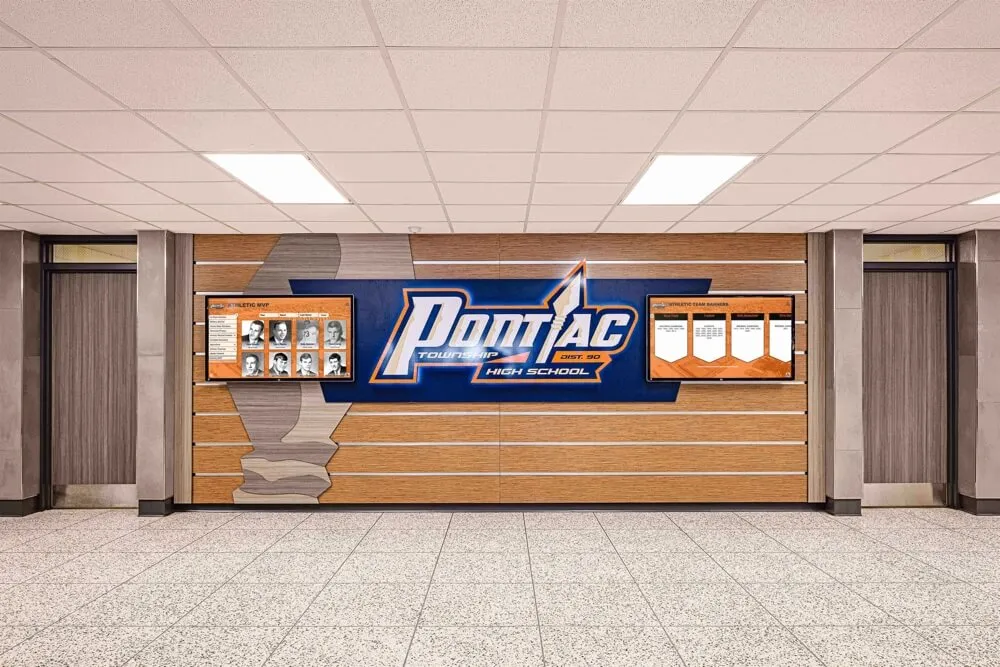
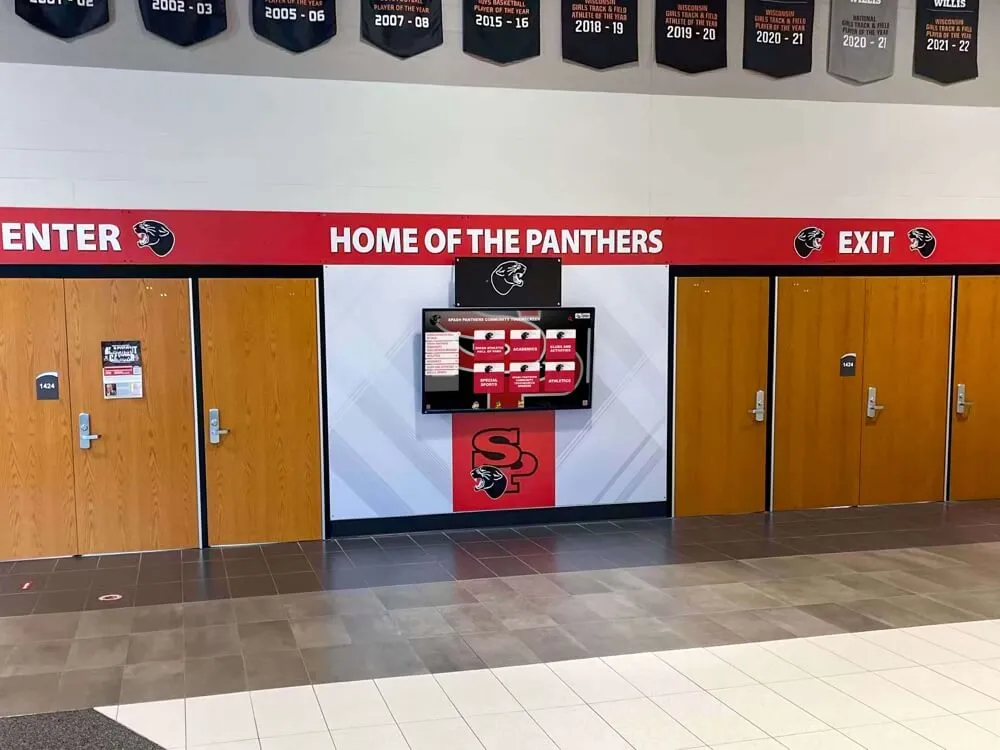
Athletic history walls that integrate environmental design with digital recognition content create lasting visual identities that evolve as new achievements are added each season
Getting Started: Practical First Steps
For athletic directors and administrators looking at a century of history and wondering where to begin, the path forward is clearer than it might appear.
Step 1: Assign ownership. Someone—an athletic director, a dedicated staff member, or a committee—needs to own the project. Without clear ownership, audits stall and decisions get deferred indefinitely.
Step 2: Start the audit. Spend a few weeks walking storage rooms, interviewing longtime staff members, and pulling together what exists. You do not need a perfect inventory before moving forward, but you need to understand the scope of what you are working with.
Step 3: Set display priorities. Identify the three to five achievements your program is most known for—the championships that people in the community still talk about. These become the anchor of your physical display and the starting point for your digital archive.
Step 4: Evaluate digital display options. Interactive touchscreen systems for schools vary considerably in capability, content management tools, and long-term support. Evaluating options before committing ensures you select a system that can grow with your archive over the coming decades.
Step 5: Build a multi-year plan. Write out the phases, assign tentative timelines, and identify funding sources. A written plan that gets reviewed annually is far more likely to result in a completed athletic history wall than a standing intention without structure.
Honoring the Past, Engaging the Present
A school athletic history wall built around a hundred years of competition does something that a trophy case alone cannot: it connects current students and athletes to the full arc of what their program has meant. A freshman who walks past a touchscreen kiosk showing that their program won a state championship the year their parents graduated sees themselves as part of something larger. A returning alumnus who finds their own name in a digital archive experiences recognition that physical plaques almost never provide.
The investment in building and maintaining a comprehensive school athletic history wall pays dividends that extend well beyond the display itself. Programs with strong recognition cultures report better alumni engagement, stronger booster support, and—consistently—current athletes who play with a deeper sense of what they are contributing to.
A hundred years of history is worth capturing. The tools to do it effectively have never been more accessible.
Ready to Turn a Century of History Into One Interactive Display?
Discover how Touch Archive helps schools transform physical archives into living, searchable, year-by-year athletic histories that engage every visitor who walks through the door.
Explore Rocket Alumni Solutions